
NCERT Solutions for Class 10 Economics Chapter 4 Globalisation and the Indian Economy वैश्वीकरण और भारतीय अर्थव्यवस्था
Important Questions for Class 10 Economics Chapter 4
Thank you for reading this post, don't forget to subscribe!
NCERT Solutions for Class 10 Economics Chapter 4 Globalisation and the Indian Economy वैश्वीकरण और भारतीय अर्थव्यवस्था
Question 1:
What do you understand by globalisation? Explain in your own words.
वैश्वीकरण से आप क्या समझते हैं? अपने शब्दों में स्पष्ट कीजिए।
Answer
Globalisation is the process of rapid integration or interconnection between countries. MNCs are playing a major role in the globalisation process. More and more goods and services, investments and technology are moving between countries.
It includes
(i) Increase in foreign trade
(ii) Export and import of techniques of production.
(iii) Flow of capital and finance from one country to another
(iv) Migration of people from one country to another.
विभिन्न देशों के बीच परस्पर संबंध और तीव्र एकीकरण की प्रक्रिया ही वैश्वीकरण है। बहुराष्ट्रीय कंपनियाँ वैश्वीकरण की प्रक्रिया में मुख्य भूमिका निभा रही हैं। विभिन्न देशों के बीच अधिक से अधिक वस्तुओं और सेवाओं, निवेश और प्रोद्योगिकी का आदान-प्रदान हो रहा है।
इसमें निम्नलिखित चीज़ें समाविष्ट हैं:
(i) विदेशी व्यापार में वृद्धि
(ii) उत्पादन की तकनीकों का निर्यात और आयात।
(iii) एक देश से दूसरे देश में पूंजी और वित्त का प्रवाह
(iv) एक देश से दूसरे देश में लोगों का प्रवास।
NCERT Solutions for Class 10 Economics Chapter 4 Globalisation and the Indian Economy वैश्वीकरण और भारतीय अर्थव्यवस्था
Question 2:
What were the reasons for putting barriers to foreign trade and foreign investment by the Indian government? Why did it wish to remove these barriers?
भारत सरकार द्वारा विदेश व्यापार एवं विदेशी निवेश पर अवरोधक लगाने के क्या कारण थे? इन अवरोधकों को सरकार क्यों हटाना चाहती थी?
Answer
Reasons for putting barriers:
(1) To protect domestic industries from foreign competition after Independence.
(2) Indian industries were small and new in the 1950s–60s and needed protection to grow.
(3) Imports were allowed only for essential goods to reduce dependence on foreign products.
Reasons for removing barriers (after 1991):
(1) The government felt Indian producers were ready to face global competition.
(2) Foreign competition would help improve quality and efficiency of Indian goods.
(3) Liberalisation was supported by international organisations to boost trade and investment.
अवरोधक लगाने के कारण:
(1) स्वतंत्रता के बाद स्थानीय उद्योगों को विदेशी प्रतिस्पर्धा से बचाने के लिए अवरोध लगाए गए।
(2) 1950–60 के दशक में भारतीय उद्योग छोटे और नवस्थापित थे, जिन्हें संरक्षण की आवश्यकता थी।
(3) केवल आवश्यक वस्तुओं के आयात की अनुमति दी गई ताकि विदेशी निर्भरता कम हो।
अवरोधक हटाने के कारण (1991 के बाद):
(1) सरकार को लगा कि अब भारतीय उत्पादक वैश्विक प्रतिस्पर्धा के लिए तैयार हैं।
(2) विदेशी प्रतिस्पर्धा से भारतीय उत्पादों की गुणवत्ता और दक्षता में सुधार होगा।
(3) अंतरराष्ट्रीय संस्थाओं के सहयोग से व्यापार और निवेश बढ़ाने के लिए उदारीकरण अपनाया गया।
NCERT Solutions for Class 10 Economics Chapter 4 Globalisation and the Indian Economy वैश्वीकरण और भारतीय अर्थव्यवस्था
Question 3:
How would flexibility in labour laws help companies?
श्रम कानूनों में लचीलापन कंपनियों को कैसे मदद करेगा?
Answer
Flexibility in labour laws will help companies in being competitive and progressive. By easing up on labour laws, company heads can negotiate wages and terminate employment, depending on market conditions. This will lead to an increase in the company’s competitiveness.
श्रम कानूनों में लचीलापन कंपनियों को श्रमिकों की संख्या पर नियंत्रण रखने में मदद करेगा। फिर कोई भी कम्पनी श्रमिकों की मौसमी माँग के हिसाब से नियोजन कर सकती है या उन्हें काम से हटा सकती है। कम माँग की स्थिति में किसी भी कम्पनी को अतिरिक्त श्रमिकों को ढ़ोने की आवश्यकता नहीं पड़ेगी। इससे कम्पनियों के मुनाफे में भी सुधार होगा।
NCERT Solutions for Class 10 Economics Chapter 4 Globalisation and the Indian Economy वैश्वीकरण और भारतीय अर्थव्यवस्था
Question 4:
What are the various ways in which MNCs set up, control or produce in other countries?
दूसरे देशों में बहुराष्ट्रीय कंपनियाँ किस प्रकार उत्पादन या उत्पाद पर नियंत्रण स्थापित करती हैं?
Answer
Multinational Corporations (MNCs) set up their factories or production units close to markets where they can get desired type of skilled or unskilled labour at low costs along with other factors of production. After ensuring these conditions MNCs set up production units in the following ways :
(i) Jointly with some local companies of the existing country.
(ii) Buy the local companies and then expand its production with the help of modern technology.
(iii) They place orders for small producers and sell these products under their own brand name to the customers worldwide.
दूसरे देशों में बहुराष्ट्रीय कंपनियाँ कई तरीकों से उत्पादन या उत्पाद पर नियंत्रण स्थापित करती हैं जैसे:
(i) कई MNC किसी स्थानीय कम्पनी से साझा वेंचर करते हैं ताकि उनका काम शुरु हो सके। स्थानीय कम्पनी को स्थानीय बाजार में व्यवसाय के माहौल के बारे में बेहतर पता होने की वजह से MNC को इससे मदद मिलती है। इसके अलावा स्थानीय कम्पनी का व्यवसाय का ढ़ाँचा पहले से ही जमा हुआ होता है।
(ii) कुछ MNC पहले दिन से ही स्वतंत्र रूप से काम करना शुरु करती है।
(iii) कुछ MNC केवल स्थानीय बाजार के लिये उत्पादन करती है, वहीं कुछ अन्य निर्यात के लिये उत्पादन करती है।
NCERT Solutions for Class 10 Economics Chapter 4 Globalisation and the Indian Economy वैश्वीकरण और भारतीय अर्थव्यवस्था
Question 5:
Why do developed countries want developing countries to liberalise their trade and investment? What do you think should the developing countries demand in return?
विकसित देश, विकासशील देशों से उनके व्यापार और निवेश का उदारीकरण क्यों चाहते हैं? क्या आप मानते हैं कि विकासशील देशों को भी बदले में ऐसी माँग करनी चाहिए?
Answer
Developed countries want developing countries to liberalise their trade and investment because then the MNCs belonging to the developed countries can set up factories in less-expensive developing nations, and thereby increase profits, with lower manufacturing costs and the same sale price.
In my opinion, the developing countries should demand, in return, for some manner of protection of domestic producers against competition from imports. Also, charges should be levied on MNCs looking to set base in developing nations.
विकसित देश विकासशील देशों से उनके व्यापार और निवेश का उदारीकरण इसलिए चाहते हैं ताकि उनके देशों की बहुराष्ट्रीय कंपनियाँ विकासशील देशों में सस्ते श्रम व अन्य संसाधनों का लाभ उठा सकें। इसके अतिरिक्त विश्व व्यापार संगठन ने व्यापार और निवेश के उदारीकरण के लिए विकासशील देशों पर दबाव डाला है।
इसलिए मेरा मानना है कि विकासशील देशों को विकसित देशों से भी माँग करनी चाहिए कि वे भी अपनी नीतियाँ उदार बनाएं तथा किसानों को आर्थिक सहायता बंद करें तथा व्यापार पर अवरोधकों को समाप्त करें। विकसित देशों को भी विश्व व्यापार संगठन के नियमों का पालन करना चाहिए ताकि व्यापार दोनों ओर से चल सके|
NCERT Solutions for Class 10 Economics Chapter 4 Globalisation and the Indian Economy वैश्वीकरण और भारतीय अर्थव्यवस्था
Question 6:
“The impact of globalisation has not been uniform.” Explain this statement.
‘वैश्वीकरण का प्रभाव एक समान नहीं है’। इस कथन की अपने शब्दों में व्याख्या कीजिए।
Answer
“The impact of globalisation has not been uniform”. It has only benefitted skilled and professional person in urban not the unskilled persons. The industrial and service sector has much gained in globalisation than in agriculture. It benefitted MNCs on domestic producers and the industrial working class. Small producers of goods such as batteries, capacitors, plastics, toys, tyres, dairy products and vegetable oil have been hit hard by competition from cheaper imports.
वैश्वीकरण से भारत में व्यापार करने के ढंग में और लोगों के रोजमर्रा के जीवन में बहुत बदलाव हुआ है, लेकिन अभी भी आबादी एक बहुत बड़े भाग तक इसका लाभ नहीं पहुँच पाया है। इससे स्थानीय एवं विदेशी दोनों, के बीच बेहतर प्रतिस्पर्धा से उपभोक्ताओं, विशेषकर शहरी क्षेत्र में धनी वर्ग के उपभोक्ताओं को लाभ हुआ हैं। इन उपभोक्ताओं के समक्ष पहले से अधिक विकल्प हैं और वे अब अनेक उत्पादों की उत्कृष्ट गुणवत्ता और काम कीमत से लाभान्वित्त हो रहे हैं। इसलिए ये लोग पहले की तुलना में आज अपेक्षाकृत उच्चतर जीवन स्तर का आनंद ले रहे हैं।
NCERT Solutions for Class 10 Economics Chapter 4 Globalisation and the Indian Economy वैश्वीकरण और भारतीय अर्थव्यवस्था
Question 7:
How has liberalisation of trade and investment policies helped the globalisation process?
व्यापार और निवेश नीतियों का उदारीकरण वैश्वीकरण प्रक्रिया में कैसे सहायता पहुँचाती है?
Answer
Liberalisation of trade and investment policies has helped the globalisation process by making foreign trade and investment easier. Earlier, several developing countries had placed barriers and restrictions on imports and investments from abroad to protect domestic production. However, to improve the quality of domestic goods, these countries have removed the barriers. Thus, liberalisation has led to a further spread of globalisation because now businesses are allowed to make their own decisions on imports and exports. This has led to a deeper integration of national economies into one conglomerate whole.
व्यापार और निवेश नीतियों के उदारीकरण से अभिप्राय यह है कि विदेशी व्यापार एवं विदेशी निवेश पर से अवरोधकों को हटा दिया जाता है जिससे विभिन्न देशों के बाजारों एवं उत्पादनों में एकीकरण होता है। विभिन्न देशों के बीच अधिक-से-अधिक वस्तुओं, सेवाओं, निवेश तथा प्रौद्योगिकी का आदान-प्रदान हो रहा है। प्रौद्योगिकी में तीव्र उन्नति ने भी वैश्वीकरण प्रक्रिया को उत्प्रेरित किया है। यदि वस्तुओं और सेवाओं का सुगमता से आयात-निर्यात किया जा सकेगा तो विदेशी कंपनियां अपने कार्यालय और कारखाने आसानी से स्थापित करने में सक्षम होंगी। बहुराष्ट्रीय कंपनियों की गतिविधियों के द्वारा ही विदेशी व्यापार में काफ़ी वृद्धि हुई है। अधिक निवेश व व्यापार के द्वारा ही विभिन्न देशों के उत्पादन का एकीकरण संभव हुआ है। इससे विश्व के देश एक-दूसरे के और निकट आ रहे हैं। इस तरह व्यापार और निवेश नीतियों का उदारीकरण वैश्वीकरण प्रक्रिया में सहायता पहुँचा रहा है।
NCERT Solutions for Class 10 Economics Chapter 4 Globalisation and the Indian Economy वैश्वीकरण और भारतीय अर्थव्यवस्था
Question 8:
How does foreign trade lead to integration of markets across countries? Explain with an example other than those given here.
विदेश व्यापार विभिन्न्न देशों के बाजारों के एकीकरण में किस प्रकार मदद करता है? यहाँ दिए गए उदाहरण से भिन्न उदाहरण सहित व्याख्या कीजिए।
Answer
Foreign trade provides opportunities for both producers and buyers to reach beyond the markets of their own countries. Goods travel from one country to another.Competition among producers of various countries as well as buyers prevails. Thus foreign trade leads to integration of markets across countries.
For example, during Diwali season, buyers in India have the option of choosing between Indian and Chinese decorative lights and bulbs. So this provides an opportunity to expand business.
विदेश व्यापार से विश्व के विभिन्न बाजार आपस में जुड़ जाते हैं जिससे उनका एकीकरण होता है। इसे समझने के लिये मोबाइल फोन का उदाहरण लेते हैं। मोबाइल फोन बनाने वाली मुख्य कम्पनियाँ अमेरिका और यूरोप में हैं। इन देशों में उत्पाद का डिजाइन तैयार होता है। मोबाइल के अलग अलग पार्ट पूर्वी एशियाई देशों (मलेशिया, चीन और ताइवान) में बनते हैं और उन्हें चीन या भारत में एसेंबल किया जाता है। फिर अंतिम उत्पाद को पूरी दुनिया में बेचा जाता है। यह उदाहरण विश्व के कई बाजारों के एकीकरण को दर्शाता है।
NCERT Solutions for Class 10 Economics Chapter 4 Globalisation and the Indian Economy वैश्वीकरण और भारतीय अर्थव्यवस्था
Question 9:
Globalisation will continue in the future. Can you imagine what the world would be like twenty years from now? Give reasons for your answer.
वैश्वीकरण भविष्य में जारी रहेगा। क्या आप कल्पना कर सकते हैं कि आज से बीस वर्ष बाद विश्व कैसा होगा? अपने उत्तर का कारण दीजिए।
Answer
After twenty years, world would undergo a positive change which will possess the following features— healthy competition, improved productive efficiency, increased volume of output, income and employment, better living standards, greater availability of information and modern technoloy.
Reason for the views given above : These are the favourable factors for globalisation :
(1) Availability of human resources both quantitywise and qualitywise.
(2) Broad resource and industrial base of major countries.
(3) Growing entrepreneurship
(4) Growing domestic market.
वैश्वीकरण के भविष्य में जारी रहने के कारण विश्व के विभिन्न देशों से वस्तुओं, सेवाओं, तकनीक, पूँजी आदि का आदान-प्रदान बंद हो जाएगा। इसलिए आज से बीस वर्ष बाद विश्व एक ही बाज़ार बन जाएगा। हम दुनिया के किसी भी कोने में स्थित कम्पनी को अपना ऑर्डर दे सकते हैं। इंटरने की सुविधा के कारण हम किसी भी उत्पाद को अपने अनुसार फेरबदल करके मंगवा सकते हैं। यातायात के तीव्र साधनों के कारण कोई भी उत्पाद दुनिया के किसी भी कोने तक कम से कम समय में डिलिवर किया जा सकेगा।
NCERT Solutions for Class 10 Economics Chapter 4 Globalisation and the Indian Economy वैश्वीकरण और भारतीय अर्थव्यवस्था
Question 10:
Supposing you find two people arguing: One is saying globalisation has hurt our country’s development. The other is telling, globalisation is helping India develop. How would you respond to these arguments?
मान लीजिए कि आप दो लोगों को तर्क करते हुए पाते हैं – एक कह रहा है कि वैश्वीकरण ने हमारे देश के विकास को क्षति पहुँचाई है, दूसरा कह रहा है कि वैश्वीकरण ने भारत के विकास में सहायता की है। इन लोगों को आप कैसे जवाब दोगे?
Answer
Benefits of globalisation of India :
(1) Increase in the volume of trade in goods and services
(2) Inflow of private foreign capital and export orientation of the economy.
(3) Increases volume of output, income and employment.
Negative Impact / Fears of Globalisation.
(1) It may not help in achieving sustainable growth.
(2) It may lead to widening of income inequalities among various countries.
(3) It may lead to aggravation of income inequalities within countries.
Whatever may be the fears of globalisation, I feel that it has now become a process which is catching the fancy of more and more nations. Hence we must become ready to accept globalisation with grace and also maximise economic gains from the world market.
मुझे लगता है कि वैश्वीकरण से भारत के विकास में मदद मिली है। आज के युग में हम बिना वैश्वीकरण के उन्नति नहीं कर सकते। हालांकि वैश्वीकरण से भारत के सामने नकारात्मक और सकारात्मक दोनों ही नतीजे आए हैं परन्तु लोगो ने सकारात्मक प्रभाव को कहीं अधिक महसूस किया हैं| भारत जैसे देश में जहाँ पूँजी की कमी है तथा श्रम अधिक मात्रा में पाया जाता है, वैश्वीकरण के कारण इनका उपयोग सही हो रहा है। कोई भी देश अपने ही देश में सब कुछ पैदा नहीं कर सकता।अधिक-से-अधिक बहुराष्ट्रीय कंपनियों (MNCs) बीमा, बैंकिंग व खादय जैसे विभिन्न क्षेत्रों में निवेश कर रही हैं। इस प्रकार के निवेश देश के लोगों को विभिन्न प्रकार से लाभान्वित कर रहे हैं। बढ़ती प्रतिस्पर्धा के परिणामस्वरूप कई छोटे उत्पादकों और श्रमिकों को नुकसान हुआ है। इसलिए उन्होंने वैश्वीकरण के लाभों को साझा नहीं किया है।
सरकार को वैश्वीकरण को अधिक निष्पक्ष बनाने की कोशिश करनी चाहिए। न्यायसंगत वैश्वीकरण सभी के लिए अवसर प्रदान करेगा और यह सुनिश्चित भी करेगा कि वैश्वीकरण के लाभों में सबकी बेहतर हिस्सेदारी हो।
NCERT Solutions for Class 10 Economics Chapter 4 Globalisation and the Indian Economy वैश्वीकरण और भारतीय अर्थव्यवस्था
Question 11:
Fill in the blanks.
Indian buyers have a greater choice of goods than they did two decades back. This is closely associated with the process of __. Markets in India are selling goods produced in many other countries. This means there is increasing __ with other countries. Moreover, the rising number of brands that we see in the markets might be produced by MNCs in India. MNCs are investing in India because _ _______________________________ . While consumers have more choices in the market, the effect of rising ___ and ______________has meant greater _________________among the producers.
दो दशक पहले की तुलना में भारतीय खरीददारों के पास वस्तुओं के अधिक विकल्प हैं। यह …………….की प्रक्रिया से नजदीक से जुड़ा हुआ है। अनेक दूसरे देशों में उत्पादित वस्तुओं को भारत के बाजारों में बेचा जा रहा है। इसका अर्थ है कि अन्य देशों के साथ ………………बढ़ रहा है। इससे भी आगे भारत में बहुराष्ट्रीय कंपनियों द्वारा उत्पादित ब्रांडों की बढ़ती संख्या हम बाजारों में देखते हैं। बहुराष्ट्रीय कंपनियाँ भारत में निवेश कर रही हैं क्योंकि ……………..। जबकि बाजार में उपभोक्ताओं के लिए अधिक विकल्प इसलिए बढ़ते ………….और ………………..के प्रभाव का अर्थ है उत्पादकों के बीच अधिकतम ……………।
Answer
Indian buyers have a greater choice of goods than they did two decades back. This is closely associated with the process of globalisation. Markets in India are selling goods produced in many other countries. This means there is increasing trade with other countries. Moreover, the rising number of brands that we see in the markets might be produced by MNCs in India. MNCs are investing in India because of cheaper production costs. While consumers have more choices in the market, the effect of rising demand and purchasing power has meant greater competition among the producers.
दो दशक पहले की तुलना में भारतीय खरीददारों के पास वस्तुओं के अधिक विकल्प हैं। यह वैश्वीकरण की प्रक्रिया से नजदीक से जुड़ा हुआ है। अनेक दूसरे देशों में उत्पादित वस्तुओं को भारत के बाजारों में बेचा जा रहा है। इसका अर्थ है कि अन्य देशों के साथ व्यापार बढ़ रहा है। इससे भी आगे भारत में बहुराष्ट्रीय कंपनियों द्वारा उत्पादित ब्रांडों की बढ़ती संख्या हम बाजारों में देखते हैं। बहुराष्ट्रीय कंपनियाँ भारत में निवेश कर रही हैं क्योंकि यह उनके लिये फायदेमंद है। जबकि बाजार में उपभोक्ताओं के लिए अधिक विकल्प इसलिए बढ़ते माँग और उम्मीदों के प्रभाव का अर्थ है उत्पादकों के बीच अधिकतम प्रतिस्पर्धा।
NCERT Solutions for Class 10 Economics Chapter 4 Globalisation and the Indian Economy वैश्वीकरण और भारतीय अर्थव्यवस्था
Question 12:
Match the following.
निम्नलिखित को सुमेलित कीजिए:
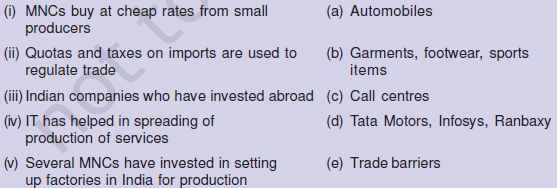
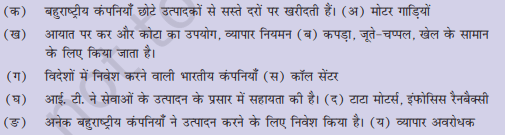
Answer
(i) – (b); (ii)-(e); (iii)-(d); (iv)-(c); (v)-(a)
NCERT Solutions for Class 10 Economics Chapter 4 Globalisation and the Indian Economy वैश्वीकरण और भारतीय अर्थव्यवस्था
Question 13:
Choose the most appropriate option.
(i) The past two decades of globalisation has seen rapid movements in
(a) goods, services and people between countries.
(b) goods, services and investments between countries.
(c) goods, investments and people between countries.
(ii) The most common route for investments by MNCs in countries around the world is to
(a) set up new factories.
(b) buy existing local companies.
(c) form partnerships with local companies.
(iii) Globalisation has led to improvement in living conditions
(a) of all the people
(b) of people in the developed countries
(c) of workers in the developing countries
(d) none of the above
(अ) वैश्वीकरण के विगत दो दशकों में द्रुत आवागमन देखा गया है:
(क) देशों के बीच वस्तुओं, सेवाओं और लोगों का
(ख) देशों के बीच वस्तुओं, सेवाओं और निवेशों का
(ग) देशों के बीच वस्तुओं, निवेशों और लोगों का
(आ) विश्व के देशों में बहुराष्ट्रीय कंपनियों द्वारा निवेश का सबसे अधिक सामान्य मार्ग है
(क) नये कारखानों की स्थापना
(ख) स्थानीय कंपनियों को खरीद लेना
(ग) स्थानीय कंपनियों से साझेदारी करना
(इ) वैश्वीकरण ने जीवन स्तर के सुधार में सहायता पहुँचाई है।
(क) सभी लोगों के
(ख) विकसित देशों के लोगों के
(ग) विकासशील देशों के श्रमिकों के
(घ) उपर्युक्त में से कोई नहीं
Answer
(i)-(b); (ii)-(b); (iii)-(d)
NCERT Solutions for Class 10 Economics Chapter 4 Globalisation and the Indian Economy वैश्वीकरण और भारतीय अर्थव्यवस्था
