
NCERT Solution of Class 9 English Chapter 8 Kathmandu
Thank you for reading this post, don't forget to subscribe!Summary of Class 9 English Chapter 8 Kathmandu
Important Questions for Class 9 English Chapter 8 Kathmandu
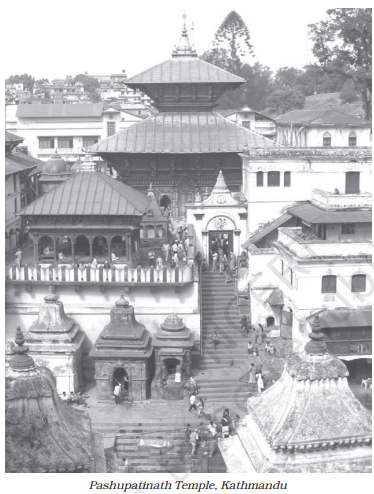
I. Answer these questions in one or two words or in short phrases.
Question 1:
Name the two temples the author visited in Kathmandu.
Answer
Pashupatinath and Baudhnath Stupa.
Question 2:
The writer says, “All this I wash down with Coca Cola.” What does ‘all this’ refer to?
Answer
Com-on-the-cob and marzipan.
Question 3:
What does Vikram Seth compare to the quills of a porcupine?
Answer
Vikram Seth compares a flute seller to the quills of a porcupine. The flute seller was holding a long pole that had around fifty to sixty flutes at its top.
Question 4:
Name five kinds of flutes.
Answer
The five kinds of flutes are:
(1) The reed neh,
(2) the Japanese shakuhachi,
(3) the deep bansuri,
(4) the breathy flutes of South America,
(5) the high pitched Chinese flutes.
NCERT Solution of Class 9 English Chapter 8 Kathmandu
II. Answer each question in a short paragraph.
Question 1:
What difference does the author note between the flute seller and the other hawkers?
Answer
The author noticed that the flute seller was calm and quiet. He did not scream to sell his wares like other hawkers did.
Question 2:
What is the belief at Pashupatinath about the end of Kaliyug?
Answer
People believe that when a small shrine emerges fully on Bagwati river, the goddess inside will escape, and the evil period of the Kalyug will end on earth.
Question 3:
The author has drawn powerful images and pictures. Pick out three examples each of
(i) the atmosphere of ‘febrile confusion’ outside the temple of Pashupatinath
(for example: some people trying to get the priest’s attention are elbowed aside…)
(ii) the things he sees
(iii) the sounds he hears
Answer
(i) The author describes the monkey’s fight vividly and graphically. A fight breaks out between two monkeys. One chases the other, who jumps onto a shivalinga, then runs screaming around the temples and down to the river.
(ii) The author observes a princess of the Nepalese royal house. Everyone bows to her. He sees monkeys. He sees felt bags, Tibetan prints and silver jewellery. He looks at flute sellers, hawkers of postcards, shops selling western cosmetics, etc.
(iii) He hears film songs from the radios, car horns, bicycle bells, stray cows low and vendors shout out their wares. He also listens to the various flutes played by the flute seller.
NCERT Solution of Class 9 English Chapter 8 Kathmandu
III. Answer the following questions in not more than 100–150 words each.
Question 1:
Compare and contrast the atmosphere in and around the Baudhnath shrine with the Pashupatinath temple.
Answer
The author says that the atmosphere in Pashupatinath temple was an atmosphere of ‘febrile confusion’. He says that priests, hawkers, devotees, tourists, cows, monkeys, pigeons and dogs can be seen roaming through the grounds. There are so many worshippers that people are elbowed aside by others pushing their way to the front.
At Baudhnath temple, the Buddhist shrine, there was a sense of stillness. There is no crowd. It is a safe place of quietness in the busy streets around.
Question 2:
How does the author describe Kathmandu’s busiest streets?
Answer
Kathmandu’s busiest streets are lined with shops and stalls selling different things. There are small temples having deities adorned with flowers. The vendors scream to attract buyers. There are shops selling various things, namely, chocolates, camera film rolls, imported cosmetics, postcards, utensils and antiques. There are hawkers selling fruits, flutes, postcards for the tourists.
Question 3:
“To hear any flute is to be drawn into the commonality of all mankind.” Why does the author say this?
Answer
The author says this because the sound produced by the flute is the closest to human voice. It is an extension of human voice as it is produced by exhaling into it.
NCERT Solution of Class 9 English Chapter 8 Kathmandu
