
NCERT Solutions for Class 10 Maths Chapter 10 Circles वृत
Important Questions for Class 10 Maths Chapter 10 Circles
Thank you for reading this post, don't forget to subscribe!
Exercise 10.1
Question 1:
How many tangents can a circle have?
Solution
There can be infinite tangents to a circle.
Question 2:
Fill in the blanks :
(i) A tangent to a circle intersects it in _______ point (s).
(ii) A line intersecting a circle in two points is called a _______ .
(iii) A circle can have _______ parallel tangents at the most.
(iv) The common point of a tangent to a circle and the circle is called _______ .
Answer
(i) one (ii) secant (iii) two (iv) point of contact
Question 3:
A tangent PQ at a point P of a circle of radius 5 cm meets a line through the centre O at a point Q so that OQ = 12 cm. Length PQ is :
(A) 12 cm \(\quad\) (B) 13 cm \(\quad\)(C) 8.5 cm \(\quad\) (D) \(\sqrt{119}\) cm
Solution

The line that is drawn from the centre of the given circle to the tangent PQ is perpendicular to PQ.
And so, OP ⊥ PQ
Using Pythagoras’ theorem in triangle ΔOPQ, we get,
OQ2 = OP2+PQ2
(12)2 = 52+PQ2
PQ2 = 144-25
PQ2 = 119
PQ = √119 cm (D)
Question 4:
Draw a circle and two lines parallel to a given line such that one is a tangent and the other, a secant to the circle.
Solution
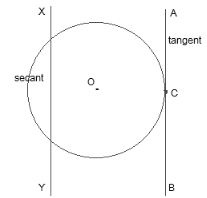
XY and AB are two parallel lines. Line segment AB is the tangent at point C, while line segment XY is the secant.
NCERT Solutions for Class 10 Maths Chapter 10 Circles
Exercise 10.2
Question 1:
From a point Q, the length of the tangent to a circle is 24 cm and the distance of Q from the centre is 25 cm. The radius of the circle is
(A) 7 cm (B) 12 cm (C) 15 cm (D) 24.5 cm
Solution
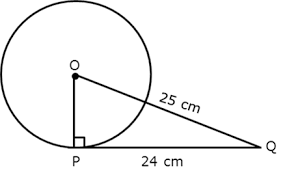
△OPQ is a right-angled triangle.
It is given that OQ = 25 cm and PQ = 24 cm
By using Pythagoras’ theorem in △OPQ,
OQ2 = OP2 +PQ2
(25)2 = OP2+(24)2
OP2 = 625-576
OP2 = 49
OP = 7 cm (A)
Question 2:
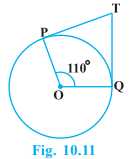
In Fig. 10.11, if TP and TQ are the two tangents to a circle with centre O so that \(\angle\) POQ = 110°, then \(\angle\) PTQ is equal to:
(A) 60° (B) 70° (C) 80° (D) 90°
Solution
OP ⊥ PT and TQ ⊥ OQ
∴ ∠OPT = ∠OQT = 90°
Now,
In the quadrilateral POQT, we know that the sum of the interior angles is 360°.
So, ∠PTQ+∠POQ+∠OPT+∠OQT = 360°
∠PTQ +90°+110°+90° = 360°
∠PTQ = 70°
Question 3:
If tangents PA and PB from a point P to a circle with centre O are inclined to each other at angle of 80°, then \(\angle\) POA is equal to
(A) 50° (B) 60° (C) 70° (D) 80°
Question 4:
Prove that the tangents drawn at the ends of a diameter of a circle are parallel.
Question 5:
Prove that the perpendicular at the point of contact to the tangent to a circle passes through the centre.
Question 6:
The length of a tangent from a point A at distance 5 cm from the centre of the circle is 4 cm. Find the radius of the circle.
Question 7:
Two concentric circles are of radii 5 cm and 3 cm. Find the length of the chord of the larger circle which touches the smaller circle.
दो संकेंद्रीय वृतों की त्रिज्याएँ 5 cm और 3 cm हैं। बड़े वृत की जीवा, जो छोटे वृत को स्पर्श करती है, की लंबाई ज्ञात कीजिए।
Question 8:
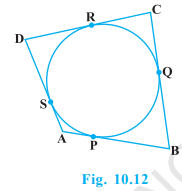
A quadrilateral ABCD is drawn to circumscribe a circle (see Fig. 10.12). Prove that AB + CD = AD + BC
Question 9:
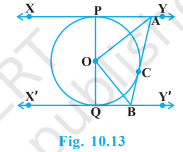
In Fig. 10.13, XY and X’Y’ are two parallel tangents to a circle with centre O and another tangent AB with point of contact C intersecting XY at A and X’Y’ at B. Prove that \(\angle\) AOB = 90°.
Question 10:
Prove that the angle between the two tangents drawn from an external point to a circle is supplementary to the angle subtended by the line-segment joining the points of contact at the centre.
Question 11:
Prove that the parallelogram circumscribing a circle is a rhombus.
सिद्ध कीजिए कि किसी वृत्त के परिगत समांतर चतुर्भुज समचतुर्भुज होता है।
Solution
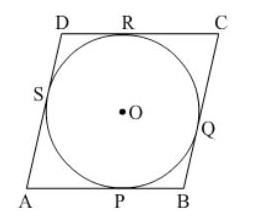
∴ AB || CD and BC || AD.
∴ AB = CD and BC = AD
The lengths of tangents drawn from an external point to a circle are equal.
Therefore, ⇒ BP = BQ ……….. (1)
⇒ CR = CQ ……….. (2)
⇒ DR = DS ……….. (3)
⇒ AP = AS ……….. (4)
Adding (1) + (2) + (3) + (4), we get :
⇒ BP + CR + DR + AP = BQ + CQ + DS + AS
⇒ (BP + AP) + (CR + DR) = (BQ + CQ) + (DS + AS)
⇒ AB + CD = BC + AD
Substitute CD = AB and AD = BC since ABCD is a parallelogram, then
⇒ AB + AB = BC + BC
⇒ 2AB = 2BC
⇒ AB = BC
∴ AB = BC = CD = DA
This implies that all the four sides are equal.
Hence, proved that the parallelogram circumscribing a circle is a rhombus.
Question 12:
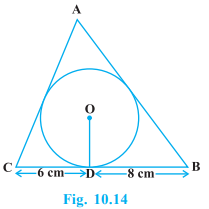
A triangle ABC is drawn to circumscribe a circle of radius 4 cm such that the segments BD and DC into which BC is divided by the point of contact D are of lengths 8 cm and 6 cm respectively (see Fig. 10.14). Find the sides AB and AC.
Question 13:
Prove that opposite sides of a quadrilateral circumscribing a circle subtend supplementary angles at the centre of the circle.
NCERT Solutions for Class 10 Maths Chapter 10 Circles
