
NCERT Solutions for Class 10 Science Chapter 12 Magnetic Effects of Electric Current विद्युत् धारा के चुंबकीय
Thank you for reading this post, don't forget to subscribe!Page No: 196
Question 1:
Why does a compass needle get deflected when brought near a bar magnet?
चुंबक के निकट लाने पर दिकसूचक की सूई विक्षेपित क्यों हो जाती है?
Answer
The needle of a compass is a small magnet. That’s why when a compass needle is brought near a bar magnet, its magnetic field lines interact with that of the bar magnet. Hence, a compass needle gets deflected.
दिकसूचक की सूई चुंबक होती है| इसलिए दिकसूचक की सूई जब चुंबक के निकट लायी जाती है, इसकी चुंबकीय क्षेत्र रेखाएँ चुंबक से आकर्षित होती हैं| यही कारण है कि दिकसूचक की सूई विक्षेपित हो जाती है|
NCERT Solutions for Class 10 Science Chapter 12 Magnetic Effects of Electric Current विद्युत् धारा के चुंबकीय
Page No: 200
Question 1:
Draw magnetic field lines around a bar magnet.
किसी छड़ चुंबक के चारों ओर चुंबकीय क्षेत्र रेखाएँ खींचिए|
Answer
Magnetic field lines of a bar magnet emerge from the north pole and terminate at the south pole. Inside the magnet, the field lines emerge from the south pole and terminate at the north pole, as shown in the given figure.
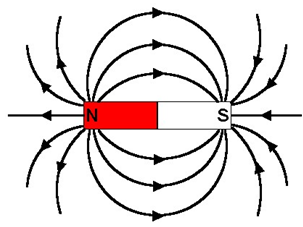
चुंबकीय क्षेत्र रेखाएँ चुंबक के उत्तर ध्रुव से प्रकट होती हैं तथा दक्षिण ध्रुव पर विलीन हो जाती हैं| चुंबक के भीतर चुंबकीय क्षेत्र रेखाओं की दिशा उसके दक्षिण ध्रुव से उत्तर ध्रुव की ओर होती है, जैसा कि चित्र में दिखाया गया है-
कारण कोई भी प्रकीर्णित किरणें अंतरिक्षयात्री के नेत्रों तक नहीं पहुँच पाती हैं और आकाश काला प्रतीत होता है|

Question 2:
List the properties of magnetic lines of force.
चुंबकीय क्षेत्र रेखाओं के गुणों की सूची बनाइए|
Answer
The properties of magnetic lines of force are as follows.
(1) Magnetic field lines emerge from the north pole.
(2) They merge at the south pole.
(3) The direction of field lines inside the magnet is from the south pole to the north pole.
(4) Magnetic lines do not intersect with each other.
चुंबकीय क्षेत्र रेखाओं के गुण निम्नलिखित हैं :
(1) चुंबकीय क्षेत्र रेखाएँ उत्तर ध्रुव से प्रकट होती हैं|
(2) यह दक्षिण ध्रुव पर विलीन हो जाती हैं|
(3) चुंबक के भीतर चुंबकीय क्षेत्र रेखाओं की दिशा उसके दक्षिण ध्रुव से उत्तर ध्रुव की ओर होती है|
(4) चुंबकीय क्षेत्र रेखाएँ कहीं भी एक-दूसरे को प्रतिच्छेद नहीं करतीं|
Question 3:
Why don’t two magnetic lines of force intersect each other?
दो चुंबकीय क्षेत्र रेखाएँ एक-दूसरे को प्रतिच्छेद क्यों नहीं करतीं?
Answer
The two magnetic field lines do not intersect each other because if they do it means at the point of intersect the compass needle is showing two different directions which is not possible.
दो चुंबकीय क्षेत्र रेखाएँ एक-दूसरे को प्रतिच्छेद नहीं करतीं, क्योंकि यदि वे ऐसा करें तो इसका यह अर्थ होगा कि प्रतिच्छेद बिंदु पर दिकसूची को रखने पर उसकी सूई दो दिशाओं की ओर संकेत करेगी जो संभव नहीं हो सकता|
NCERT Solutions for Class 10 Science Chapter 12 Magnetic Effects of Electric Current विद्युत् धारा के चुंबकीय
Page No: 201-202
Question 1:
Consider a circular loop of wire lying in the plane of the table. Let the current pass through the loop clockwise. Apply the right-hand rule to find out the direction of the magnetic field inside and outside the loop.
मेज के तल में पड़े तार के वृत्ताकार पाश पर विचार कीजिए| मान लीजिए इस पाश में दक्षिणावर्त विद्युत् धारा प्रवाहित हो रही है| दक्षिण-हस्त अंगुष्ठ नियम को लागू करके पाश के भीतर तथा बाहर चुंबकीय क्षेत्र की दिशा ज्ञात कीजिए|
Answer
Inside the loop = Pierce inside the table
Outside the loop = Appear to emerge out from the table
For downward direction of current flowing in the circular loop, the direction of magnetic field lines will be as if they are emerging from the table outside the loop and merging in the table inside the loop. Similarly, for upward direction of current flowing in the circular loop, the direction of magnetic field lines will be as if they are emerging from the table outside the loop and merging in the table inside the loop, as shown in the given figure.
वृत्ताकार पाश में विद्युत धारा का प्रवाह दक्षिणावर्त दिशा के लिए, चुंबकीय क्षेत्र के रेखाओं की दिशा भी यही होगी क्योंकि वे मेज के तल पर पड़े पाश के बाहर से प्रकट होकर भीतर की ओर विलीन होते हैं| उसी प्रकार वृत्ताकार पाश में विद्युत धारा के प्रवाह उर्ध्वाधरतः दिशा में होने पर चुंबकीय क्षेत्रों की दिशा भी वही होगी क्योंकि क्योंकि वे मेज के तल पर पड़े पाश के बाहर से प्रकट होकर भीतर की ओर विलीन होते हैं, जैसा कि चित्र में दिखाया गया है

2. The magnetic field in a given region is uniform. Draw a diagram to represent it.
किसी दिए गए क्षेत्र में चुंबकीय क्षेत्र एकसमान है| इसे निरूपित करने के लिए आरेख खींचिए|
Answer

The magnetic field lines inside a current-carrying long straight solenoid are uniform.
किसी विद्युत् धारावाही परिनालिका के भीतर चुंबकीय क्षेत्र की क्षेत्र रेखाएँ एकसमान होती हैं|
Questionb 3:
Choose the correct option.
The magnetic field inside a long straight solenoid-carrying current
(a) is zero
(b) decreases as we move towards its end
(c) increases as we move towards its end
(d) is the same at all points
सही विकल्प चुनिए:
किसी विद्युत् धारावाही सीधी लंबी परिनालिका के भीतर चुंबकीय क्षेत्र-
(a) शून्य होता है|
(b) इसके सिरे की ओर जाने पर घटता है|
(c) इसके सिरे की ओर जाने पर बढ़ता है|
(d) सभी बिंदुओं पर समान होता है|
Answer
(d) is the same at all points
(d) सभी बिंदुओं पर समान होता है|
Page No: 203-204
Question 1:
Which of the following property of a proton can change while it moves freely in a magnetic field? (There may be more than one correct answer.)
(a) mass
(b) speed
(c) velocity
(d) momentum
किसी प्रोटॉन का निम्नलिखित में से कौन-सा गुण किसी चुंबकीय क्षेत्र में मुक्त गति करते समय परिवर्तित हो जाता है? (यहाँ एक से अधिक सही उत्तर हो सकते हैं|)
(a) द्रव्यमान
(b) चाल
(c) वेग
(d) संवेग
Answer
(c) velocity and (d) momentum
c) वेग (d) संवेग
Question 2:
In Activity 12.7, how do we think the displacement of rod AB will be affected if (i) current in rod AB is increased: (ii) a stronger horse-shoe magnet is used: and (iii) length of the rod AB is increased?
क्रियाकलाप 12.7 में हमारे विचार से छड़ AB का विस्थापन किस प्रकार प्रभावित होगा यदि (i) छड़ AB में प्रवाहित विद्युत् धारा में वृद्धि हो जाए (ii) अधिक प्रबल नाल चुंबक प्रयोग किया जाए; और (iii) छड़ AB की लंबाई में वृद्धि कर दी जाए|
Answer
The displacement of rod AB is increased due to magnetic force exerted on it, if :
(i) If the current in the rod is increased then rod will be deflected with greater force.
(ii) If a stronger horse-shoe magnet is used then also rod will be deflected with greater force due to the increase in magnetic field.
(iii) If the length of the rod AB is increased.
छड़ AB का विस्थापन उस पर लगे चुंबकीय बल के कारण अधिक होगा, यदि:
(i) यदि छड़ AB में प्रवाहित विद्युत् धारा में वृद्धि हो जाए तो छड़ अधिक बल के साथ विक्षेपित होगा|
(ii) यदि अधिक प्रबल नाल चुंबक प्रयोग किया जाए तो चुंबकीय क्षेत्र में वृद्धि के कारण छड़ अधिक बल के साथ विक्षेपित होगा|
(iii) यदि छड़ AB की लंबाई में वृद्धि कर दी जाए, तो छड़ अधिक बल के साथ विक्षेपित होगा|
Question 3:
A positively-charged particle (alpha-particle) projected towards west is deflected towards north by a magnetic field. The direction of magnetic field is
(a) towards south
(b) towards east
(c) downward
(d) upward
पश्चिम की ओर प्रक्षेपित कोई धनावेशित कण (अल्फ़ा–कण) किसी चुंबकीय क्षेत्र द्वारा उत्तर की ओर विक्षेपित हो जाता है| चुंबकीय क्षेत्र की दिशा क्या है?
(a) दक्षिण की ओर
(b) पूर्व की ओर
(c) अधोमुखी
(d) उपरिमुखी
Answer
(d) upward
(d) उपरिमुखी
Page No: 205
1. Name two safety measures commonly used in electric circuits and appliances.
विद्युत परिपथों तथा साधित्रों में सामान्यतः उपयोग होने वाले दो सुरक्षा उपायों के नाम लिखिए|
Answer
Two safety measures commonly used in electric circuits and appliances are
(1) Electric Fuse: An electric fuse is connected in series it protects the circuit from overloading and prevents it from short circuiting.
(2) Proper earthing of all electric circuit in which any leakage of current in an electric appliance is transferred to the ground and people using the appliance do not get the shock.
विद्युत परिपथों तथा साधित्रों में सामान्यतः उपयोग होने वाले दो सुरक्षा उपायों के नाम हैं:
(1) विद्युत फ्यूज: विद्युत परिपथ में लगा फ्यूज परिपथ तथा साधित्र को अतिभारण के कारण होने वाली क्षति से बचाता है|
(2) सभी विद्युत परिपथों का उचित भूसंपर्कन, जिससे विद्युत धारा का कोई क्षरण होने पर उस साधित्र का विभव भूमि के विभव के बराबर हो जाएगा| फलस्वरूप इस साधित्र का उपयोग करने वाला व्यक्ति तीव्र विद्युत आघात से सुरक्षित बचा रहता है|
Question 2:
An electric oven of 2 kW is operated in a domestic electric circuit (220 V) that has a current rating of 5 A. What result do you expect? Explain.
2 kW शक्ति अनुमतांक का एक विद्युत तंदूर किसी घरेलू विद्युत परिपथ (220V) में प्रचलित किया जाता है जिसका विद्युत धारा अनुमतांक 5 A है, इससे आप किस परिणाम की अपेक्षा करते हैं? स्पष्ट कीजिए|
Answer
Current drawn by the electric oven can be obtained by the expression,
P = VI
Where,
Current = I
Power of the oven, P = 2 kW = 2000 W
Voltage supplied, V = 220 V
I = 2000/220 V = 9.09 A
Hence, the current drawn by the electric oven is 9.09 A, which exceeds the safe limit of the circuit. Fuse element of the electric fuse will melt and break the circuit.
विद्युत तंदूर द्वारा प्रचलित विद्युत धारा को व्यंजक द्वारा प्राप्त किया जा सकता है-
P = VI
जहाँ,
विद्युत धारा = I
तंदूर की शक्ति = P = 2 kW = 2000 W
आपूर्ति की गई वोल्टता = V = 220 V
I = 2000/220 V = 9.09 A
इस प्रकार विद्युत तंदूर द्वारा प्रचलित विद्युत धारा 9.09 A है, जो परिपथ की सुरक्षित सीमा से अधिक है| विद्युत फ्यूज का फ्यूज तत्व पिघल जाएगा और परिपथ टूट जाएगा|
3. What precaution should be taken to avoid the overloading of domestic electric circuits?
घरेलू विद्युत परिपथों में अतिभारण से बचाव के लिए क्या सावधानी बरतनी चाहिए?
Answer
The precautions that should be taken to avoid the overloading of domestic circuits are as follows:
(1) Too many appliances should not be connected to a single socket.
(2) Too many appliances should not be used at the same time.
(3) Faulty appliances should not be connected in the circuit.
(4) Fuse should be connected in the circuit.
घरेलू विद्युत परिपथों में अतिभारण से बचाव के लिए निम्नलिखित सावधानी बरतनी चाहिए :
(1) एक ही सॉकेट से एक से अधिक साधित्रों को नहीं जोड़ना चाहिए|
(2) एक ही समय में बहुत अधिक साधित्रों का एक साथ प्रयोग नहीं करना चाहिए|
(3) दोषपूर्ण साधित्रों को परिपथ में नहीं जोड़ना चाहिए|
(4) विद्युत परिपथ में फ्यूज जुड़ा होना चाहिए|
Page No: 207
Exercise
Question 1:
Which of the following correctly describes the magnetic field near a long straight wire?
(a) The field consists of straight lines perpendicular to the wire
(b) The field consists of straight lines parallel to the wire
(c) The field consists of radial lines originating from the wire
(d) The field consists of concentric circles centred on the wire
निम्नलिखित में से कौन किसी लंबे विद्युत धारावाही तार के निकट चुंबकीय क्षेत्र का सही वर्णन करता है?
(a) चुंबकीय क्षेत्र की क्षेत्र रेखाएँ तार के लंबवत होती हैं|
(b) चुंबकीय क्षेत्र की क्षेत्र रेखाएँ तार के समांतर होती हैं|
(c) चुंबकीय क्षेत्र की क्षेत्र रेखाएँ अरीय होती हैं जिनका उद्भव तार से होता है|
(d) चुंबकीय क्षेत्र की संकेंद्री क्षेत्र रेखाओं का केंद्र तार होता है|
Answer
(d) The field consists of concentric circles centred on the wire
(d) चुंबकीय क्षेत्र की संकेंद्री क्षेत्र रेखाओं का केंद्र तार होता है|
Question 2:
At the time of short circuit, the current in the circuit
(a) reduces substantially
(b) does not change
(c) increases heavily
(d) vary continuously
लघुपथन के समय परिपथ में विद्युत धारा का मान-
(a) बहुत कम हो जाता है|
(b) परिवर्तित नहीं होता|
(c) बहुत अधिक बढ़ जाता है|
(d) निरंतर परिवर्तित होता है|
Answer
(c) increases heavily
(c) बहुत अधिक बढ़ जाता है|
Question 3:
State whether the following statements are true or false.
निम्नलिखित प्रकथनों में कौन-सा सही है तथा कौन-सा गलत है?
(a) The field at the centre of a long circular coil carrying current will be parallel straight lines.
किसी लंबी वृत्ताकार विद्युत धारावाही कुंडली के केंद्र पर चुंबकीय क्षेत्र समांतर सीधी क्षेत्र रेखाएँ होता है|
(b)A wire with a green insulation is usually the live wire of an electric supply.
हरे विद्युतरोधन वाला तार प्रायः विद्युन्मय तार होता है|
Answer
(a) True सही
(b) False, Live wire has red insulation cover, whereas earth wire has green insulation colour in the domestic circuits.
गलत, हरे विद्युतरोधन वाला तार भूसंपर्कन तार होता है|
Question 4:
List three sources of magnetic fields.
चुंबकीय क्षेत्र के तीन स्रोतों की सूची बनाइए|
Answer
Three sources of magnetic fields are as follows:
(1) Current-carrying conductors
(2) Permanent magnets
(3) Electromagnets
चुंबकीय क्षेत्र के तीन स्रोत निम्नलिखित हैं :
(1) विद्युत धारावाही चालक
(2) स्थायी चुंबक
(3) वैद्युतचुंबक
Question 5:
When is the force experienced by a current-carrying conductor placed in a magnetic field largest?
किसी चुंबकीय क्षेत्र में स्थित विद्युत धारावाही चालक पर आरोपित बल कब अधिकतम होता है?
Answer
The force experienced by a current-currying conductor is the maximum when the direction of current is perpendicular to the direction of the magnetic field.
किसी चुंबकीय क्षेत्र में स्थित विद्युत धारावाही चालक पर आरोपित बल अधिकतम होता है जब धारा की दिशा चुंबकीय क्षेत्र की दिशा के लंबवत होती है|
Question 6:
Imagine that you are sitting in a chamber with your back to one wall. An electron beam, moving horizontally from back wall towards the front wall, is deflected by a strong magnetic field to your right side. What is the direction of magnetic field?
मान लीजिए आप किसी चैंबर में अपनी पीठ को किसी एक दीवार से लगाकर बैठे हैं| कोई इलेक्ट्रॉन पुंज आपके पीछे की दीवार से सामने वाली दीवार की ओर क्षैतिजतः गमन करते हुए किसी प्रबल चुंबकीय क्षेत्र द्वारा आपके दाईं ओर विक्षेपित हो जाता है| चुंबकीय क्षेत्र की दिशा क्या है?
Answer
The direction of the magnetic field is vertically downwards. The direction of current is from the front wall to the back wall because negatively charged electrons are moving from back wall to the front wall. The direction of magnetic force is rightward. Hence, using Fleming’s left hand rule, it can be concluded that the direction of magnetic field inside the chamber is downward.
चुंबकीय क्षेत्र की दिशा ऊर्ध्वाधरतः अधोमुखी है| विद्युत धारा की दिशा सामने वाली दीवार से पीछे की दीवार तक है क्योंकि ऋणावेशित इलेक्ट्रॉन पीछे की दीवार से सामने की दीवार की ओर गमन करते हैं| चुंबकीय बल की दिशा दाईं ओर होती है| इस प्रकार फ्लेंमिंग के वामहस्त नियम का प्रयोग करते हुए यह निष्कर्ष निकाला जाता है कि किसी चैंबर में चुंबकीय क्षेत्र की दिशा अधोमुखी होती है|
Question 7:
State the rule to determine the direction of a (i) magnetic field produced around a straight conductor-carrying current, (ii) force experienced by a current-carrying straight conductor placed in a magnetic field which is perpendicular to it, and (iii) current induced in a coil due to its rotation in a magnetic field.
निम्नलिखित की दिशा को निर्धारित करने वाला नियम लिखिए-
(i) किसी विद्युत धारावाही सीधे चालक के चारों ओर उत्पन्न चुंबकीय क्षेत्र,
(ii) किसी चुंबकीय क्षेत्र में, क्षेत्र के लंबवत स्थित, विद्युत धारावाही सीधे चालक पर आरोपित बल, तथा
(iii) किसी चुंबकीय क्षेत्र में किसी कुंडली के घूर्णन करने पर उस कुंडली में उत्पन्न प्रेरित विद्युत धारा|
Answer
(i) Maxwell’s right hand thumb rule
(ii) Fleming’s left hand rule
(iii) Fleming’s right hand rule
(i) मैक्सवेल का दक्षिण-हस्त अंगुष्ठ नियम
(ii) फ्लेंमिंग का वामहस्त नियम
(iii) फ्लेंमिंग का दक्षिण-हस्त नियम
Question 8:
When does an electric short circuit occur?
किसी विद्युत परिपथ में लघुपथन कब होता है?
Answer
If the insulation of the wires used in the circuit is damaged or the appliance used is faulty due to which the live wire and the neutral wire comes in direct contact as a result current in the circuit rises and the short circuit occurs.
तारों के विद्युतरोधन क्षतिग्रस्त होने अथवा साधित्र में कोई दोष होने के कारण जब विद्युन्मय तार तथा उदासीन तार दोनों सीधे संपर्क में आते हैं तो अतिभारण हो सकता है| ऐसी परिस्थितियों में, किसी परिपथ में विद्युत धारा अकस्मात बहुत अधिक हो जाती है| इसे लघुपथन कहते हैं|
Question 9:
What is the function of an earth wire? Why is it necessary to earth metallic appliances?
भूसंपर्क तार का क्या महत्त्व है? धातु के आवरण वाले विद्युत साधित्रों को भूसंपर्कित करना क्यों आवश्यक है?
Answer
The metallic body of electric appliances is connected to the earth by means of earth wire so that any leakage of electric current is transferred to the ground. This prevents any electric shock to the user. That is why earthing of the electrical appliances is necessary.
धातु के आवरणों से संयोजित भूसंपर्क तार विद्युत धारा के लिए अल्प प्रतिरोध का चालन पथ प्रस्तुत करता है| इससे विद्युत साधित्र के धात्विक आवरण में विद्युत धारा का कोई क्षरण होने पर उस साधित्र का विभव भूमि के विभव के बराबर हो जाएगा| इस साधित्र को उपयोग करने वाला व्यक्ति तीव्र विद्युत आघात से सुरक्षित बचा रहता है| इसलिए विद्युत साधित्रों का भूसंपर्कन आवश्यक होता है|
