
NCERT Solutions for Class 9 Ganita Manjari Chapter 3 The World of Numbers
Thank you for reading this post, don't forget to subscribe!
Table of Contents
Exercise Set 3.1
Question 1:
A merchant in the port city of Lothal is exchanging bags of spices for copper ingots. He receives 15 ingots for every 2 bags of spices. If he brings 12 bags of spices to the market, how many copper ingots will he leave with?
Solution
2 bags of spices = 15 ingots
1 bag of spices = \(\frac{15}{2}\)
12 bags of spices = \(\frac{15}{2} \times 12\) = 90
Thus, the merchant will leave with 90 copper ingots.
Question 2:
Look at the sequence of numbers on one column of the Ishango bone:
11, 13, 17, 19.
What do these numbers have in common? List the next three numbers that fit this pattern.
Solution
The numbers 11, 13, 17, 19 are all prime numbers.
Common Number = 1
Next three numbers = 23, 29, 31.
Question 3:
We know that Natural Numbers are closed under addition (the sum of any two natural numbers is always a natural number). Are they closed under subtraction? Provide a couple of examples to justify your answer.
Solution
Natural Numbers are not closed under subtraction.
Justification:
Closure means the result should also be a natural number.
Examples:
(i) 5 – 3 = 2 which is a Natural Number.
(ii) 3 – 5 = – 2 which is not a Natural Number.
Since subtraction can give a negative number, so natural numbers are not closed under subtraction.
Question *4:
Ancient Indians used the joints of their fingers to count, a practice still seen today. Each finger has 3 joints, and the thumb is used to count them. How many can you count on one hand? How does this relate to the ancient base-12 counting systems?
Solution
Each hand has 4 fingers (exclusing the thumb), and each finger has 3 joints.
So, total joints = 4 \(\times\) 3 = 12
We can count upto 12 on one hand.
Since counting on one hand gives 12, this method naturally leads to counting in groups of 12.
Hence, it is related to the base-12 system used in ancient times.
NCERT Solutions for Class 9 Ganita Manjari Chapter 3 The World of Numbers
Exercise Set 3.2
Question 1:
The temperature in the high-altitude desert of Ladakh is recorded as 4 °C at noon. By midnight, it drops by 15 °C. What is the midnight temperature?
Solution
Temperature = 4 °C
Drop = 15 °C
Midnight temperature = 4 °C – 15 °C = – 11 °C
Question 2:
A spice trader takes a loan (debt) of ₹ 850. The next day, he makes a profit (fortune) of ₹ 1,200. The following week, he incurs a loss of ₹ 450. Write this sequence as an equation using integers and calculate his final financial standing.
Solution
Loan (debt) = – ₹ 850
Profit = + ₹ 1,200
Loss = – ₹ 450
Equation; – 850 + 1200 – 450 = – 100
Therefore, his financial standing = – ₹ 100 (loss).
3. Calculate the following using Brahmagupta’s laws:
(i) (–12) × 5 \(\quad\) (ii) (– 8) × (–7)
(iii) 0 – (–14) \(\quad\) (iv) (–20) ÷ 4
Solution
(i) (-12) × 5
The product of a debt and a fortune is a debt.
[Negative × Positive = Negative]
-12 × 5 = -60
(ii) (-8) × (-7)
The product of two debts is a fortune
[Negative × Positive = Negative]
(-8) × (-7) = 56
(iii) 0 – (-14)
Zero minus debt is a fortune
(Subtracting a negative becomes addition):
0 + 14 = 14
(iv) (-20)+ 4
A debt divided by fortune is debt
(A negative divided by a positive is negative):
-20 + 4 = -5
Question 4:
Explain, using a real-world example of debt, why subtracting a negative number is the same as adding a positive number (e.g., 10 – (–5) = 15).
Solution
Suppose you have ₹ 10, and a debt of ₹ 5 is represented as -₹ 5.
So, starting with ₹ 10 and subtracting a debt of ₹ 5:
10 – (-5) means you are removing a debt of ₹ 5, which is the same as gaining ₹ 5.
Therefore,
10 – (-5) = 10 + 5 = 15
Thus, subtracting a negative number is the same as adding a positive number because removing a debt increases your total.
NCERT Solutions for Class 9 Ganita Manjari Chapter 3 The World of Numbers
Exercise Set 3.3
Question 1:
Prove that the following rational numbers are equal:
(i) \(\frac{2}{3}\) and \(\frac{4}{6}\) \(\quad\quad\quad\) (ii) \(\frac{5}{4}\) and \(\frac{10}{8}\)
(iii) -\(\frac{3}{5}\) and -\(\frac{6}{10}\) \(\quad\quad\) (iv) \(\frac{9}{3}\) and 3
Solution
(i) \(\frac{2}{3}\) and \(\frac{4}{6}\)
\(\quad\) \(\frac{2}{3} \times \frac{2}{2}\) = \(\frac{4}{6}\)
\(\therefore\) \(\frac{2}{3}\) = \(\frac{4}{6}\)
(ii) \(\frac{5}{4}\) and \(\frac{10}{8}\)
\(\quad\) \(\frac{5}{4} \times \frac{2}{2}\) = \(\frac{10}{8}\)
\(\therefore\) \(\frac{5}{4}\) = \(\frac{10}{8}\)
(iii) -\(\frac{3}{5}\) and -\(\frac{6}{10}\)
\(\quad\) -\(\frac{3}{5} \times \frac{2}{2}\) = -\(\frac{6}{10}\)
\(\therefore\) -\(\frac{3}{5}\) = -\(\frac{6}{10}\)
(iv) \(\frac{9}{3}\) and 3
\(\quad\) \(\frac{9}{3} \div \frac{3}{3}\) = \(\frac{3}{3}\) = 1
\(\therefore\) \(\frac{9}{3}\) = 3
Question 2:
Find the sum:
(i) \(\frac{2}{5}\) + \(\frac{3}{10}\) \(\quad\quad\) (ii) \(\frac{7}{12}\) + \(\frac{5}{8}\)
(iii) -\(\frac{4}{7}\) + \(\frac{3}{14}\)
Solution
(i) \(\frac{2}{5}\) + \(\frac{3}{10}\)
\(\\\quad\) = \(\frac{2 \times 2 + 3}{10}\)
\(\\\quad\) = \(\frac{4 + 3}{10}\)
\(\\\quad\) = \(\frac{7}{10}\)
(ii) \(\frac{7}{12}\) + \(\frac{5}{8}\)
\(\\\quad\) = \(\frac{7 \times 2 + 5 \times 3}{24}\)
\(\\\quad\) = \(\frac{14 + 15}{24}\)
\(\\\quad\) = \(\frac{29}{24}\)
(iii) -\(\frac{4}{7}\) + \(\frac{3}{14}\)
\(\\\quad\) = \(\frac{-4 \times 2 + 3}{14}\)
\(\\\quad\) = \(\frac{-8 + 3}{14}\)
\(\\\quad\) = \(\frac{-5}{14}\)
Question 3:
Find the difference:
(i) \(\frac{5}{6}\) – \(\frac{1}{4}\) \(\quad\quad\) (ii) \(\frac{11}{8}\) – \(\frac{3}{4}\)
(iii) -\(\frac{7}{9}\) – \(\left(-\frac{2}{3}\right)\)
Solution
(i) \(\frac{5}{6}\) – \(\frac{1}{4}\)
\(\\\quad\) = \(\frac{5 \times 2 – 1 \times 3}{12}\)
\(\\\quad\) = \(\frac{10 – 3}{12}\)
\(\\\quad\) = \(\frac{7}{12}\)
(ii) \(\frac{11}{8}\) – \(\frac{3}{4}\)
\(\\\quad\) = \(\frac{11 \times 2 – 3 \times 4}{16}\)
\(\\\quad\) = \(\frac{22 – 12}{16}\)
\(\\\quad\) = \(\frac{10}{16}\)
\(\\\quad\) = \(\frac{5}{8}\)
(iii) -\(\frac{7}{9}\) – \(\left(-\frac{2}{3}\right)\)
\(\\\quad\) = -\(\frac{7}{9} + \frac{2}{3}\)
\(\\\quad\) = \(\frac{-7 + 2 \times 3}{9}\)
\(\\\quad\) = \(\frac{-7 + 6}{9}\)
\(\\\quad\) = \(\frac{-1}{9}\)
Question 4:
Find the product:
(i) \(\frac{2}{3} \times \frac{3}{10}\) \(\quad\quad\) (ii) \(\frac{7}{11} \times \frac{5}{8}\)
(iii) \(-\frac{4}{7} \times \frac{5}{14}\)
Solution
(i) \(\frac{2}{3} \times \frac{3}{10}\)
\(\\\quad\) = \(\frac{2 \times 3}{3 \times 10}\)
\(\\\quad\) = \(\frac{1 \times 1}{1 \times 5}\)
\(\\\quad\) = \(\frac{1}{5}\)
(ii) \(\frac{7}{11} \times \frac{5}{8}\)
\(\\\quad\) = \(\frac{7 \times 5}{11 \times 8}\)
\(\\\quad\) = \(\frac{35}{88}\)
(iii) \(-\frac{4}{7} \times \frac{5}{14}\)
\(\\\quad\) = \(-\frac{4 \times 5}{7 \times 14}\)
\(\\\quad\) = \(-\frac{2 \times 5}{7 \times 7}\)
\(\\\quad\) = \(\frac{-10}{49}\)
Question 5:
Find the quotient:
(i) \(\frac{2}{3} \div \frac{3}{10}\) \(\quad\quad\) (ii) \(\frac{7}{11} \div \frac{5}{8}\)
(iii) \(-\frac{4}{7} \div \frac{5}{14}\)
6. Show that: \(\left(\frac{1}{2} + \frac{3}{4}\right) \times \frac{8}{3} = \frac{1}{2} \times \frac{8}{3} + \frac{3}{4} \times \frac{8}{3}\)
7. Simplify the following using the distributive property:
\(\quad\quad\) \(\frac{7}{9} \left(\frac{6}{7} – \frac{3}{4}\right)\).
8. Find the rational number x such that:
\(\quad\quad\) \(\frac{5}{6} \left(x + \frac{3}{5}\right) = \frac{5}{6}x + \frac{1}{2}\)
NCERT Solutions for Class 9 Ganita Manjari Chapter 3 The World of Numbers
Exercise Set 3.4
1. Represent the rational numbers \(\frac{2}{3}\), -\(\frac{5}{4}\) and 1\(\frac{1}{2}\) on a single number line.
2. Find three distinct rational numbers that lie strictly between -\(\frac{1}{2}\) and \(\frac{1}{4}\).
3. Simplify the expression: \(\left(-\frac{1}{4}\right) + \left(\frac{5}{12}\right)\).
4. A tailor has 15\(\frac{3}{4}\) metres of fine silk. If making one kurta requires 2\(\frac{1}{4}\) metres of silk, exactly how many kurtas can he make?
5. Find three rational numbers between 3.1415 and 3.1416.
*6. Can you think of other way(s) to find a rational number between any two rational numbers?
NCERT Solutions for Class 9 Ganita Manjari Chapter 3 The World of Numbers
Exercise Set 3.5
Question 1:
Without performing long division, determine which of the following rational numbers will have terminating decimals and which will be repeating: \(\frac{7}{20}, \frac{4}{15}\), and \(\frac{13}{250}\). Then check your answers by explicitly performing the long divisions and expressing these rational numbers as decimals.
Question 2:
Perform the long division for \(\frac{1}{13}\). Identify the repeating block of digits. Does it show cyclic properties if you evaluate \(\frac{2}{13}\)? Now compute \(\frac{3}{13}\), \(\frac{4}{13}\), etc. What do you notice?
Question 3:
Classify the following numbers as rational or irrational:
(i) \(\sqrt{81}\)
(ii) \(\sqrt{21}\)
(iii) 0.33333…
(iv) 0.123451234512345…
(v) 1.01001000100001… (Notice the pattern: Is it repeating a single block?)
(vi) 23.560185612239874790120
Find the explicit fractions in case they are rational.
Question 4:
The number \(0.\overline{9}\) (which means 0.99999 … ) is a rational number. Using algebra (let x = \(0.\overline{9}\), multiply by 10, and subtract), explain why 0.9 is exactly equal to 1.
Question 5:
We have seen that the repeating block of \(\frac{1}{7}\) is a cyclic number. Try to find more numbers (n) whose reciprocals ( \(\frac{1}{n}\) ) produce decimals with repeating blocks that are cyclic.
NCERT Solutions for Class 9 Ganita Manjari Chapter 3 The World of Numbers
End-of-Chapter Exercise
Question 1:
Convert the following rational numbers in the form of a terminating decimal or non-terminating and repeating decimal, whichever the case may be, by the process of long division:
(i) \(\frac{3}{50}\) \(\quad\quad\quad\quad\) (ii) \(\frac{2}{9}\)
Question 2:
Prove that \(\sqrt{5}\) is an irrational number.
Question 3:
Convert the following decimal numbers in the form of \(\frac{p}{q}\).
(i) 12.6 \(\quad\quad\quad\) (ii) 0.0120 \(\quad\quad\quad\) (iii) \(3.0\overline{52}\)
(iv) \(1.2\overline{35}\) \(\quad\quad\) (v) \(0.\overline{23}\) \(\quad\quad\quad\quad\) (vi) \(2.0\overline{5}\)
(vii) \(2.12\overline{5}\) \(\quad\quad\) (viii) \(3.12\overline{5}\) \(\quad\quad\) (ix) \(2.\overline{1625}\)
Question 4:
Locate the following rational numbers on the number line.
(i) 0.532 \(\quad\quad\quad\quad\) (ii) \(1.1\overline{5}\)
Question 5:
Find 6 rational numbers between 3 and 4.
Question 6:
Find 5 rational numbers between \(\frac{2}{5}\) and \(\frac{3}{5}\).
Question 7:
Find 5 rational numbers between \(\frac{1}{6}\) and \(\frac{2}{5}\).
Question 8:
If \(\frac{x}{3}\) + \(\frac{x}{5}\) = \(\frac{16}{15}\), find the rational number x.
Question 9:
Let a and b be two non-zero rational numbers such that a + \(\frac{1}{b}\) = 0. Without assigning any numerical values, determine whether ab is positive or negative. Justify your answer.
Question 10:
A rational number has a terminating decimal expansion whose last non-zero digit occurs in the 4th decimal place. Show that such a number can be written in the form \(\frac{p}{10^{4}}\) , where p is an integer not divisible by 10. Is it necessary that the denominator of this rational number, when written in the lowest form, is divisible by 24 or 54 ? Give reasons.
Question 11:
Without performing division, determine whether the decimal expansion of \(\frac{18}{125}\) is terminating or non-terminating. If it terminates, state the number of decimal places.
Question 12:
A rational number in its lowest form has denominator 23× 5. How many decimal places will its decimal expansion have? Explain your answer.
* Question 13:
Let a = \(\frac{7}{12}\) and b = \(\frac{5}{6}\). Express both a and b in the form \(\frac{K_1}{m}\) and \(\frac{k_2}{m}\)
where k1, k2 and m are integers and k2 – k1 > 6. Using the same denominator m, write exactly five distinct rational numbers lying between a and b keeping an integer numerator. Explain why the condition k2 – k1 > n + 1 is necessary to find n such rational numbers between the two rational numbers a and b using this method.
* Question 14:
Three rational numbers x, y, z satisfy x + y + z = 0 and xy + yz + zx = 0. Show that all the rational numbers x, y, z must be
simultaneously zero.
* Question 15:
Show that the rational number \(\frac{(a + b)}{2}\) lies between the rational numbers a and b.
Question 16:
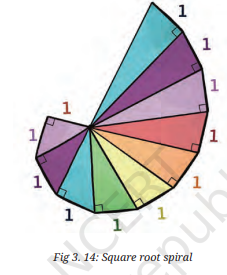
Find the lengths of the hypotenuses of all the right triangles in Fig. 3.14 which is referred to as the square root spiral.
NCERT Solutions for Class 9 Ganita Manjari Chapter 3 The World of Numbers
