
NCERT Solutions for Class 9 Science Chapter 2 The Building Blocks of Life
Thank you for reading this post, don't forget to subscribe!
Table of Contents
Page No. 8
Think It Over
Question 1:
Where does a cell come from?
कोशिका कहाँ से आती है?
Answer
According to the Cell Theory expanded by Rudolf Virchow in 1855, all cells arise from pre-existing cells. This means that cells do not appear out of nowhere; they are formed through the process of cell division from cells that already exist.
1855 में Rudolf Virchow द्वारा विस्तारित कोशिका सिद्धांत के अनुसार, सभी कोशिकाएँ पहले से मौजूद कोशिकाओं से उत्पन्न होती हैं। इसका अर्थ है कि कोशिकाएँ अचानक अपने आप नहीं बनतीं, बल्कि वे पहले से मौजूद कोशिकाओं के विभाजन की प्रक्रिया द्वारा बनती हैं।
Question 2:
How have technological interventions facilitated the creation of new knowledge in understanding the world beyond the naked eye?
तकनीकी हस्तक्षेपों ने नग्न आँखों से परे दुनिया को समझने में नए ज्ञान के निर्माण को कैसे आसान बनाया है?
Answer
Technology has played a huge role in studying tiny structures like cells:
(1) The invention of the microscope allowed scientists to see cells for the first time.
(2) Advanced microscopes (like electron microscopes) show detailed structures inside cells.
(3) Techniques like staining, imaging, and digital analysis help scientists observe cell functions clearly.
Because of these tools, we now understand things like cell structure, microorganisms, and how diseases work.
कोशिकाओं जैसी सूक्ष्म संरचनाओं का अध्ययन करने में तकनीक ने बहुत महत्वपूर्ण भूमिका निभाई है:
(1) सूक्ष्मदर्शी के आविष्कार ने वैज्ञानिकों को पहली बार कोशिकाओं को देखने में सक्षम बनाया।
(2) उन्नत सूक्ष्मदर्शी (जैसे इलेक्ट्रॉन माइक्रोस्कोप) कोशिकाओं के अंदर की संरचनाओं को विस्तार से दिखाते हैं।
(3) रंगाई, इमेजिंग और डिजिटल विश्लेषण जैसी तकनीकें वैज्ञानिकों को कोशिकाओं के कार्यों को स्पष्ट रूप से देखने में मदद करती हैं।
इन उपकरणों की वजह से आज हम कोशिका संरचना, सूक्ष्मजीवों और बीमारियों के कार्य करने के तरीके जैसी चीजों को समझ पाए हैं।
Question 3:
How is the cell structural and functional unit of life?
कोशिका जीवन की संरचनात्मक और क्रियात्मक इकाई कैसे है?
Answer
A cell is called the structural and functional unit of life because:
(1) Structural unit: All living organisms are made up of cells (from single-celled organisms to complex multicellular ones like humans).
(2) Functional unit: All life processes (like respiration, digestion, excretion, growth) occur inside cells.
So, cells are the basic building blocks that perform all essential functions of life.
कोशिका को जीवन की संरचनात्मक और क्रियात्मक इकाई कहा जाता है क्योंकि:
(1) संरचनात्मक इकाई: सभी जीवित जीव कोशिकाओं से बने होते हैं (एककोशिकीय जीवों से लेकर मनुष्यों जैसे जटिल बहुकोशिकीय जीवों तक)।
(2) क्रियात्मक इकाई: सभी जीवन प्रक्रियाएँ (जैसे श्वसन, पाचन, उत्सर्जन और वृद्धि) कोशिकाओं के अंदर होती हैं।
इसलिए, कोशिकाएँ जीवन की मूल निर्माण इकाइयाँ हैं जो सभी आवश्यक कार्य करती हैं।
Question 4:
How does a cell multiply?
कोशिका कैसे गुणित होती है?
Answer
Cells multiply through a process called cell division. There are two main types:
(1) Mitosis:
\(\quad\quad\quad\) a. Produces two identical daughter cells
\(\quad\quad\quad\) b. Helps in growth and repair
(2) Meiosis:
\(\quad\quad\quad\) a. Produces cells with half the number of chromosomes.
\(\quad\quad\quad\) b. Important for reproduction (formation of gametes like sperm and egg).
In simple terms, one cell divides to form two new cells.
कोशिकाएँ कोशिका विभाजन नामक प्रक्रिया द्वारा गुणित होती हैं। इसके दो मुख्य प्रकार हैं:
- माइटोसिस (Mitosis):
a. यह दो समान पुत्री कोशिकाएँ बनाता है।
b. यह वृद्धि और मरम्मत में सहायता करता है। - मीयोसिस (Meiosis):
a. यह आधी संख्या वाले गुणसूत्रों वाली कोशिकाएँ बनाता है।
b. यह प्रजनन के लिए महत्वपूर्ण है (शुक्राणु और अंडाणु जैसे युग्मकों के निर्माण में)।
सरल शब्दों में, एक कोशिका विभाजित होकर दो नई कोशिकाएँ बनाती है।
NCERT Solutions for Class 9 Science Chapter 2 The Building Blocks of Life
Page No. 14
Pause and Ponder
Question 1:
What argument would you give for the necessity of a cell wall in plants usually fixed in one place versus in animals usually moving from one place to the other?
एक ही स्थान पर स्थिर रहने वाले पौधों में कोशिका भित्ति की आवश्यकता के पक्ष में आप क्या तर्क देंगे, जबकि जानवर सामान्यतः एक स्थान से दूसरे स्थान तक चलते-फिरते हैं?
Answer
Plant cells usually remain fixed in one place, so they need extra support and protection. The cell wall provides:
(1) Rigidity and strength to maintain shape
(2) Protection from mechanical damage
(3) Ability to withstand internal pressure (turgor pressure) without bursting
In contrast, animal cells:
(1) Move from place to place
(2) Need flexibility, not rigidity
So, they only have a cell membrane, which allows movement and shape change.
पौधों की कोशिकाएँ सामान्यतः एक ही स्थान पर स्थिर रहती हैं, इसलिए उन्हें अतिरिक्त सहारा और सुरक्षा की आवश्यकता होती है। कोशिका भित्ति निम्नलिखित कार्य करती है:
(1) आकार बनाए रखने के लिए कठोरता और मजबूती प्रदान करती है।
(2) यांत्रिक क्षति से सुरक्षा देती है।
(3) आंतरिक दाब (टर्गर दाब) को सहन करने की क्षमता देती है, जिससे कोशिका फटती नहीं है।
इसके विपरीत, पशु कोशिकाएँ:
(1) एक स्थान से दूसरे स्थान तक गतिशील रहती हैं।
(2) उन्हें कठोरता नहीं, बल्कि लचीलापन चाहिए होता है।
इसलिए, उनमें केवल कोशिका झिल्ली होती है, जो गति और आकार परिवर्तन की अनुमति देती है।
Question 2:
Why is it important to cut the two potato pieces in roughly equal size and measure their initial weight before placing them in different liquids?
दो आलू के टुकड़ों को लगभग समान आकार में काटना और उन्हें अलग-अलग द्रवों में रखने से पहले उनका प्रारम्भिक भार मापना क्यों महत्वपूर्ण है?
Answer
This is important for a fair experiment:
(1) Equal size ensures same surface area and volume, so both pieces absorb or lose water similarly.
(2) Measuring initial weight helps compare accurate changes after osmosis.
(3) It ensures that any weight change is due to the liquid, not size differences
Without this, the results would not be reliable.
यह एक निष्पक्ष प्रयोग के लिए महत्वपूर्ण है:
(1) समान आकार यह सुनिश्चित करता है कि दोनों आलू के टुकड़ों का सतही क्षेत्रफल और आयतन समान हो, जिससे वे समान रूप से पानी को अवशोषित करें या खोएँ।
(2) प्रारम्भिक भार मापने से परासरण के बाद होने वाले वास्तविक परिवर्तन की सही तुलना की जा सकती है।
(3) इससे यह सुनिश्चित होता है कि भार में परिवर्तन द्रव के कारण हुआ है, न कि आकार के अंतर के कारण।
इसके बिना, प्रयोग के परिणाम विश्वसनीय नहीं होंगे।
Question 3:
What consequences would you predict for a plant cell if its cell wall were to become as flexible as a cell membrane?
यदि किसी पादप कोशिका की कोशिका भित्ति कोशिका झिल्ली जितनी लचीली हो जाए, तो आप क्या परिणाम होने की भविष्यवाणी करेंगे?
Answer
If the cell wall lost its rigidity:
(1) The cell would lose its fixed shape.
(2) It could burst easily due to water entering (osmotic pressure)
(3) The plant would lose support and strength, becoming weak or wilted
(4) Overall, plants would not be able to stand upright.
So, the rigid cell wall is essential for plant survival and structure.
यदि कोशिका भित्ति अपनी कठोरता खो दे:
(1) कोशिका अपना निश्चित आकार खो देगी।
(2) पानी के प्रवेश (परासरण दाब ) के कारण कोशिका आसानी से फट सकती है।
(3) पौधा अपना सहारा और मजबूती खो देगा तथा कमजोर या मुरझाया हुआ दिखाई देगा।
(4) कुल मिलाकर, पौधे सीधे खड़े नहीं रह पाएँगे।
इसलिए, कठोर कोशिका भित्ति पौधों के जीवित रहने और उनकी संरचना के लिए अत्यंत आवश्यक है।
NCERT Solutions for Class 9 Science Chapter 2 The Building Blocks of Life
Page No. 19
Pause and Ponder
Question 4:
Do white flowers contain any pigment? Give reasons.
क्या सफेद फूलों में कोई वर्णक (पिगमेंट) होता है? कारण बताइए।
Answer
White flowers generally lack colored pigments like anthocyanins. Instead, they contain many air spaces between cells that reflect all wavelengths of light, making them appear white.
सफेद फूलों में सामान्यतः एन्थोसाइनिन जैसे रंगीन वर्णक नहीं होते हैं। इसके बजाय, उनकी कोशिकाओं के बीच बहुत से वायु-स्थान होते हैं, जो प्रकाश की सभी तरंगदैर्घ्यों को परावर्तित करते हैं। इसी कारण वे सफेद दिखाई देते हैं।
Question 5:
Draw a well-labelled schematic diagram of a plant or an animal cell using these clues —
(i) Nucleus appears as a dark and round body inside the cell.
(ii) ER spreads like a network of extended nuclear envelope.
(iii) Mitochondria and chloroplasts are rod shaped.
इन संकेतों की सहायता से पादप कोशिका या जन्तु कोशिका का एक सुव्यवस्थित एवं नामांकित रेखाचित्र बनाइए—
(i) केंद्रक कोशिका के अंदर गहरे रंग की गोलाकार संरचना के रूप में दिखाई देता है।
(ii) एंडोप्लाज़्मिक रेटिकुलम (ER) केंद्रकीय झिल्ली के विस्तारित जाल की तरह फैला होता है।
(iii) माइटोकॉन्ड्रिया तथा हरितलवक छड़ (rod) के आकार के होते हैं।
Answer
NCERT Solutions for Class 9 Science Chapter 2 The Building Blocks of Life
Page No. 22
Pause and Ponder
Question 6:
Instead of many small ones, why does a cell not have a single giant mitochondrion? How does this relate to the concept of surface area?
कोशिका में एक बहुत बड़े माइटोकॉन्ड्रिया के बजाय कई छोटे माइटोकॉन्ड्रिया क्यों होते हैं? यह सतह क्षेत्रफल की अवधारणा से कैसे संबंधित है?
Answer
Having many small mitochondria instead of one giant one increases the total surface area of the inner mitochondrial membrane. This provides more space for chemical reactions to occur, enhancing energy production (ATP). Smaller organelles also ensure efficient transport and distribution of energy across different parts of the cytoplasm, which a single giant structure could not manage effectively.
एक बड़े माइटोकॉन्ड्रिया की बजाय अनेक छोटे माइटोकॉन्ड्रिया होने से आंतरिक माइटोकॉन्ड्रियल झिल्ली का कुल सतह क्षेत्रफल बढ़ जाता है। इससे रासायनिक अभिक्रियाओं के होने के लिए अधिक स्थान उपलब्ध होता है, जिससे ऊर्जा (ATP) का उत्पादन अधिक प्रभावी ढंग से होता है।
छोटे कोशिकांग कोशिका द्रव्य के विभिन्न भागों में ऊर्जा के कुशल परिवहन और वितरण में भी सहायता करते हैं, जबकि एक बहुत बड़ी संरचना यह कार्य प्रभावी रूप से नहीं कर सकती।
NCERT Solutions for Class 9 Science Chapter 2 The Building Blocks of Life
Question 7:
If the skin cells start dividing by meiosis instead of mitosis, what do you think will happen to a cut on the skin?
यदि त्वचा की कोशिकाएँ समसूत्री विभाजन के बजाय अर्धसूत्री विभाजन करने लगें, तो त्वचा पर लगे कट का क्या होगा?
Answer
If skin cells divided by meiosis, the cut would not heal. Mitosis produces identical cells for growth and repair, whereas meiosis halves the chromosome number. This would result in genetically different, non-functional cells, failing to restore the skin’s structural integrity.
यदि त्वचा की कोशिकाएँ अर्धसूत्री विभाजन करने लगें, तो कट ठीक नहीं होगा। समसूत्री विभाजन वृद्धि और मरम्मत के लिए समान कोशिकाएँ बनाता है, जबकि अर्धसूत्री विभाजन में गुणसूत्रों की संख्या आधी हो जाती है।
इसके परिणामस्वरूप आनुवंशिक रूप से भिन्न और कार्यहीन कोशिकाएँ बनेंगी, जो त्वचा की संरचनात्मक अखंडता को पुनः स्थापित नहीं कर पाएँगी।
NCERT Solutions for Class 9 Science Chapter 2 The Building Blocks of Life
Page No, 24
Revise, Reflect, Refine
Question 1:
Differentiate between the following pairs of terms based on the clues given in parentheses:
(i) Cell membrane and cell wall (permeability)
(ii) RER and SER (structure)
(iii) Chloroplasts and chromoplasts (pigments)
निम्नलिखित शब्द-युग्मों में कोष्ठकों में दिए गए संकेतों के आधार पर अंतर स्पष्ट कीजिए—
(i) कोशिका झिल्ली तथा कोशिका भित्ति — (पारगम्यता)
(ii) खुरदुरा एंडोप्लाज़्मिक रेटिकुलम (RER) तथा चिकना एंडोप्लाज़्मिक रेटिकुलम (SER) — (संरचना)
(iii) हरितलवक तथा वर्णलवक — (वर्णक / Pigments)
Answer
(i) Cell membrane and cell wall: The cell membrane is selectively permeable, allowing only specific substances to pass through, whereas the cell wall is completely permeable, allowing various substances in solution to pass through freely.
(ii) RER and SER: Rough Endoplasmic Reticulum (RER) has a rough appearance because ribosomes are attached to its surface, while Smooth Endoplasmic Reticulum (SER) lacks ribosomes and appears smooth.
(iii) Chloroplasts and chromoplasts: Chloroplasts contain the green pigment chlorophyll (essential for photosynthesis), while chromoplasts contain non-green pigments like yellow or orange, which give color to flowers and fruits.
(i) कोशिका झिल्ली तथा कोशिका भित्ति:
कोशिका झिल्ली चयनात्मक पारगम्य होती है, अर्थात यह केवल विशेष पदार्थों को ही अपने आर-पार जाने देती है, जबकि कोशिका भित्ति पूर्णतः पारगम्य होती है और विलयन में उपस्थित विभिन्न पदार्थों को स्वतंत्र रूप से गुजरने देती है।
(ii) RER तथा SER:
खुरदुरा एंडोप्लाज़्मिक रेटिकुलम (RER) की सतह पर राइबोसोम जुड़े होने के कारण यह खुरदुरा दिखाई देता है, जबकि चिकना एंडोप्लाज़्मिक रेटिकुलम (SER) पर राइबोसोम नहीं होते, इसलिए यह चिकना दिखाई देता है।
(iii) हरितलवक तथा वर्णलवक:
हरितलवक में हरा वर्णक क्लोरोफिल पाया जाता है, जो प्रकाश-संश्लेषण के लिए आवश्यक है, जबकि वर्णलवक में पीले, नारंगी आदि गैर-हरे वर्णक पाए जाते हैं, जो फूलों और फलों को रंग प्रदान करते हैं।
NCERT Solutions for Class 9 Science Chapter 2 The Building Blocks of Life
Question 2:
Two similar animal cells are placed in two different solutions:
(i) Cell X is placed in pure water.
(ii) Cell Y is placed in a concentrated salt solution
Cells are observed after some time. Cell X swells, and Cell Y shrinks.
Which statement provides the correct explanation for the above observations?
(i) Salt molecules moved into Cell Y, causing it to shrink.
(ii) Water moved into Cell X and more water moved out of Cell Y than the salt solution entered in it.
(iii) Water moved into Cell X and moved out of Cell Y through the cell membrane.
(iv) Solute movement caused osmosis in both cells.
दो समान पशु कोशिकाओं को दो अलग-अलग विलयों में रखा गया है:
(i) कोशिका X को शुद्ध जल में रखा गया है।
(ii) कोशिका Y को सान्द्र (गाढ़े) नमक के विलयन में रखा गया है।
कुछ समय बाद कोशिकाओं का अवलोकन किया गया। कोशिका X फूल जाती है, जबकि कोशिका Y सिकुड़ जाती है।
उपरोक्त प्रेक्षणों के लिए कौन-सा कथन सही व्याख्या प्रदान करता है?
(i) नमक के अणु कोशिका Y के अंदर चले गए, जिससे वह सिकुड़ गई।
(ii) जल कोशिका X के अंदर गया और कोशिका Y से उतना जल बाहर निकल गया जितना नमक का विलयन उसके अंदर नहीं गया।
(iii) जल कोशिका X के अंदर गया और कोशिका झिल्ली के माध्यम से कोशिका Y से बाहर निकल गया।
(iv) विलेय की गति के कारण दोनों कोशिकाओं में परासरण हुआ।
Answer
The correct explanation is statement (iii). In pure water (hypotonic), water moves into Cell X through osmosis, causing it to swell. In a concentrated salt solution (hypertonic), water moves out of Cell Y, causing it to shrink.
सही व्याख्या कथन (iii) है। शुद्ध जल (हाइपोटोनिक विलयन) में जल परासरण के माध्यम से कोशिका X के अंदर प्रवेश करता है, जिससे वह फूल जाती है। सान्द्र नमक के विलयन (हाइपरटोनिक विलयन) में जल कोशिका Y से बाहर निकल जाता है, जिससे वह सिकुड़ जाती है।
NCERT Solutions for Class 9 Science Chapter 2 The Building Blocks of Life
Question 3:
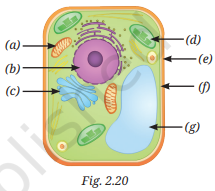
Look at the diagram of a cell in Fig. 2.20. Identify the parts labelled from (a) to (g) and correctly match them with their functions given below:
(i) Controlling all the activities of a cell.
(ii) Site of cellular respiration.
(iii) Storage organelle that also provides rigidity to the cell.
(iv) Separates the cell contents from surroundings.
(v) Provides structural rigidity to the cell.
(vi) Packs and stores materials received from ER.
(vii) Helps in manufacturing food.
चित्र 2.20 में दर्शाई गई कोशिका का अवलोकन कीजिए। (a) से (g) तक चिन्हित भागों की पहचान कीजिए तथा उन्हें नीचे दिए गए कार्यों से सही प्रकार मिलाइए—
(i) कोशिका की सभी क्रियाओं का नियंत्रण करना।
(ii) कोशिकीय श्वसन का स्थान।
(iii) भंडारण कोशिकांग, जो कोशिका को दृढ़ता भी प्रदान करता है।
(iv) कोशिका की सामग्री को बाहरी वातावरण से अलग करना।
(v) कोशिका को संरचनात्मक दृढ़ता प्रदान करना।
(vi) ER से प्राप्त पदार्थों को पैक और संग्रहित करना।
(vii) भोजन निर्माण में सहायता करना।
Solution
| Label | Organelle | Function Match | Description of Function |
| (a) | Cell Wall | (v) | Provides structural rigidity and protection to the cell. |
| (b) | Cell Membrane | (iv) | Separates the cell contents from the surroundings; regulates entry/exit. |
| (c) | Chloroplast | (vii) | Contains chlorophyll and helps in manufacturing food (photosynthesis). |
| (d) | Mitochondrion | (ii) | Known as the powerhouse; it is the site of cellular respiration. |
| (e) | Golgi Apparatus | (vi) | Modifies, packs, and stores materials received from the ER. |
| (f) | Nucleus | (i) | The control center that coordinates all the activities of the cell. |
| (g) | Vacuole | (iii) | Large storage organelle that provides turgidity and rigidity to the cell. |
| लेबल | कोशिकांग | कार्य का मिलान | कार्य का विवरण |
|---|---|---|---|
| (a) | कोशिका भित्ति | (v) | कोशिका को संरचनात्मक दृढ़ता और सुरक्षा प्रदान करती है। |
| (b) | कोशिका झिल्ली | (iv) | कोशिका की सामग्री को बाहरी वातावरण से अलग करती है तथा पदार्थों के प्रवेश और निकास को नियंत्रित करती है। |
| (c) | हरितलवक | (vii) | इसमें क्लोरोफिल होता है और यह भोजन निर्माण (प्रकाश संश्लेषण) में सहायता करता है। |
| (d) | माइटोकॉन्ड्रिया | (ii) | इसे कोशिका का ऊर्जा-गृह कहा जाता है; यह कोशिकीय श्वसन का स्थान है। |
| (e) | गोल्जी उपकरण | (vi) | एंडोप्लाज्मिक रेटिकुलम (ER) से प्राप्त पदार्थों का संशोधन, पैकेजिंग और भंडारण करता है। |
| (f) | केंद्रक | (i) | कोशिका का नियंत्रण केंद्र, जो कोशिका की सभी गतिविधियों का समन्वय करता है। |
| (g) | रिक्तिका | (iii) | एक बड़ा भंडारण कोशिकांग, जो कोशिका को स्फीति और दृढ़ता प्रदान करता है। |
Question 4:
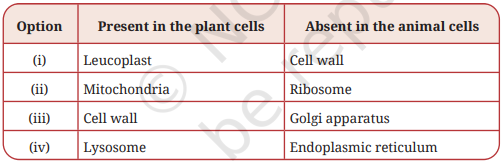
Which of the following option (s) of the pairs of cell organelles are correctly placed under the given categories?
निम्नलिखित विकल्पों में से कौन-सा (कौन-से) विकल्प कोशिकांगों के युग्मों को दी गई श्रेणियों के अंतर्गत सही रूप से दर्शाते हैं?
Answer
The correctly matched options are:
(i) Nucleus & Mitochondria: Both contain their own genetic material (DNA).
(iii) Ribosomes & Centrosomes: Both are organelles that lack a surrounding membrane.
Options (ii) and (iv) are incorrect because lysosomes have a single membrane, and chloroplasts have a double membrane.
सही रूप से मेल खाने वाले विकल्प हैं:
(i) केंद्रक और माइटोकॉन्ड्रिया: दोनों में अपना स्वयं का आनुवंशिक पदार्थ (DNA) होता है।
(iii) राइबोसोम और सेंट्रोसोम: दोनों ऐसे कोशिकांग हैं जिनके चारों ओर कोई झिल्ली नहीं होती।
विकल्प (ii) और (iv) गलत हैं, क्योंकि लाइसोसोम एकल झिल्ली से घिरे होते हैं, जबकि हरितलवक द्वि-झिल्ली से घिरे होते हैं।
Question 5:
Two students, Renu and Rohit, were having a discussion on the plastids. Renu emphasised that all parts of the plants, even roots, contain plastids. However, Rohit did not agree with the statement and told her that plastids are absent in plant roots since the roots are underground and do not need to perform photosynthesis. Who is correct? Justify your answer
Answer
Renu is correct. While chloroplasts for photosynthesis are absent in roots, they contain other plastids called leucoplasts. These colorless organelles are primarily used for storage, such as amyloplasts that store starch in root cells like those of a potato or carrot.
Question 6:
Mitochondria and chloroplasts are two important organelles in a plant cell. Discuss how these two organelles are structurally and functionally similar to each other, and different from each other.
Answer
(1) Similarities: Both are double-membrane-bound organelles, contain their own DNA and ribosomes, and are involved in energy transformation.
(ii) Differences: Mitochondria (site of cellular respiration) break down food to release energy (ATP) and are found in both plants and animals. Chloroplasts (site of photosynthesis) use sunlight to manufacture food and are unique to plant cells.
Question 7:
Which of the following pairs of cell organelles contains DNA?
(i) Chloroplasts, Ribosomes
(ii) Mitochondria, Nucleus
(iii) Golgi bodies, Ribosomes
(iv) Nucleus, Lysosomes
Answer
The correct option is (ii) Mitochondria, Nucleus.
Question 8:
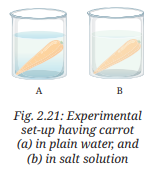
A researcher carried out an experiment in which she took two carrots of similar size. She placed one carrot in plain water and the other carrot in concentrated salt solution (Fig. 2.21). After 24 hours she recorded her observations.
(i) What hypothesis does she want to test through this experiment?
(ii) What would you suggest for the improvement of this experiment?
(iii) Why does the carrot in plain water stay stiff and crunchy, but the carrot in concentrated salt solution become rubbery and limp?
Answer
(i) Hypothesis being tested
The experiment tests if water moves across a semi-permeable cell membrane based on surrounding concentration gradients (osmosis).
(ii) Suggested improvements
– Measure and compare the initial and final weight/volume of the carrots.
– Include a control setup with a carrot placed in an isotonic solution.
(iii) Reason for physical changes
Carrot B (Salt solution): Placed in a hypertonic medium, water exits the cells via exosmosis, leading to plasmolysis which makes it rubbery and limp.
Carrot A (Plain water): Placed in a hypotonic medium, water enters the cells via endosmosis, creating turgor pressure that keeps it stiff.
Question 9:
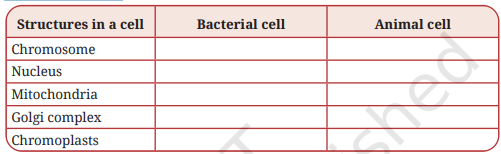
Indicate the presence or absence of following structures in bacterial and animal cells:
Answer
| Structures in a cell | Bacterial cell | Animal cell |
| Chromosome | Present (Single, circular) | Present (Multiple, linear) |
| Nucleus | Absent (Has an undefined nucleoid) | Present (Well-defined with nuclear membrane) |
| Mitochondria | Absent | Present |
| Golgi complex | Absent | Present |
| Chromoplasts | Absent | Absent (Found only in plant cells) |
NCERT Solutions for Class 9 Science Chapter 2 The Building Blocks of Life
Question 10:
Carry out the following experiment:
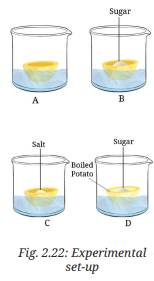
Take four peeled potato halves and scoop each one out to make potato cups. One of these potato cups should be made from a boiled potato. Place each of the potato cups in a beaker containing water (Fig. 2.22).
Now, set up the experiment as follows:
(a) Keep Cup A empty.
(b) Add one teaspoon sugar in Cup B.
(c) Add one teaspoon salt in Cup C.
(d) Add one teaspoon sugar in the boiled potato in Cup D.
Observe the four potato cups at least two hours and answer the following questions:
(i) Explain why water gathers in the hollowed portion of Cup B and Cup C.
(ii) Why is Cup A necessary for this experiment?
(iii) Explain why water does not gather in the hollowed portions of Cups A and D.
Answer
(i) Water gathers due to osmosis. Adding sugar to Cup B and salt to Cup C creates a hypertonic environment (lower water concentration) inside the hollowed cavity compared to the water outside. Water moves from the beaker through the living potato cells into the cavity.
(ii) Cup A serves as a control experiment. It demonstrates that water does not move or gather on its own without a concentration gradient, proving that the accumulation of water in Cups B and C is specifically caused by the solute (sugar/salt).
(iii) Cup A: Lacks a solute gradient, so no osmosis occurs.
Cup D: Boiled potato cells are dead, destroying the semi-permeability of the cell membranes. Consequently, osmosis cannot take place despite the presence of sugar.
NCERT Solutions for Class 9 Science Chapter 2 The Building Blocks of Life
Question 11:
Identify the pair that incorrectly matches the cell organelle with its function.
(i) Ribosome — Protein synthesis
(ii) SER — Lipid and cellulose synthesis
(iii) Lysosome — Digestion of foreign agents
Answer
The pair that is incorrectly matched is (ii) SER — Lipid and cellulose synthesis.
NCERT Solutions for Class 9 Science Chapter 2 The Building Blocks of Life
Question 12:
What outcome do you expect, if all the mitochondria are removed from a eukaryotic cell?
Answer
If all mitochondria are removed from a eukaryotic cell, its energy production will drastically drop. The cell will fail to perform aerobic respiration and cannot synthesize adequate ATP required for vital cellular processes. Consequently, active transport, metabolic reactions, and protein synthesis will cease, ultimately leading to cellular starvation and programmed cell death (apoptosis).
NCERT Solutions for Class 9 Science Chapter 2 The Building Blocks of Life
Question 13:
Which phenomenon inhibits the formation of tumors in the human body? Can plants also develop tumors? Explain.
Answer
Contact inhibition is the phenomenon that inhibits tumor formation. Normal cells exhibit this property, where contact with neighboring cells stalls their uncontrolled proliferation. Cancer cells lose this characteristic, leading to continuous division and tumor development.
Yes, plants can develop tumors, often called galls. They are typically triggered by bacterial infections (like Agrobacterium tumefaciens), viral attacks, or insect damage, leading to uncontrolled, localized cell division.
NCERT Solutions for Class 9 Science Chapter 2 The Building Blocks of Life
Question 14:
The cell membrane of a cell is made up of proteins and lipids. Which cell organelles help in the synthesis of cell membrane? Write the path of these compounds from their site of synthesis to the cell membrane and show this through a labelled diagram.
Answer
The Rough Endoplasmic Reticulum (RER) synthesizes proteins, while the Smooth Endoplasmic Reticulum (SER) synthesizes lipids.
Path:
Synthesized lipids and proteins \(\rightarrow\) Endoplasmic Reticulum \(\rightarrow\)Transport vesicles \(\rightarrow\) Golgi apparatus (for modification and packaging) \(\rightarrow\)Secretory vesicles \(\rightarrow\) Cell Membrane (this process is called membrane biogenesis).
NCERT Solutions for Class 9 Science Chapter 2 The Building Blocks of Life
Question 15:
What would happen if gametes are formed by mitotic divisions?
Answer
If gametes were formed by mitotic division, they would remain diploid (2n) instead of becoming haploid (n). During fertilization, the fusion of these diploid gametes would double the chromosome number in the zygote (4n). This doubling would accumulate exponentially with each generation, disrupting genetic stability and making it impossible to maintain the specific chromosome number of a species.
NCERT Solutions for Class 9 Science Chapter 2 The Building Blocks of Life
Question 16:
A farmer, Deepa, was very happy with the harvest of amla (Indian Gooseberry) and lemons on her farm. However, she could sell only one-fourth of the produce in the local market. Recognising that a significant amount of produce may be lost post-harvest, she employed a traditional yet scientifically sound method to extend the shelf life of amla and lemons. She turned perishable produce into profitable products, such as pickles and sharbat. She used the excess produce to prepare pickles, murabbas, and sharbat by adding appropriate amounts of salt, sugar,
or jaggery to small pieces of fruit and their juices. These were then stored in small glass bottles for sale, helping her prevent the wastage of post-harvest produce. This shift from farming to agro-processing would strengthen food security and boost the local economy, creating a sustainable model that cuts waste while increasing her income. Based on the above passage, answer the following questions:
(i) Which scientific concept has the farmer applied in the preservation of the farm produce?
(ii) How does the addition of high concentrations of salt and sugar create an environment that prevents the growth of spoilage-causing bacteria and fungi?
(iii) Suggest a healthy recipe of this kind for food preservation.
(iv) What are the scientific values addressed in this case?
Answer
(i) The farmer has applied the scientific concept of osmosis (specifically exosmosis leading to plasmolysis) for food preservation.
(ii) High concentrations of salt (in pickles) or sugar/jaggery (in murabbas and sharbat) create a highly hypertonic environment outside any microbial cells. When spoilage-causing bacteria or fungi come into contact with these preserves, water moves out of the microbial cells into the concentrated surrounding medium via osmosis. This causes the microbial cells to lose water, shrink (plasmolyse), and ultimately die or become inactive, preventing food spoilage.
(iii) Healthy Amla Murabba (Using Jaggery):
(a) Storage: Allow it to cool and store it in clean, airtight glass bottles. The high concentration of jaggery acts as a natural preservative while retaining the high Vitamin C content of amla.
(b) Preparation: Wash fresh amla fruits, prick them thoroughly with a fork, and steam them until they soften slightly.
(c) Preservation: Instead of refined sugar, mix the steamed amla with an equal amount of organic jaggery powder in a pan.
(d) Cooking: Heat the mixture gently until the jaggery melts completely into a thick syrup and coats the amlas.
NCERT Solutions for Class 9 Science Chapter 2 The Building Blocks of Life
