
NCERT Solutions for Class 9 Kaveri Chapet 2 The Pot Makker
Word-Meanings of Class 9 Kaveri Chapter 2 The Pot Maker
Thank you for reading this post, don't forget to subscribe!
Summary of Class 9 Kaveri Chapter 2 The Pot Maker
Important Questions for Class 9 Chapter 2 The Pot Maker

Table of Contents
Page No. 37 Check Your Understanding
Question I:
Do you think pot making is easy? If yes, why? If no, why not?
Answer
No, pot making is not easy because it requires a lot of hard work, patience, and skill. The potters have to collect clay from far away, knead and shape it carefully, dry the pots, and then bake them in a kiln. It is also tiring and time-consuming.
Question II:
Would Sentila be able to fulfil her dream of becoming a pot maker? Explain.
Answer
Yes, Sentila would be able to fulfil her dream because she was very interested in pottery and eager to learn it. She regularly visited the potters, observed their work carefully, and practised the skill. In the end, the village council also supported the idea of teaching her pottery.
Question III:
Do you think Mesoba and Arenla would support Sentila? Give a reason.
Answer
Yes, Mesoba and Arenla would support Sentila because they understood that pottery was an important traditional art that should be passed on to the next generation. They also realized that Sentila truly loved pot making and was talented in it.
NCERT Solutions for Class 9 Kaveri Chapet 2 The Pot Makker
Question I:
Do you think Onula’s support helped Sentila? If yes, why? If no, why not?
Answer
Yes, Onula’s support was crucial. Her warmth removed Sentila’s anxiety, boosting her confidence. Instead of criticizing, Onula offered patient guidance and constructively redirected Sentila to observe her mother’s specific techniques, successfully rebuilding her broken learning process.
Question II:
Sentila observes her mother making pots. What does this tell us about her?
Answer
This shows Sentila is deeply resilient, highly observant, and a keen learner. Instead of giving up after a year of failure, she minutely analyzed her mother’s hand movements and rhythm, proving her dedication and latent talent.
Question III:
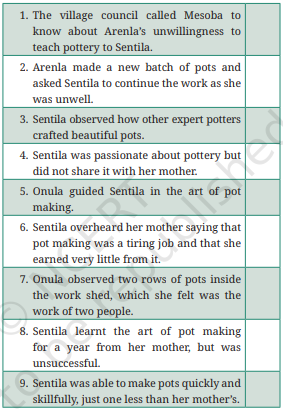
Arrange the following events of the story in the correct sequence. Share your answer with your classmates and teacher.
NCERT Solutions for Class 9 Kaveri Chapet 2 The Pot Makker
Critical Reflection
I Read the extracts given below and answer the questions that follow.
- Pounding the stubborn clay inside bamboo cylinders to soften it, is also tedious. So many times I’ve dropped the mould out of sheer exhaustion and have had to start all over again. It takes months to bring out a batch of pots after so much labour. And the reward?
A few rupees. But if Sentila learns weaving, she can make much more money besides providing enough cloth for the family. Weaving is not messy like pot making and can be done indoors in all seasons. Also, the time spent on weaving one shawl is much less and the return is handsome.
(i) Choose the correct reason for the given assertion.
(A): The effort in making pots is far greater than the returns.
A. The process of pot making is quite tiresome and long, and one hardly earns much.
B. The process of pot making is exhausting, takes a long time, yet gives a sense of satisfaction.
Answer
A. The process of pot making is quite tiresome and long, and one hardly earns much.
(ii) Why does Arenla want Sentila to learn weaving?
Answer
Arenla wants Sentila to learn weaving because it pays much better, provides enough cloth for the family, is a clean process that can be done indoors in all seasons, and takes far less time than pot making for a lucrative return.
(iii) State one advantage that weaving has over pot making, as per the extract.
Answer
Weaving is not messy like pot making and can be done indoors during all seasons.
(iv) Choose the sentence that uses the word ‘handsome’ in the same way as in the extract.
A. My father is a handsome man.
B. They will make a handsome profit selling this property.
Answer
B. They will make a handsome profit selling this property.
(v) ‘And the reward?’ What is the author’s purpose of using a question mark here?
Answer
The author uses a question mark to create a rhetorical question that emphasizes how shockingly low, disappointing, and inadequate the financial income is compared to the immense physical labour put into the work. - Onula saw her taking out some clay and the implements from her basket quietly. She watched Sentila’s clumsy efforts to make a pot and noticed that Sentila was too tense. As a result, the clay seemed unable or unwilling to yield the right shape. When Sentila wearily let the misshapen lump fall flat on the ground, Onula went to her and said, “Don’t worry, little one, I shall teach you how to make a perfect pot.” Sentila watched in amazement as Onula fashioned a beautiful pot and asked her to try again.
(i) Complete the sentence with an appropriate reason.
Onula feels Sentila’s effort at making a pot is clumsy because _______.
Answer
Onula feels Sentila’s effort at making a pot is clumsy because Sentila is too tense and anxious, which prevents her from holding the clay properly and causes it to lose its right shape.
(ii) Choose the correct option to complete the following sentence.
‘Don’t worry, little one, I shall teach you how to make a perfect pot.’
This shows that Onula was ________.
A. sincere and generous
B. forgiving and thoughtful
C. thoughtful and generous
D. forgiving and sincere
Answer
C. thoughtful and generous
(iii) Which among the following is the effect of a cause?
A. As a result, the clay seemed unable or unwilling to yield the right shape.
B. Onula saw her taking out some clay and the implements from her basket quietly.
Answer
A. As a result, the clay seemed unable or unwilling to yield the right shape.
(iv) ‘Onula fashioned a beautiful pot.’ Here, the word ‘fashioned’ means _________. (created/styled)
Answer
created
(v) How might Sentila have felt when she saw ‘the misshapen lump fall flat on the ground’?
Answer
Sentila must have felt deeply frustrated, ashamed, exhausted, and heartbroken, feeling as though she was an absolute failure who would never master her family’s traditional art. - Answer the following questions.
1. Describe the process of pot making followed by expert pot makers, as observed by Sentila.
Answer
As observed by Sentila, expert potters dig grey and red clay using a dao, soak it in a trough, and pound it inside a bamboo cylinder into malleable dough. While shaping, they skillfully use a wooden spatula, slacken their rhythm to fashion the mouth, and add an elongated strip to form a perfect rim.
2. What warning was given to Mesoba by the village council?
Answer
The village council summoned Mesoba because rumors spread that Arenla was refusing to teach her daughter pottery. The elders firmly warned him that traditional skills belong to the entire community’s history and lineage, not to any individual, and must be passed down to the next generation.
3. How did Sentila feel when she failed at pot making even after a year of training with her mother?
Answer
When Sentila failed at pot making even after a year of continuous practice, she felt deeply discouraged and was filled with an intense sense of shame and frustration. The pressure of her mother’s silent observation made her so anxious and tense that she could not even hold the lump of clay properly, leaving her feeling utterly helpless and heartbroken.
4. ‘Onula stood there for a long time as if trying to absorb a new phenomenon’. Explain.
Answer
This line highlights Onula’s disbelief upon discovering two identical rows of fresh pots inside the work shed. She stands captivated because the pots are so indistinguishable that they seem like the work of one spirit. It represents the miraculous, spiritual transfer of ancestral mastery from mother to daughter.
5. ‘The tradition and history of the people did not belong to any individual,’ what does this symbolise?
Answer
This lines symbolises that cultural heritage, art, and traditional skills are collective communal wealth rather than personal property. They transcend individual egos or family resistance. An artisan is merely a custodian of this legacy, which naturally finds its way to flow through the next generation to keep the community’s history alive.
6. What is the significance of the concluding line of the story, ‘A new pot maker was born’?
Answer
The concluding line signifies the triumphant continuation of cultural heritage and lineage. At the exact moment the old master, Arenla, passes away, her extraordinary skill seamlessly awakens within Sentila. It highlights that the ancestral art did not die; rather, a resilient new custodian has emerged to carry the legacy forward.
7. What is the role of perseverance in pursuing one’s dreams? Elaborate with reference to Sentila.
Answer
Perseverance is vital for success as it transforms continuous failure into eventual mastery. Despite facing her mother’s fierce resistance and experiencing a grueling year of absolute failure, Sentila never abandoned her dream. She persisted by practicing in secret, which ultimately allowed her to unlock her latent talent and become a master artisan.
NCERT Solutions for Class 9 Kaveri Chapet 2 The Pot Makker
