
NCERT Solutions for Class 9 Matha 2 Chapter 13: Two Variables, One Line
Table of Contents
Exercise Set 13.1
Question 1:
Write a linear equation in two variables in which a = 3, b = 0 and c = – \(\frac{1}{5}\).
दो चरों में एक रैखिक समीकरण लिखिए, जिसमें \(a = 3\), \(b = 0\) तथा \(c = -\frac{1}{5}\) हो।
Solution
The standard form of linear equation is ax + by + c = 0.
Using a = 3, b = 0 and c = –,
3x + 0(y) + = 0
3x – = 0
Hence, the required linear equation is 3x – = 0.
Question 2:
Complete the following table after expressing the given linear equations in standard form.
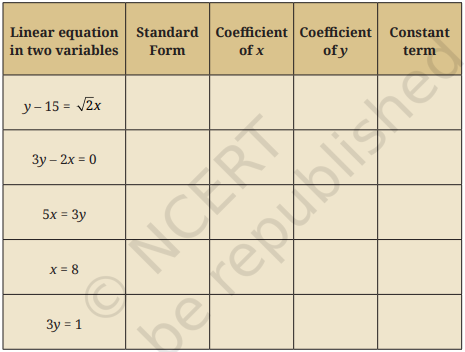
दिए गए रैखिक समीकरणों को मानक रूप में व्यक्त करने के बाद निम्नलिखित सारणी को पूरा कीजिए।
| दो चरों में रैखिक समीकरण | मानक रूप | \(x\) का गुणांक | \(y\) का गुणांक | अचर पद |
|---|---|---|---|---|
| \(y-15=\sqrt{2}x\) | ||||
| \(3y-2x=0\) | ||||
| \(5x=3y\) | ||||
| \(x=8\) | ||||
| \(3y=1\) |
Answer
(i) \(y-15=\sqrt{2}x\)
\(\quad\quad\quad\) Standard Form \(- \sqrt{2}x = y – 15\)
\(\quad\quad\quad\) Coefficent of x = – \(\sqrt{2}\)
\(\quad\quad\quad\) Coefficent of y = 1
\(\quad\quad\quad\) Constant Term = – 15
(ii) \(3y-2x=0\)
\(\quad\quad\quad\)
(iii) \(5x=3y\)
\(\quad\quad\quad\)
(iv) \(x=8\)
\(\quad\quad\quad\)
(v) \(3y=1\)
\(\quad\quad\quad\)
Question 3:
(i) The cost of a notebook is twice the cost of a pen. Consider the cost of a notebook to be ₹t and that of a pen to be ₹ p. Charlie wrote t = 2p, whereas Meera wrote p = 2t. Which of these two representations is correct?
(i) एक नोटबुक की कीमत एक पेन की कीमत से दोगुनी है। मान लीजिए कि नोटबुक की कीमत ₹\(t\) तथा पेन की कीमत ₹\(p\) है। चार्ली ने \(t = 2p\) लिखा, जबकि मीरा ने \(p = 2t\) लिखा। इन दोनों में से कौन-सा निरूपण सही है?
Answer
Let the cost of a notebook to be ₹t and that of a pen to be ₹p.
Since the cost of a notebook is twice the cost of a pen.
Therefore,
t = 2p
Hence, Charlie’s representation is correct.
(ii) In a one-day International Cricket match between India and Sri Lanka played in Nagpur, two Indian batsmen together scored 176 runs. Manisha expressed this situation as x + y = 176, where the number of runs scored by one batsman is x, and the number of runs scored by the other is y. Is this a correct representation?
(ii) नागपुर में भारत और श्रीलंका के बीच खेले गए एक दिवसीय अंतरराष्ट्रीय क्रिकेट मैच में भारत के दो बल्लेबाजों ने मिलकर कुल 176 रन बनाए। मनीषा ने इस स्थिति को \(x+y=176\) के रूप में व्यक्त किया, जहाँ एक बल्लेबाज द्वारा बनाए गए रनों की संख्या \(x\) तथा दूसरे बल्लेबाज द्वारा बनाए गए रनों की संख्या \(y\) है। क्या यह निरूपण सही है?
Answer
Let the number of runs scored by one batsman is x, and the number of runs scored by the other is y.
Since the two batsmen together scored 176 runs.
Therefore,
x + y = 176
Thus, x + y = 176 is the correct representation.
Exercise Set 13.2
Question 1:
Verify if the ordered pair (4, 3) is a solution of 5x – 6y = 2. Explain your reasoning.
जाँच कीजिए कि क्रमित युग्म \((4, 3)\), समीकरण \(5x-6y=2\) का हल है या नहीं। अपने उत्तर का कारण स्पष्ट कीजिए।
Solution
LHS = 5x – 6y and RHS = 2
For ordered pair (4, 3),
LHS = 5x – 6y = 5(4) – 6(3) = 20 –18 = 2 = RHS
Since LHS = RHS = 2
Therefore, (4, 3) is a solution of 5x − 6y = 2.
Question 2:
Find any two solutions for each of the following equations:
निम्नलिखित प्रत्येक समीकरण के कोई दो हल ज्ञात कीजिए:
(i) 7x – 3y = 21 (ii) 2x + 3y = 5
Answer
(i) We have, 7x – 3y = 21
Substituting x = 0 in the equation, we get
⇒ 7(0) – 3y = 21
⇒ – 3y = 21
⇒ y = –7
So, (0, –7) is a solution of the given equation.
Similarly, substituting y = 0 in the equation, we get
⇒ 7x – 3(0) = 21
⇒ 7x = 21
⇒ x = 3
Thus, (3, 0) is also a solution of the given equation.
(ii) 2x + 3y = 5
Substituting x = 0 in the equation, we get
⇒ 2(0) + 3y = 5
⇒ 3y = 5
⇒ y =
So, is a solution of the given equation.
Similarly, substituting y = 0 in the equation, we get
⇒ 2x + 3(0) = 5
⇒ 2x = 5
⇒ x =
Thus, is also a solution of the given equation.
Question 3:
In the equations given below, m and n are unknown constants:
2mx + 3y = 7; 4x + ny = –10.
If (2, –1) is the solution of both equations, find the values of m and n.
नीचे दिए गए समीकरणों में, \(m\) और \(n\) अज्ञात अचर राशियाँ हैं:
2mx + 3y = 7; 4x + ny = –10.
यदि \((2, -1)\) दोनों समीकरणों का हल है, तो \(m\) और \(n\) के मान ज्ञात कीजिए।
Answer
Given (2, –1) is the solution of 2mx + 3y = 7.
∴ 2m(2) + 3(–1) = 7
⇒ 4m – 3 = 7
⇒ 4m = 7 + 3
⇒ 4m = 10
⇒ m =
Also, (2, –1) is the solution of 4x + ny = –10.
∴ 4(2) + n(–1) = – 10
⇒ 8 – n = –10
⇒ n = 8 + 10 = 18
Therefore, m = and n = 18.
Question 4:
Find two solutions which lie in different quadrants for each of the following linear equations. Identify the quadrants in which the points lie.
(i) 5x + 3y = 7 (ii) 5x – 3y = 7
(iii) –5x + 3y = 7 (iv) –5x – 3y = 7
Verify your solutions by representing the linear equations on a graph paper.
निम्नलिखित प्रत्येक रैखिक समीकरण के ऐसे दो हल ज्ञात कीजिए, जो अलग-अलग चतुर्थांशों में स्थित हों। यह भी पहचानिए कि वे बिंदु किन-किन चतुर्थांशों में स्थित हैं।
(i) 5x + 3y = 7 (ii) 5x – 3y = 7
(iii) –5x + 3y = 7 (iv) –5x – 3y = 7
अपने हलों की पुष्टि ग्राफ पेपर पर रैखिक समीकरणों को आलेखित (ग्राफ बनाकर) करके कीजिए।
Answer
(i) 5x + 3y = 7
Taking x = 2,
5(2) + 3y = 7
10 + 3y = 7
3y = 7 – 10
3y = –3
y = –1
So, (2, –1) lies in the Quadrant IV.
Taking x = –1,
5(–1) + 3y = 7
–5 + 3y = 7
3y = 7 + 5
3y = 12
y = 4
So, (–1, 4) lies in the Quadrant II.
(ii) 5x – 3y = 7
Taking x = 2,
5(2) – 3y = 7
10 – 3y = 7
3y = 10 – 7
3y = 3
y = 1
So, (2, 1) lies in the Quadrant I.
Taking x = –1,
5(–1) – 3y = 7
–5 – 3y = 7
–3y = 7 + 5
3y = –12
y = –4
So, (–1, –4) lies in the Quadrant III.
(iii) –5x + 3y = 7
Taking x = –2,
–5(–2) + 3y = 7
10 + 3y = 7
3y = 7 – 10
3y = –3
y = –1
So, (–2, –1) lies in the Quadrant III.
Taking x = 1,
–5(1) + 3y = 7
–5 + 3y = 7
3y = 7 + 5
3y = 12
y = 4
So, (1, 4) lies in the Quadrant I.
(iv) –5x – 3y = 7
Taking x = –2,
–5(–2) – 3y = 7
10 – 3y = 7
3y = 10 – 7
3y = 3
y = 1
So, (–2, 1) lies in the Quadrant II.
Taking x = 1,
–5(1) – 3y = 7
–5 – 3y = 7
3y = –7 + –5
3y = –12
y = –4
So, (1, –4) lies in the Quadrant IV.
Question 5:
Consider the graph of the equation 3x – 7y = 21 shown below.
Does the point C (2, 3) lie on the line? Does it satisfy the equation? Can points that do not lie on the line satisfy the equation?
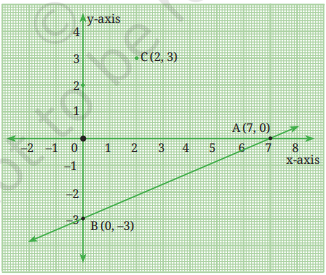
नीचे दिए गए समीकरण \(3x-7y=21\) के ग्राफ पर विचार कीजिए।
क्या बिंदु \(C(2,3)\) रेखा पर स्थित है? क्या यह दिए गए समीकरण को संतुष्ट करता है? क्या ऐसे बिंदु, जो रेखा पर स्थित नहीं हैं, समीकरण को संतुष्ट कर सकते हैं?
Answer
Given equation, 3x – 7y = 21.
Subtituting (2, 3) into the given equation,
⇒ 3(2) – 7(3) = 21
⇒ 6 – 21 = 21
⇒ –15 ≠ 21
Therefore, C (2, 3) does not satisfy the equation and hence does not lie on the line.
No, points lying on the line cannot satisfy the equation.
Question 6:
State whether the following sentences are True or False. Justify your answer.
(i) A linear equation in two variables has only one solution.
(ii) The graph of a linear equation in two variables always passes through the origin.
(iii) A linear equation in two variables can never have rational solutions.
(iv) x = 3 is a valid linear equation in two variables.
(v) The equation 2x + 3y = 7 has infinitely many solutions.
(vi) The point (1, 2) is a solution of the equation 2x + 3y = 7.
निम्नलिखित कथन सत्य हैं या असत्य, बताइए। अपने उत्तर का औचित्य भी स्पष्ट कीजिए।
(i) दो चरों वाले एक रैखिक समीकरण का केवल एक ही हल होता है।
(ii) दो चरों वाले रैखिक समीकरण का ग्राफ हमेशा मूल बिंदु (Origin) से होकर गुजरता है।
(iii) दो चरों वाले रैखिक समीकरण के हल कभी भी परिमेय संख्याएँ नहीं हो सकते।
(iv) \(x=3\), दो चरों में एक मान्य रैखिक समीकरण है।
(v) समीकरण \(2x+3y=7\) के अपरिमित रूप से अनेक हल हैं।
(vi) बिंदु \((1,2)\), समीकरण \(2x+3y=7\) का एक हल है।
Answer
(i) False.
A linear equation in two variables has infinitely many solutions.
(ii) False.
Only a line of the form ax + by = 0 passes through the origin.
(iii) False.
A linear equation can have rational solutions. For example: 3x + 2y = 12 has the solution , where both coordinates are rational numbers.
(iv) True.
It can be written as x + 0y – 3 = 0, which is of the form ax + by + c = 0.
(v) True.
Every linear equation has infinite solutions.
(vi) True.
Substituting x = 1 and y = 2 in the given equation,
LHS = 2x + 3y = 2(1) + 3(2) = 2 + 6 = 8 ≠ 7 (RHS)
Therefore, the statement is actually False.
Question 7:
(i) Compare the solutions of the equations 3x + 4y = 7 and 6x + 8y = 14. Argue that they have the same set of solutions, that is, every solution of one is also a solution of the other.
(i) समीकरणों \(3x+4y=7\) तथा \(6x+8y=14\) के हलों की तुलना कीजिए। तर्क सहित सिद्ध कीजिए कि इन दोनों समीकरणों के हलों का समुच्चय समान है, अर्थात् एक समीकरण का प्रत्येक हल दूसरे समीकरण का भी हल है।
(ii) Show that the equations ax + by = c and kax + kby = kc, with k ≠ 0, have the same set of solutions.
(ii) सिद्ध कीजिए कि समीकरण \(ax+by=c\) तथा \(kax+kby=kc\), जहाँ \(k\neq 0\) है, के हलों का समुच्चय समान होता है।
Solution
Consider the second equation, 6x + 8y = 14
Dividing both sides by 2, we get
3x + 4y = 7
which is the first equation.
Therefore, both equations are equivalent and have the same set of solutions.
Consider the second equation, kax + kby = kc
Dividing both sides by k, we get
ax + by = c
which is the first equation.
Therefore, both equations have the same set of solutions.
Exercise Set 13.3
Question 1:
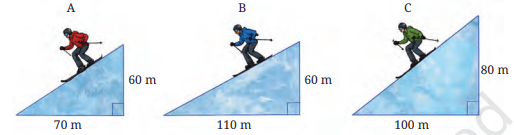
The following diagrams represent ski hills. Rank the hills in order of their steepness, from least to greatest.
Question 2:
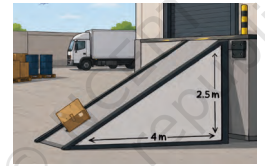
The ramp at a loading dock rises 2.5 metres over a run of 4 metres. Find the slope of the ramp.
Question 3:
Find the slope of the line l in each of the following diagrams.
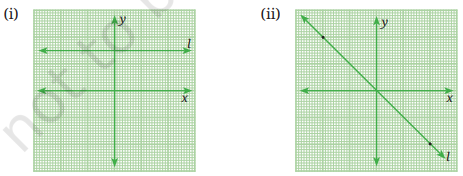
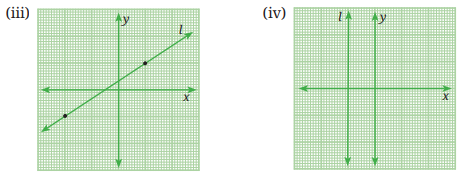
Question 4:
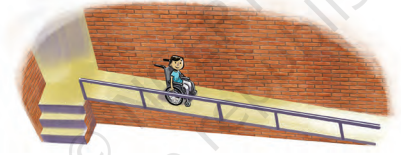
An accessibility ramp for wheelchairs is to be made alongside the staircase. The guidelines given for the slope of the ramp is 1 cm vertical rise to 12 cm horizontal length. What should be the horizontal length of the ramp if the total height of the stairs is 18 cm?
Exercise Set 13.4
Given below are some everyday situations. Construct a pair of linear equations in two variables for each situation:
Question 1:
On two different days a family buys movie tickets and snack boxes. Let the cost of one movie ticket be ₹x and the cost of one snack box be ₹y. Frame a pair of linear equations in x and y to represent the following situations:
(i) On the first day, the family buys 2 movie tickets and 3 snack boxes for ₹850.
(ii) On the second day, the family buys 4 movie tickets and 1 snack box for ₹1100.
Question 2:
Two friends, Sahil and Meena, travelled by taxi. Let the fixed charge for one taxi trip be ₹x and the additional charge per kilometre be ₹y. Frame a pair of linear equations in x and y to represent the following situation:
(i) Sahil travelled 6 km and paid a total fare of ₹122.
(ii) Meena travelled 8 km and paid a total fare of ₹160.
Question 3:
In a sports meet, tickets for adults cost ₹150 each and tickets for children cost ₹100 each. A total of 200 people attended the meet, and the total amount collected from ticket sales was ₹25,000. (Let the number of adult tickets sold be x and the number of children’s tickets sold be y.) Frame a pair of linear equations in x and y to represent this situation.
Exercise Set 13.5
Question 1:
Form a pair of linear equations for each of the following problems and find their solutions.
(i) The sum of two integers is +5 and their difference is –21. Find the two numbers.
(ii) The difference between two numbers is 26 and one number is three times the other. Find the numbers.
(iii) The coach of a cricket team buys 7 bats and 6 balls for ₹8880. Later, she buys 3 bats and 5 balls for ₹4000. Find the cost of each bat and each ball.
(iv) The taxi charges in a city consist of a fixed charge together with the charge for the distance covered for every km. For a distance of 10 km, the total amount paid is ₹155 and for a journey of 15 km, the total amount paid is ₹220. What is the fixed charge and the charge per km? How much does a person have to pay for travelling a distance of 25 km?
(v) A fraction becomes equal to \(\frac{9}{11}\) if 2 is added to both the numerator and the denominator. If 3 is added to both the numerator and the denominator, it becomes equal to \(\frac{5}{6}\). Find the fraction.
(vi) If we add 1 to the numerator and subtract 1 from the denominator, a fraction reduces to 1. It becomes equal to \(\frac{1}{2}\) if we add 1 only to the denominator. What is the fraction?
(vii) Five years ago, Nuri was thrice as old as Sonu. Ten years later, Nuri will be twice as old as Sonu. How old are Nuri and Sonu?
(viii) The sum of the digits of a two-digit number is 9. Also, nine times this number is twice the number obtained by reversing the order of the digits. Find the number.
(ix) Meena went to a bank to withdraw ₹2000. She asked the cashier to give her ₹50 and ₹100 notes only. Meena got 25 notes in all. Find how many notes of ₹50 and ₹100 did she receive?
(x) A lending library has a fixed charge for the first three days and an additional charge for each day thereafter. Saritha paid ₹27 for a book kept for seven days, while Susy paid ₹21 for the book she kept for five days. Find the fixed charge and the charge for each extra day.
Question 2:
Form a pair of linear equations and find their common solutions graphically.
10 students of Grade 9 took part in a Mathematics quiz. If the number of girls is 4 more than the number of boys, find the number of boys and girls who took part in the quiz.
Question 3:
Use the ratios \(\frac{a_1}{a_2}, \frac{b_1}{b_2}, \frac{c_1}{c_2}\), to determine whether the lines
representing the following pairs of linear equations intersect at a point, are parallel or are coincident.
(i) 5x – 4y + 8 = 0; 7x + 6y – 9 = 0
(ii) 9x + 3y + 12 = 0; 18x + 6y + 24 = 0
(iii) 6x – 3y + 10 = 0; 2x – y + 9 = 0
Question 4:
Which of the following pairs of linear equations have solutions? If they have solutions, find them graphically.
(i) x + y = 5, 2x + 2y = 10
(ii) x – y = 8, 3x – 3y = 16
(iii) 2x + y – 6 = 0, 4x – 2y – 4 = 0
(iv) 2x – 2y – 2 = 0, 4x – 4y – 5 = 0
Question 5:
Half the perimeter of a rectangular garden, whose length is 4 m more than its width, is 36 m. Find the dimensions of the garden.
Question 6:
Given the linear equation 2x + 3y – 8 = 0, write another linear equation in two variables so that the graphs of the pair formed represent (i) intersecting lines (ii) parallel lines (iii) coincident lines.
Question 7:
Here is a problem that was posed by Mahāvīrāchārya in Gaṇita sāra saṅgraha (c. 850 CE).
The price of 9 citrons and 7 fragrant wood-apples taken together is 107; and the price of 7 citrons and 9 fragrant wood-apples taken together is 101.
O mathematician, tell me quickly the price of each citron and of each fragrant wood-apple.
(Hint: The given problem can be modelled as
9x + 7y = 107
7x + 9y = 101
Can you figure out a way of solving these equations without directly using elimination or the substitution method? What is special in this pair of equations? The x and y coefficients are interchanged in the 2 equations.
What will happen if we add the pair of equations? What will happen if we subtract the pair of equations? Can the resulting equations be solved to find the values of x and y?)
Question 8:
5 pencils and 7 pens together cost ₹50, whereas 7 pencils and 5 pens together cost ₹46. Find the cost of each pencil and pen.
Question 9:
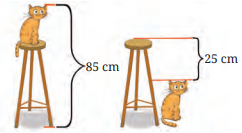
Find the height of the stool.
End-of-Chapter Exercises
Question 1:
The graph of the line y = 3x, passing through (0, 0) and (2, 6) is given below.
(i) Identify the slope of the line from the graph and explain how you calculated it using the two points on the line.
(ii) What is the y-intercept of the line? Explain its significance.
(iii) A water tank is being filled so that the water level y (in cm) after x minutes follows this graph.
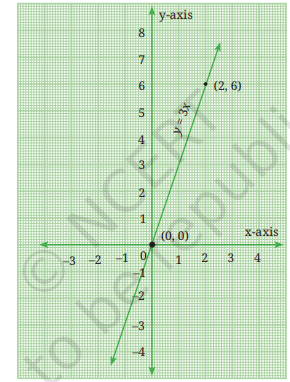
(a) How high is the water after 5 minutes?
(b) How many minutes will it take for the water to reach a height of 21 cm?
(iv) Without drawing a new graph, determine whether the point (4, 10) lies on this line. Justify your answer.
(v) Plot the point where this line intersects the line x = 3. Explain how you found the coordinates.
Question 2:
In countries like the USA, temperature is measured in Fahrenheit, whereas in countries like India, it is measured in Celsius. Here is a linear equation that converts Celsius to Fahrenheit:
F = \(\frac{9}{5}\) C + 32
(i) Draw the graph of the linear equation above using Celsius on the x-axis and Fahrenheit on the y-axis.
(ii) If the temperature is 30 °C, what is the temperature in Fahrenheit?
(iii) If the temperature is 95 °F, what is the temperature in Celsius?
(iv) If the temperature is 0 °C, what is the temperature in Fahrenheit and if the temperature is 0 °F, what is the temperature in Celsius?
(v) Is there a temperature which is numerically the same in both Fahrenheit and Celsius? If yes, find it.
Quesiton 3:
Solve the following system of equations graphically:
2x + y = 6, 2x – y – 2 = 0.
Question 4:
Find the point of intersection of the lines shown on the cover page.
Question 5:
Give a formula to find the x-intercept of the line y = mx + c.
Question 6:
A person is choosing between two mobile plans.
Plan A: ₹50 monthly fee + ₹0.20 per minute of call time.
Plan B: ₹30 monthly fee + ₹0.30 per minute of call time.
For how many minutes of calling per month is Plan A cheaper than Plan B? For how many minutes is Plan B cheaper? Also find the number of minutes at which both plans cost the same.
Question 7:
How many lines exist that
(i) have a given slope?
(ii) have a given slope and pass through a given point?
Question 8:
For what values of p does the pair of equations given below have a unique solution?
4x + py + 8 = 0; 2x + 2y + 2 = 0.
Question 9:
Find the values of a and b for which the following system of equations has infinitely many solutions:
(a + b)x – 2by = 5a + 2b + 1; 3x – y = 14.
Question 10:
Find the value of ‘k’ for which the following system of equations represents a pair of coincident lines:
x + 2y = 3; (k – 1)x + (k + 1)y = k + 3.
Quesiton 11:
(i) Robot 1 starts from the origin and traces a path by repeatedly moving 3 units to the right and then 4 units upward. Robot 2 starts from the point (10, 0) and repeatedly moves 1 unit to the right and then 2 units upward. Will the paths traced by these two robots intersect and if so, where?
(ii) Robot 1 starts from (3, 0) and traces a path by repeatedly moving 5 units to the right and then 5 units upward. Robot 2 starts from the point (7, 0) and repeatedly moves 5 units to the right and then 3 units downwards. Will the paths traced by these two robots intersect and if so, where?
Question *12:
At a certain time, Jacob notices that his digital watch reads ‘a’ minutes after two o’clock. Fifteen minutes later, it reads ‘b’ minutes after three o’ clock. He noticed that a is six times greater than b. What time was it when he looked at his watch for the second time?
Question *13:
The sum of the digits of a two-digit number is 15. The number obtained by interchanging the digits exceeds the given number by 9. Find the number.
Question *14:
In a cyclic quadrilateral ABCD, ∠A = (x + 7)°, ∠B = (y + 8)°, ∠C = (3y + 23)° and ∠D = (4x + 12)°. Find all four angles of the cyclic quadrilateral.
Question *15:
A train moving with uniform speed for a certain distance takes 6 hours less if its speed is increased by 6 km/hour. It would have taken 6 hours more had its speed been decreased by 4 km/hour. Find the distance travelled and the speed of the train.
Question *16:
The age of a father is equal to the sum of the ages of his four children. After 20 years, the sum of the ages of the children will be twice the age of the father. Find the age of the father.
