
NCERT Solutions for Class 9 Kaveri Poem 3 Canvas of Soil
Word-Meaning of Class 9 Kaveri Poem 3 Canvas of Soil
Thank you for reading this post, don't forget to subscribe!
Summary of Class 9 Kaveri Poem 3 Canvas of Soil
Important Questions for Class 9 Kaveri Poem 3 Canvas of Soil
Table of Contents
Pages 87-89 – Check Your Understanding
I. Read the poem again and complete the summary of each stanza by filling in the blanks.
- The _________ is portrayed as a rich palette where gardeners’ ___ a_s flourish in the form of _______ , awaiting spring.
- The garden flowers _________ into a beautiful display of different b _________ ms, resembling a _________ by Mother Nature, in the light of morning.
- Each garden is likened to a wide ___ n __ s, integrating art and _________ . Through the efforts of gardeners, gardens transform into still-life _________ .
Answer:
- The earth is portrayed as a rich palette where gardeners’ dreams flourish in the form of blossoms, awaiting spring.
- The garden flowers bloom into a beautiful display of different blossoms, resembling a painting by Mother Nature, in the light of morning.
- Each garden is likened to a wide canvas, integrating art and life. Through the efforts of gardeners, gardens transform into still-life paintings.
II. Select the appropriate title for each stanza from those given below. There are two extra titles.
1. Nature’s Work of Art
2. Sweet-smelling Blossoms
3. Gardens as Living Canvases
4. Earth and Possibilities
5. The Painter’s Canvas
Answer:
Stanza 1: 4. Earth and Possibilities
Stanza 2: 1. Nature’s Work of Art
Stanza 3: 3. Gardens as Living Canvases
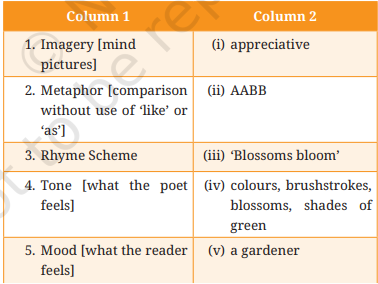
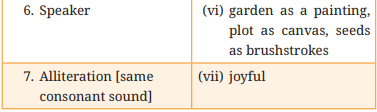
III. Match the poetic devices in Column 1 to the examples in Column 2. Discuss your responses in pairs. Then share the responses with your classmates and teacher.
The poem may be interpreted as an allegory.
An allegory is a literary device used to express larger ideas than those presented without explicitly stating them. Allegory operates on two levels-the surface meaning and the deeper meaning.
Upon considering this poem as an allegory, the garden could symbolise various aspects of life or nature.
> Life’s journey and growth-The garden, with its changing seasons and blooming flowers, could represent the journey of life, growth, and the cyclical nature of existence.
> Harmony and diversity-The interaction of different colours in the garden could symbolise the beauty and importance of diversity and harmony in our world.
Answer:
| Column 1 | Column 2 |
| 1. Imagery [mind pictures] | (iv) colours, brushstrokes, blossoms, shades of green |
| 2. Metaphor [comparison without use of ‘like’ or ‘as’] | (vi) garden as a painting, plot as canvas, seeds as brushstrokes |
| 3. Rhyme Scheme | (ii) AABB |
| 4. Tone [what the poet feels] | (i) appreciative |
| 5. Mood [what the reader feels] | (vii) joyful |
| 6. Speaker | (v) a gardener |
| 7. Alliteration [same consonant sound] | (iii) ‘Blossoms bloom’ |
NCERT Solutions for Class 9 Kaveri Poem 3 Canvas of Soil
Pages 89-91 – Critical Reflection
I. Read the given extracts from the poem and answer the questions that follow.
1. Brushstrokes of seeds, planted true,
\(\quad\) Awaiting spring’s vibrant hue.
(i) The poet has used a metaphor in ‘Brushstrokes of seeds’. Which option from those given below uses a metaphor?
A. Her mother’s heart heard her heartfelt request with kindness.
B. She has a heart of gold.
C. Her heart did a dance of joy on seeing the new doll.
D. She has a very kind heart.
Answer:
B. She has a heart of gold.
(ii) Complete the sentence appropriately.
The phrase ‘planted true’ is significant because it implies _________ .
Answer:
that the seeds are planted with sincerity, care and honest effort of the gardener.
(iii) Why has the poet used the word ‘hue’ instead of ‘colours’ in the extract?
Answer:
The word ‘hue’ is more poetic and suggests a soft, unified and harmonious colour, making the line sound musical and artistic.
(iv) Complete the following analogy correctly with a word from the extract.
Summer : hot :: Spring : _________
Answer:
Vibrant (hue)
(v) Read the Assertion (A) and the Reason (R) and select the option that is correctly suited.
(A): Gardeners wait for Spring.
(R): Gardens are worth painting in Spring.
A. Both (A) and (R) are true, and (R) is the correct explanation of (A).
B. Both (A) and (R) are true, but (R) is not the correct explanation of (A).
C. (A) is true, but ( R ) is false.
D. (A) is false, but (R) is true.
Answer:
A. Both (A) and (R) are true, and (R) is the correct explanation of (A).
2. Each plot, a canvas wide,
\(\quad\) Where art and life coincide.
(i) What does ‘Each plot’ refer to in this extract?
Answer:
“Each plot” in this extract refers to each land piece of garden where plants are grown.
(ii) Select which option imitates the rhyme scheme of the extract.
A. beautiful and clear laughter and cheer
B. beautiful and clear laughter and tears
Answer:
A. beautiful and clear laughter and cheer
(iii) Select the line from the extract that conveys that gardening blends aesthetic beauty with natural growth.
Answer:
“Where art and life coincide.”
(iv) Complete the following sentence appropriately. The plot is likened to a canvas suggesting that ______ .
Answer:
a garden is like a painting created by a gardener with his love, care and affection.
(v) Why has the poet most likely used the word ‘wide’ instead of ‘long’ in ‘canvas wide’?
Answer:
Because “wide” suggests a broad space for creativity and imagination, like a painter’s canvas.
NCERT Solutions for Class 9 Kaveri Poem 3 Canvas of Soil
II. Give reasons for the comparisons made by the poet in the poem.
1. A painter is compared to a gardener because _________ .
Answer:
A painter is compared to a gardener because both create beauty using skill and care – one with colours and the other with seeds, plants and flowers.
2. A palette is like earth as _________ .
Answer:
A palette is like earth as both hold many colours and possibilities.
3. The brushstrokes are like seeds because _________ .
Answer:
The brushstrokes are like seeds because both are the starting point of creation – brushstrokes create a painting and seeds create plants and flowers.
4. A canvas is similar to a garden plot as _________ .
Answer:
A canvas is similar to a garden plot as both are empty spaces that are turned into beautiful creations.
NCERT Solutions for Class 9 Kaveri Poem 3 Canvas of Soil
III. Answer the following questions.
Question 1.
How does the metaphor ‘Brushstrokes of seeds’, enhance the understanding of gardening as an art form?
Answer:
It shows that planting seeds is like painting, and gardening needs creativity and care just like art.
Question 2.
What can you infer about the poet’s perspective on the relationship between nature and creativity from the following lines?
‘Each plot, a canvas wide,/Where art and life coincide.’
Answer:
The poet believes that nature and creativity work together, and gardening is where art and life meet.
Question 3.
Do you think the imagery in the poem successfully paints a vivid picture in the reader’s mind? If yes, why? If no, why not?
Answer:
Yes, because the poet uses colour words and painting imagery like palette, canvas, brushstrokes and blossoms, which create a clear picture of a colourful garden.
Question 4.
Support the view that the poet’s mention of the colour yellow, besides red, blue and green, would have lent effectively to the imagery.
Answer:
Yes, yellow would have added brightness and warmth, making the picture of the garden more lively and cheerful.
Question 5.
Considering the line ‘Gardens become paintings still’, what can you interpret about the poet’s view on the timelessness of nature’s beauty?
Answer:
It suggests that nature’s beauty looks timeless and peaceful, like a still painting that can be admired forever.
Question 6.
Justify the title of the poem, ‘Canvas of Soil’.
Answer:
The title is suitable because soil is compared to a canvas, and seeds are like brushstrokes that turn it into a beautiful garden.
NCERT Solutions for Class 9 Kaveri Poem 3 Canvas of Soil
