
NCERT Solutions for Class 9 Kaveri Chapter 7 Carrier of Words
Summary of Class 9 Kaveri Chapter 7 Carrier of Words
Word-Meaning of Class 9 Kaveri Chapter 7 Carrier of Words
Important Questions for Class 9 Kaveri Chapter 7 Carrier of Words
Pages 203-204 – Reflect and Respond
I. Look at the pictures given below of persons engaged in the same profession.
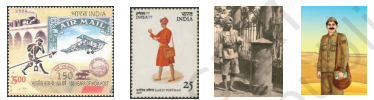
Discuss in pairs and share your answers with your classmates and teacher.
Question 1.
Which profession do they belong to?
Answer:
They belong to the postal service. They are postmen or mail carriers who deliver letters, parcels, and important documents to people in different areas.
Question 2.
Do they face any difficulties while doing their duty?
Answer:
Yes, the postmen do their duty in harsh terrain and climate conditions; they do face difficulties.
Question 3.
How does their profession affect the people they meet?
Answer:
Their profession greatly affects people by keeping families connected, delivering important documents and money orders, and earning trust as reliable messengers of both happy and sad news.
II. Discuss in groups.
Question 1.
How can ‘words’ be ‘carried’?
Answer:
Words can be carried through letters, messages, and other forms of written communication delivered by postal services.
Question 2.
Who could be a carrier of words?
Answer:
A postman is a carrier of words because he delivers letters and messages. Journalists, teachers, writers, and even mobile phone users can also be carriers of words. Anyone who communicates ideas, news, or emotions to others can be called a carrier of words.
Question 3.
What are the means for people to stay connected?
Answer:
In the past, people stayed connected through physical mail. Today, with the dominance of digital communication, people use various devices like mobile phones, computers, TVs etc. to stay connected.
III. Read the words given in the box below and place them in their appropriate context in the following passage.
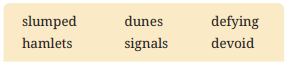
We stepped out of the vehicle at the end of the road. Immediately, our body sent 1. _______ that our decision to visit the sand 2. _______ in the afternoon was insane. We had passed a few 3. _______ on our way to the desert. We could not find even a single soul outdoors, 4. _______ the blazing sun. Even the camels were 5 . _______ in the little shade offered by the khejri trees. In this remote place people relied on Bharat Sanchar Nigam Limited (BSNL) to connect to the world as the area was 6. _______ of any other network service.
Answer:
1. signals
2. dunes
3. hamlets
4. defying
5. slumped
6. devoid
Page 207 – Check Your Understanding
I. Khetaram needs to submit information about himself to get an identity card. While reading the text, fill in the following information sheet for Khetaram.
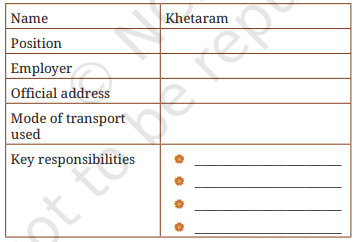
Answer:
| Name | Khetaram |
| Position | Gramin Dak Sewak (GDS) |
| Employer | India Post |
| Official address | Somarad Branch Post Office, near Indo-Pak border, Rajasthan. |
| Mode of transport used | On foot (sometimes with help from BSF vehicles or buses for part of the journey). |
| Key responsibilities | Delivering letters, parcels, and money orders to remote villages. Acting as a trusted link between families in isolated areas. Reading out letters and writing replies for villagers. Ensuring timely delivery of mail even in extreme desert conditions. |
II. Discuss with your teacher.
Question 1.
Why do you think Khetaram has taken up this challenging job?
Answer:
Khetaram has taken up this challenging job because he wants to serve the people living in remote desert villages. He understands the importance of letters and money orders in their lives. He performs his duty with dedication, responsibility and a desire to help others.
Question 2.
How do you think Khetaram would feel about taking up this challenging task every day?
Answer:
Khetaram would feel proud and satisfied while performing this challenging task every day. Although walking through the hot desert and covering long distances is tiring, he feels happy to help people and connect them with their loved ones. His sense of duty keeps him motivated.
Check Your Understanding (Page 210)
I. Complete the table given below with the situations given in Column 1 and the reasons in Column 2.
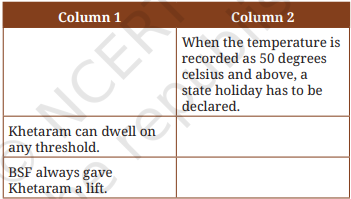
Answer:
| Column 1 | Column 2 |
| Mail is delivered in the evenings. | When the temperature is recorded as 50 degrees celsius and above a state holiday has to be declared. |
| Khetaram can dwell on any threshold. | He is trusted by everyone in the villages. |
| BSF always gave Khetaram lift. | The jawans are kind and helpful. |
II. Why was a piece of jaggery offered in the village when he brought news of a birth or weddings?
Answer:
A piece of jaggery was offered as a simple gesture of happiness and gratitude. It was the only sweet item the villagers could afford to offer when he brought good news like births or weddings.
III. How would phone lines help Khetaram in his job?
Answer:
The arrival of phone lines would help him to become a Gramin Sanchar Sewak, and he could carry a cell phone.
Pages 210-212 – Critical Reflection
I. Read the extracts given below and answer the questions.
1. “Akaal or famine is a way of life here. In a good year, I get one crop of bajra. That cannot feed my family of five. We would starve without this job,” he says.
And for each family which resides in this arid land, survival is partly dependent on money orders remitted by a relative.
(i) Complete the sentence given below with an appropriate reason.
One crop of bajra makes a little difference for people like Khetaram because _______ .
Answer:
For a poor farmer, the harvest of a single season is consumed by the family, and hardly anything is left to sell in the market and earn a profit for a good living.
(ii) Why did Khetaram term famine as ‘a way of life’?
Answer:
Khetaram lives in a dry part of Rajasthan, where farming is extremely difficult. He gets only one crop of bajra a year, which is not enough to feed his family of five. Because of this constant scarcity, he considers famine as ‘a way of life’.
(iii) Give one reason why Khetaram had to take up a job to help his family to survive.
Answer:
Khetaram had to take up a job because farming did not earn him enough to sustain a family of five. They were poor and needy.
(iv) Complete the analogy given below with a word from the extract.
Other families: Money orders:: Khetaram:
Answer:
job (Gramin Dak Sevak)
(v) What would ‘a good year’ signify?
Answer:
‘A good year’ means a year when farmers get one crop of bajra.
2. There is one letter delivery he dreads. The envelope with the right corner torn off, which signifies that the missive bears news of death.
“Ashubh Samachar cannot be carried into the house,” says Khetaram. So, he stands outside, reads out the letter twice, then tears it to bits. “Bad news must be destroyed,” he mutters philosophically.
(i) Choose the correct option for the following question.
Who could have torn the right corner of the envelope?
A. Khetaram
B. Sender of the letter
C. Receiver of the letter
D. The postmaster
Answer:
B. Sender of the letter
(ii) Complete the sentence with an appropriate reason.
The most likely reason for Khetaram reading the letter twice is because _______ .
Answer:
He wanted to ensure that the message was clearly understood by the family, especially when it carried sensitive and important news.
(iii) What was Khetaram’s philosophy regarding bad news, and how did he act upon it?
Answer:
Khetaram believed that a letter carrying bad news should not be taken inside the house as that would bring bad luck. So, standing outside the house he would read such a letter twice and then tear it up.
(iv) State whether the following sentence is true or false.
Khetaram’s action of tearing the letter differed from his beliefs.
Answer:
False
Reason: His action of tearing the letter matched his belief that bad news should not enter the house and must be destroyed.
(v) Mention any one aspect of Khetaram’s temperament which is revealed through this extract.
Answer:
One aspect of Khetaram’s temperament revealed is sensitivity and compassion, as he handles letters carrying sad news with care and to respect the feelings of the family.
II. Answer the following questions.
Question 1.
Justify the statement made by the Postmaster-General, Rajasthan Western Region, stating that the role of GDS is ‘invaluable’.
Answer:
The role of Gramin Dak Sewaks (GDS) is invaluable because they connect people living in remote villages with the rest of the country. They deliver letters, money orders and important messages, often travelling long distances in difficult weather conditions. They also help illiterate villagers by reading and writing letters for them. Their dedication and selfless service make them an essential part of rural society.
Question 2.
How was the purpose of India Post different from that of the British postal system?
Answer:
The British Postal system relayed official dak between administrative centres, while the Indian Postal system planned to include the whole population in the mailing system.
Question 3.
People trusted Gramin Dak Sewaks. Support this statement with any two instances from the text.
Answer:
People trusted Gramin Dak Sewaks because:
- They depended on them to deliver important letters and money orders safely to their families.
- Illiterate villagers trusted them to read their letters and write replies on their behalf.
These instances show that Gramin Dak Sewaks were not just postmen but also reliable members of the village community.
Question 4.
Infer the most likely reason that Khetaram was grateful to continue as a GDS, even after the age of 60.
Answer:
Khetaram was grateful to continue as a GDS after 60 because the job provided him with financial security in a famine-prone region where farming alone could not support his family. It also gave him dignity, purpose, and the opportunity to serve people who depended on him.
Question 5.
Explain why the author pays tribute to people like Khetaram.
Answer:
People like Khetaram are a part and parcel of our social fabric. They play a big role in supporting the lives of people who live in the remote areas. So, the author pays tribute to people like Khetaram.
Pages 212-215 Vocabulary and Structures in Context
I. Study the phrases given in Column 1 and match them with their meanings in Column 2.
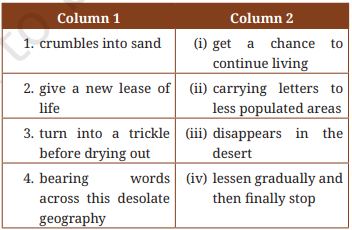
Answer:
| Column 1 | Column 2 |
| 1. crumbles into sand | (iii) disappears in the desert |
| 2. give a new lease of life | (i) get a chance to continue living |
| 3. turn into a trickle before drying out | (iv) lessen gradually and then finally stop |
| 4. bearing words across this desolate geography | (ii) carrying letters to less populated areas |
Now, use the phrases from Column 1 in sentences of your own.
Answer:
Sentences of phrases from Column 1.
- Any old sandstone structure crumbles into sand when exposed to weathering and erosion for a long time.
- The doctors assured the family that the surgery would give a new lease of life to the grandfather.
- During droughts, the roaring river would turn into a trickle before drying out completely.
- The old storyteller travelled from village to village, bearing words across this desolate geography, so that the history of his tribe was not forgotten by the future generation.
