
NCERT Solutions for Class 9 Matha 2 Chapter 9: Propositions and their Converses
Exercise Set 9.1
Frame the converse for each of the propositions in Questions 1–12. Then, determine if each of the two statements is true or not. Justify the true statements and give a counterexample for each false statement
Question 1:
If two lines are parallel, then the corresponding angles formed by a transversal are equal.
Solution
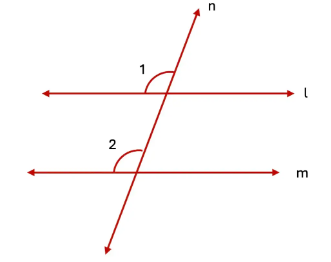
Proposition: If l ∥ m, then ∠1 = ∠2.
Converse: If ∠1 = ∠2, then l ∥ m.
The proposition is true by the corresponding angle property, and the converse is also true by the converse of the corresponding angle property.
Question 2:
If a quadrilateral is a square, then all its angles are equal.
Solution
Proposition: If a quadrilateral is a square, then all its angles are equal.
The statement is true.
Justification: A square has all angles equal, each measuring 90°
Converse: If all the angles of a quadrilateral are equal, then it is a square.
The statement is false.
Counterexample: A quadrilateral with all equal angles can be a square or a rectangle.
Question 3:
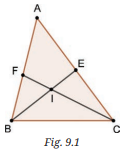
Given any ∆ABC, let us bisect the angles at B and C. The bisectors meet at the incentre I of the triangle.
Now extend the bisectors beyond I till they meet the opposite sides at E and F respectively, as shown.
Proposition: If AB = AC, then IE = IF.
Solution
Preposition: If AB = AC, then IE = IF.
Justification: In △ABE and △ACF,
AB = AC …….. (given)
∴ ∠ABC = ∠ACB
=
∠ABE = ∠ACF
∠BAE = ∠CAE …….. (common)
∴ By ASA rule, △ABE ≅ △ACF
AF = AE ……….. (c.p.c.t) ………… (i)
AB = AC ………… (ii)
Subtracting (i) from (ii),
AB – AF = AC – AE
BF = CE
∠AEB = ∠AFC ……….. (c.p.c.t)
∴ ∠BFC = ∠CEB
In △BFI and △CEI
BF = CE
∠IBF = ∠ICE
∠IFB = ∠IEC
By ASA rule, △BFI ≅ △CEI
∴ IE = IF ……… (c.p.c.t)
Hence, the proposition is true.
Converse: If IE = IF, then AB = AC.
Justification: Since △BFI ≅ △CEI
∠IBF = ∠ICE
2∠IBF = 2∠ICE
∠ABC = ∠ACB
∴ AB = AC
Hence, the converse is also true.
Question 4:
If x = y, then a + x = a + y, where x, y and a are any three numbers.
This proposition and its converse are routinely used while solving equations.
Solution:
Proposition: If x = y, then a + x = a + y.
Given that x = y
Adding ‘a’ to both sides,
x + a = y + b
Thus, the proposition is true.
Converse: If a + x = a + y, then x = y.
Given that a + x = a + y
Subtracting ‘a’ from both sides,
a + x – a = a + y – a
x = y
Thus, the converse is also true.
Question 5:
If a and b are perfect squares, then ab is a perfect square.
Solution:
Proposition: If a and b are perfect squares, then ab is a perfect square.
Take a and b as perfect squares. Let a = 9 and b = 16
∴ ab = 9 × 16 = 144
Thus, the proposition is true.
Converse: If ab is a perfect square, then a and b are perfect squares.
Take a = 2 and b = 8
Then, ab = 2 × 8 = 16, which is a perfect square.
However, neither 2 nor 8 is a perfect square.
Hence, the converse is false.
Question 6:
If x = y, then x2 = y2.
Solution:
Proposition: If x = y, then x2 = y2.
Given that x = y
Squaring both sides,
x2 = y2
Thus, the proposition is true.
Converse: If x2 = y2, then x = y.
Take x = 2, y = –2.
x2 = (2)2 = 4
y2 = (–2)2 = 4
Then, x2 = y2 = 4, but x ≠ y.
Hence, the converse is false.
Question 7:
If x = y, then x3 = y3.
Solution:
Proposition: If x = y, then x3 = y3.
Given that x = y
Taking cube on both sides,
x3 = y3
Thus, the statement is true.
Converse: If x3 = y3, then x = y.
Given that x3 = y3
Taking cube root on both sides,
=
x = y
Hence, the converse is also true.
Question 8:
If n is divisible by 24, then it is divisible by both 4 and 6.
Solution:
Proposition: If n is divisible by 24, then it is divisible by both 4 and 6.
The proposition is true.
Justification: Since 24 = 4 × 6, every multiple of 24 is divisible by both 4 and 6.
Converse: If n is divisible by both 4 and 6, then n is divisible by 24.
The converse is false.
Counterexample: Take n = 36. It is divisible by both 4 and 6, but 36 is not divisible by 24.
Question 9:
If n is divisible by 60, then it is divisible by both 5 and 12.
Solution:
Proposition: If n is divisible by 60, then it is divisible by both 5 and 12.
The proposition is true.
Justification: Since 60 = 5 × 12, every multiple of 60 is divisible by both 5 and 12.
Converse: If n is divisible by both 5 and 12, then n is divisible by 60.
The converse is also true.
Justification: If n is divisible by both 5 and 12, then it is divisible by their LCM 60.
Hence, n is divisible by 60.
Quesiton 10:
If n is the square of a prime number, then it has exactly 3 factors.
Solution:
Proposition: If n is the square of a prime number, then it has exactly 3 factors.
The proposition is true.
Justification: Let n = 9, which is the square of 3 (a prime number).
Factors of 9 = 1, 3, and 9
Thus, the square of a prime number has exactly 3 factors.
Converse: If n has exactly 3 factors, then n is the square of a prime number.
The converse is true.
Justification: Let n = 25
Factors of 25 = 1, 5, 25
And 25 = 52
Thus, 25 has exactly 3 factors and is the square of 5 (a prime number).
Question 11:
If n is a product of two unequal prime numbers, then it has exactly 4 divisors.
Solution:
Proposition: If n is a product of two unequal prime numbers, then it has exactly 4 divisors.
The proposition is true.
Justification: Let n = 35
35 = 5 × 7, which are both prime numbers.
Factors of 35 = 1, 3, 5, 7, and 35
Thus, 35 has exactly four divisors.
Converse: If n has exactly 4 divisors, then n is a product of two unequal prime numbers.
The converse is false.
Counterexample: Take n = 8 = 23
Divisors of 8 = 1, 2, 4, 8.
8 = 1 × 8 or 2 × 4
But 1, 2, and 8 are not prime numbers.
Question 12:
If n and n + 3 have no factors in common, then n is not a multiple of 3.
Solution:
Proposition: If n and n + 3 have no factors in common, then n is not a multiple of 3.
The proposition is true.
Justification: If n were a multiple of 3, then n + 3 would also be a multiple of 3. Thus, they would have 3 as a common factor. Hence, if they have no common factor, n cannot be a multiple of 3.
Converse: If n is not a multiple of 3, then n and n + 3 have no factors in common.
The converse is true.
Justification: If n is not a multiple of 3, then n and n + 3 cannot have 3 as a common factor. Since any common factor of n and n + 3 must divide their difference,
(n + 3) − n = 3, their only possible common factor greater than 1 is 3. Therefore, they have no common factor.
Question 13:
There are no known ‘neat’ expressions that generate only primes!
Find counterexamples to the following claims.
(i) AII numbers of the form 4n2 + 1 are prime.
Solution:
If n = 1, then
4n2 + 1 = 4(1)2 + 1 = 4 + 1 = 5 (a prime number)
If n = 2, then
4n2 + 1 = 4(2)2 + 1 = 4(4) + 1 = 17 (a prime number)
If n = 3, then
4n2 + 1 = 4(3)2 + 1 = 4(9) + 1 = 37 (a prime number)
If n = 4, then
4n2 + 1 = 4(4)2 + 1 = 64 + 1 = 65 (not a prime number)
Counterexample: n = 4.
(ii) All numbers of the form n2 + n + 11 are prime.
Solution:
Let P(n) = n2 + n + 11
P(1) = 12 + 1 + 11 = 13 (a prime number)
P(2) = 22 + 2 + 11 = 17 (a prime number)
P(3) = 32 + 3 + 11 = 23 (a prime number)
P(4) = 42 + 4 + 11 = 31 (a prime number)
P(5) = 52 + 5 + 11 = 41 (a prime number)
P(6) = 62 + 6 + 11 = 53 (a prime number)
P(7) = 72 + 7 + 11 = 67 (a prime number)
P(8) = 82 + 8 + 11 = 83 (a prime number)
P(9) = 92 + 9 + 11 = 109 (a prime number)
P(10) = 102 + 10 + 11 = 121 (not a prime number)
Counterexample: n = 10.
(iii) AII numbers of the form 4n + 3 are prime.
Solution:
Let P(n) = 4n + 3
P(1) = 41 + 3 = 4 + 3 = 7
P(2) = 42 + 3 = 16 + 3 = 19
P(3) = 43 + 3 = 64 + 3 = 67
P(4) = 44 + 3 = 256 + 3 = 259
Counterexample: n = 4.
Question 14:
Find counterexamples to the following statements.
(i) If n is a prime number, then 2n – 1is a prime number.
Solution:
Let P(n) = 2n – 1
Put n = a prime number (2, 3, 5, 7, 11, 13, 17, 19,…)
P(2) = 22 – 1 = 4 – 1 = 3 (a prime number)
P(3) = 23 – 1 = 8 – 1 = 7 (a prime number)
P(5) = 25 – 1 = 32 – 1 = 31 (a prime number)
P(7) = 27 – 1 = 128 – 1 = 127 (a prime number)
P(11) = 211 – 1 = 2048 – 1 = 2047 (not a prime number)
Counterexample: n = 11.
(ii) If n is an even number, then 2n + 1 is a prime number.
Solution:
Let P(n) = 2n + 1
Put n = even numbers (2, 4, 6, 8, 10, 12, ….)
P(2) = 22 + 1 = 4 + 1 = 5 (a prime number)
P(4) = 24 + 1 = 16 + 1 = 17 (a prime number)
P(6) = 26 + 1 = 64 + 1 = 65 (not a prime number)
Counterexample: n = 6
Question 15:
Consider the statement: ‘If a number is divisible by 8, then it is divisible by both 2 and 4’.
(i) Justify the statement.
Solution:
Justification:
Since 8 = 2 × 4.
So, every number divisible by 8 is also divisible by both 2 and 4.
For example, 24 is divisible by 8, and
24 ÷ 2 = 12
24 ÷ 4 = 6
Hence, the statement is true.
Logic Course Online
(ii) Recall the divisibility shortcuts that we have studied for different numbers. To check whether a given number is divisible by 8, is it enough to check whether it is divisible by 2 and 4? Why or why not?
Solution:
No, it is not enough.
For example, 12 is divisible by both 2 and 4:
12 ÷ 2 = 6 and 12 ÷ 4 = 3
But
12 ÷ 8 = 1.5
Thus, 12 is not divisible by 8.
Therefore, being divisible by both 2 and 4 does not guarantee that a number is divisible by 8.
Question 16:
Recall that a shortcut to check whether a given number is divisible by 3 is to add the digits of the number and check if the sum is a multiple of 3. Express the relationship between ‘a number is divisible by 3’ and ‘sum of the digits is a multiple of 3’ using ‘If – then’ sentences.
Solution:
Proposition:
If a number is divisible by 3, then the sum of its digits is a multiple of 3.
Converse:
If the sum of the digits of a number is a multiple of 3, then the number is divisible by 3.
Divisibility shortcut of 3: Let the number be 27534.
Sum of its digits = 2 + 7 + 5 + 3 + 4 = 21 (a multiple of 3)
Thus, 27534 is divisible by 3, or a multiple of 3.
Question 17:
We have identified different types of quadrilaterals – squares, rectangles, parallelograms, rhombi, kites and trapezia. One can identify more types (e.g., we could create a category of quadrilaterals that have equal-length opposite sides).
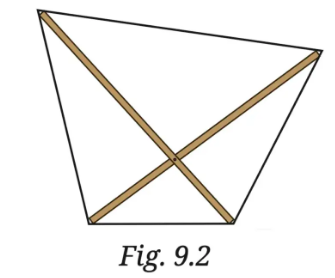
Suppose we have identified a category of quadrilaterals called Q, and we have to construct a quadrilateral of this type. For this, we are to use two thin sticks, put them together as diagonals so that the quadrilateral obtained by joining their endpoints is of type Q (see the Fig. 9.2).
(i) Suppose Q satisfies the following property.
If a quadrilateral is of type Q, then it has equal-length diagonals.
(a) Should the two sticks be of equal length? Why or why not?
(b) WiIl it matter how the two sticks are put together?
Solution:
(a) Yes. The two sticks represent the diagonals of the quadrilateral. Since every quadrilateral of type Q has equal-length diagonals, the two sticks must be of equal length.
(b) No. As long as the two sticks intersect to form the diagonals of a quadrilateral, their position does not affect the fact that their lengths are equal.
(ii) Instead of the property mentioned above, suppose Q satisfies the following property.
If a quadrilateral has equal diagonals, then it is of type Q. What will be your answers to (a) and (b) now?
Solution:
(a) Yes. The two sticks represent the diagonals. If they are of equal length, the quadrilateral formed will have equal diagonals and hence, by the given property, will be of type Q.
(b) No. The property depends only on the diagonals being equal in length. Therefore, their arrangement does not matter, provided they form a quadrilateral.
