NCERT Solutions for Class 9 Science Chapter 5 Exploring Mixtures and their Separation
Thank you for reading this post, don't forget to subscribe!
Table of Contents
Page No. 72
Think It Over
Question 1:
Why do suspended articles settle in muddy water over time but not in milk?
गंदे पानी में निलंबित कण समय के साथ नीचे बैठ जाते हैं, लेकिन दूध में क्यों नहीं?
Answer
Suspended particles in muddy water are large and heavy, so they settle down under gravity after some time. Milk is a colloid in which very small particles remain uniformly dispersed and do not settle due to their continuous random motion.
गंदे पानी में निलंबित कण बड़े और भारी होते हैं, इसलिए वे गुरुत्वाकर्षण के कारण समय के साथ नीचे बैठ जाते हैं। दूध एक कोलॉइड है, जिसमें बहुत छोटे कण समान रूप से फैले रहते हैं और लगातार गति के कारण नीचे नहीं बैठते।
Question 2:
How is evaporation different from boiling?
वाष्पीकरण और उबालना में क्या अंतर है?
Answer
Evaporation is a slow process that occurs at the surface of a liquid at any temperature.
Boiling is a rapid process that occurs throughout the liquid at a fixed temperature called the boiling point.
वाष्पीकरण एक धीमी प्रक्रिया है जो किसी भी तापमान पर द्रव की सतह से होती है।
उबालना एक तीव्र प्रक्रिया है जो द्रव के पूरे भाग में एक निश्चित तापमान (क्वथनांक) पर होती है।
Question 3:
Why do you see bright rays of sunlight when it passes through small gaps between the leaves of a dense tree?
जब सूर्य का प्रकाश किसी घने पेड़ की पत्तियों के बीच के छोटे-छोटे अंतरालों से होकर गुजरता है, तो उसकी चमकीली किरणें क्यों दिखाई देती हैं?
Answer
Bright rays of sunlight are visible because tiny dust particles and water droplets present in the air scatter the sunlight. This phenomenon, called the Tyndall effect, makes the path of light visible when it passes through small gaps between the leaves.
सूर्य की चमकीली किरणें इसलिए दिखाई देती हैं क्योंकि हवा में मौजूद धूल के सूक्ष्म कण और जल की बूंदें प्रकाश का प्रकीर्णन करती हैं। इस घटना को टिंडल प्रभाव कहते हैं, जिससे पत्तियों के बीच से गुजरने वाले प्रकाश का मार्ग दिखाई देने लगता है।
NCERT Solutions for Class 9 Science Chapter 5 Exploring Mixtures and their Separation
Page No 76
Pause and Ponder
Question 1:
A common talcum powder contains 4 % m/m zinc oxide, which acts as an antiseptic. How much zinc oxide is present in 300 g of the talcum powder?
Answer
Zinc Oxide in Talcum Powder:
4% m/ m means 4 g zinc oxide present in 100 g of talcum powder.
In 300 g of talcum powder:
\(\frac{4}{100}\) × 300 = 12 g
So, 12 g of zinc oxide is present.
Question 2:
Your mother gives you a bottle of orange juice concentrate to mix with water and serve it to your visiting friends. She asks you to mix two tablespoons of the concentrate with water in a glass tumbler. If each tablespoon measures 15 mL and you make 150 mL of juice per person, what is the % v/v of orange juice concentrate in the mixture you prepared?
Answer
2 tablespoons 2 × 15 ml =30 ml concentrate
Total volume = 150 ml
% u/v (30/150) × 100 = 20% u/u concentrate
Question 3:
Vinegar, used as a food preservative and additive, contains 5 % v/v acetic acid. Glacial acetic acid is a liquid, i.e., 100% acetic acid. If you want to make vinegar from glacial acetic acid, how would you proceed?
सिरका, जिसका उपयोग खाद्य परिरक्षक तथा खाद्य योजक के रूप में किया जाता है, में 5% v/v एसीटिक अम्ल होता है। ग्लेशियल एसीटिक अम्ल एक द्रव है, अर्थात् यह 100% एसीटिक अम्ल होता है। यदि आप ग्लेशियल एसीटिक अम्ल से सिरका बनाना चाहते हैं, तो आप इसे कैसे तैयार करेंगे?
Answer
A 5% (ν/ ν) solution means 5 g of solute in 1oo ml of solution. Therefore, to prepare vinegar containing 5% acetic acid, take 5 ml of glacial acetic acid and add water to make the total volume 100 ml.
Page No. 79
Pause and Ponder
Question 4:
Refer to the solubility curves given in Activity 5.2. If equal masses of hot, saturated solutions of compounds ‘A’ and ‘B’ are cooled from 80 °C to 60 °C, which solution is likely to deposit more solid?
गतिविधि 5.2 में दिए गए विलेयता वक्रों का संदर्भ लेते हुए बताइए कि यदि यौगिक ‘A’ और ‘B’ के 80°C पर समान द्रव्यमान वाले गर्म संतृप्त विलयनों को 60°C तक ठंडा किया जाए, तो किस विलयन से अधिक ठोस पदार्थ निक्षेपित होने की संभावना है?
Answer
From the solubility curves in Fig. 5.6 (Activity 5.2), Compound ‘B’ (blue, steeper curve) shows a larger decrease in solubility between 80°C and 60°C compared to Compound ‘A’ (red, gentler slope).
When equal masses of hot saturated solutions are cooled, the compound with a larger decrease in solubility deposits more solid. Therefore, compound ‘B’ will deposit more solid.
चित्र 5.6 (गतिविधि 5.2) में दिए गए विलेयता वक्रों के अनुसार, यौगिक ‘B’ (नीला, अधिक ढलान वाला वक्र) की विलेयता 80°C से 60°C के बीच यौगिक ‘A’ (लाल, कम ढलान वाला वक्र) की तुलना में अधिक घटती है।
जब समान द्रव्यमान वाले गर्म संतृप्त विलयनों को ठंडा किया जाता है, तो जिस यौगिक की विलेयता में अधिक कमी आती है, उससे अधिक ठोस पदार्थ निक्षेपित (जमा) होता है। अतः यौगिक ‘B’ से अधिक ठोस पदार्थ निक्षेपित होगा।
Question 5:
Will there be any change in the size of common salt crystals if the rate of evaporation is increased or decreased? Explain.
यदि वाष्पीकरण की दर बढ़ा दी जाए या घटा दी जाए, तो क्या साधारण नमक के क्रिस्टलों के आकार में कोई परिवर्तन होगा? कारण सहित समझाइए।
Answer
Yes, the size of common salt crystals changes with the rate of evaporation. If evaporation is slow, the salt particles get more time to arrange themselves, forming larger crystals. If evaporation is fast, crystals form quickly and remain smaller in size.
हाँ, वाष्पीकरण की दर बदलने पर सामान्य नमक के क्रिस्टलों का आकार भी बदलता है। यदि वाष्पीकरण धीमा हो, तो नमक के कणों को व्यवस्थित होने के लिए अधिक समय मिलता है, जिससे बड़े क्रिस्टल बनते हैं। यदि वाष्पीकरण तेज़ हो, तो क्रिस्टल जल्दी बनते हैं और उनका आकार छोटा रहता है।
Page No. 82
Pause and Ponder
Question 6:
State whether the following statements are True or False. Also, correct the False statements.
(i) Salt can be separated from a salt solution by evaporation or distillation.
(ii) Distillation can be used for separation of two liquids even when these have the same boiling point.
(iii) In paper chromatography, the solvent level should be above the sample spot at the beginning of the experiment.
(iv) Evaporation and crystallization are the same processes.
निम्नलिखित कथनों के सही या गलत होने का निर्धारण कीजिए। साथ ही, गलत कथनों को सही करके लिखिए।
(i) नमक को नमक के घोल से वाष्पीकरण या आसवन द्वारा अलग किया जा सकता है।
(ii) आसवन का उपयोग दो द्रवों को अलग करने के लिए किया जा सकता है, भले ही उनका क्वथनांक समान हो।
(iii) कागज़ क्रोमैटोग्राफी में प्रयोग की शुरुआत में विलायक का स्तर नमूना बिंदु से ऊपर होना चाहिए।
(iv) वाष्पीकरण और क्रिस्टलीकरण एक ही प्रक्रिया हैं।
Answer
| Statement | True/False | Correction (if False) |
|---|---|---|
| (i) Salt can be separated from a salt solution by evaporation or distillation. | True | No correction needed. |
| (ii) Distillation can be used for separation of two liquids even when these have the same boiling point. | False | Distillation can be used to separate two liquids only when they have different boiling points. |
| (iii) In paper chromatography, the solvent level should be above the sample spot at the beginning of the experiment. | False | In paper chromatography, the solvent level should be below the sample spot at the beginning of the experiment. |
| (iv) Evaporation and crystallization are the same processes. | False | Evaporation and crystallization are different processes. Evaporation removes the solvent, whereas crystallization is used to obtain pure solid crystals from a solution. |
(i) सत्य
(ii) असत्य
सुधार: आसवन का उपयोग तभी किया जा सकता है जब दोनों द्रवों के क्वथनांक अलग-अलग हों।
(iii) असत्य
सुधार: विलायक का स्तर नमूना बिंदु से नीचे होना चाहिए।
(iv) असत्य (False)
सुधार: वाष्पीकरण और क्रिस्टलीकरण भिन्न प्रक्रियाएँ हैं। वाष्पीकरण में विलायक हटाया जाता है, जबकि क्रिस्टलीकरण में शुद्ध ठोस के क्रिस्टल प्राप्त किए जाते हैं।
NCERT Solutions for Class 9 Science Chapter 5 Exploring Mixtures and their Separation
Page No. 84
Pause and Ponder
Question 7:
Why do immiscible liquids form two separate layers in a separating funnel?
अमिश्रणीय द्रव पृथक्कारी कीप में दो पृथक परतें क्यों बनाते हैं?
Answer
Immiscible liquids do not mix with each other because their particles have little or no attraction for one another. They have different densities, so the denser liquid settles at the bottom while the less dense liquid forms the upper layer. Thus, two separate layers are formed.
अमिश्रणीय द्रव आपस में नहीं मिलते क्योंकि उनके कणों के बीच आकर्षण बहुत कम या नहीं होता है। इनके घनत्व अलग-अलग होते हैं, इसलिए अधिक घनत्व वाला द्रव नीचे बैठ जाता है और कम घनत्व वाला द्रव ऊपर की परत बनाता है। इस प्रकार दो अलग-अलग परतें बनती हैं।
Question 8:
Is sublimation different from evaporation? Justify.
क्या ऊर्ध्वपातन, वाष्पीकरण से भिन्न है? पुष्टि कीजिए।
Answer
Yes, sublimation is different from evaporation. In sublimation, a solid changes directly into vapour without changing into a liquid, for example, camphor. In evaporation, a liquid changes into vapour from its surface, for example, water changing into water vapour.
हाँ, ऊर्ध्वपातन वाष्पीकरण से भिन्न है। ऊर्ध्वपातन में कोई ठोस पदार्थ बिना द्रव अवस्था में बदले सीधे वाष्प में परिवर्तित हो जाता है, जैसे कपूर। वाष्पीकरण में कोई द्रव अपनी सतह से वाष्प में परिवर्तित होता है, जैसे पानी का जलवाष्प में बदलना।
Page No. 88
Pause and Ponder
Question 9:
Clouds are made up of tiny water droplets or ice crystals floating in the air. Based on what you know about solutions, suspensions and colloids, what type of mixture do you think clouds are and why?
बादलों का निर्माण वायु में सूक्ष्म जल- बूंदों अथवा वायु में तैरते हिमक्रिस्टलों से होता है। विलयनों, निलंबनों और कोलॉइडों के विषय में अपनी जानकारी के आधार पर बताइए कि बादल किस प्रकार के मिश्रण हैं और क्यों?
Answer
Clouds are colloidal mixtures. They consist of tiny water droplets or ice crystals dispersed in air. These particles are very small and remain suspended in the air for a long time without settling down quickly. Therefore, clouds show the characteristics of a colloid.
बादल कोलॉइडी मिश्रण होते हैं। इनमें वायु में सूक्ष्म जल-बूंदें या हिमक्रिस्टल फैले रहते हैं। ये कण बहुत छोटे होते हैं और लंबे समय तक वायु में निलंबित रहते हैं तथा जल्दी नीचे नहीं बैठते। इसलिए बादल कोलॉइड के गुण प्रदर्शित करते हैं।
Question 10:
Why do cities with a lot of smoke and dust in the air often look hazy?
जिन नगरोंं की वाायु में अधिक धुआँ और धूल होते हैं, वे प्रायः धुँँधले क्योंं दिखाई देते हैं?
Answer
Cities with a lot of smoke and dust often look hazy because tiny particles of smoke and dust remain suspended in the air. These particles scatter light passing through the atmosphere, reducing visibility and making distant objects appear blurred or hazy.
जिन नगरों की वायु में अधिक धुआँ और धूल होती है, वे प्रायः धुँधले दिखाई देते हैं क्योंकि धुएँ और धूल के सूक्ष्म कण वायु में निलंबित रहते हैं। ये कण प्रकाश को चारों ओर फैला देते हैं, जिससे दृश्यता कम हो जाती है और दूर की वस्तुएँ धुँधली दिखाई देती हैं।
NCERT Solutions for Class 9 Science Chapter 5 Exploring Mixtures and their Separation
Page No
Revise, Reflect, Refine
Question 1:
Which of the following mixtures are correctly classified as homogeneous (Hm) and heterogeneous (Ht)? Choose the correct option.
(i) Air — Hm, Milk — Ht, Sugar solution — Hm, Smoke — Hm
(ii) Brass — Ht, Fog — Ht, Vinegar — Ht, Muddy water — Hm
(iii) Copper sulfate solution — Hm, Salt solution — Hm, Milk — Hm, Bronze — Hm
(iv) Muddy water — Ht, Milk — Ht, Blood — Ht, Brass — Hm
निम्नलिखित मिश्रणोों में से कौन-से मिश्रण सही रूप से समांगी और विषमांगी मिश्रणों के रूप में वर्गीकृत किए गए हैं? सही विकल्प चनिुए।
(i) वायु — समांगी, दुग्ध — विषमांगी, चीनी का विलयन — समांगी, धुआँ — समांगी
(ii) पीतल — विषमांगी, कोहरा — विषमांगी, सिरका — विषमांगी, पंकिल जल — समांगी
(iii) कॉपर सल्फेट का विलयन — समांगी, नमक का विलयन — समांगी, दुग्ध — समांगी, काँसा (Bronze) — समांगी
(iv) पंकिल जल — विषमांगी, दुग्ध — विषमांगी, रक्त — विषमांगी, पीतल — समांगी
Answer
(iv) Muddy water — Ht, Milk — Ht, Blood — Ht, Brass — Hm
(iv) पंकिल जल — विषमांगी, दुग्ध — विषमांगी, रक्त — विषमांगी, पीतल — समांगी
Question 2:
Choose the correct options, and explain the reason for the correct and incorrect options.
Which among the following mixtures show the Tyndall Effect?
A mixture of:
(a) air and dust particles
(b) copper sulfate and water
(c) starch and water
(d) acetone and water
(i) a and b (ii) b and d (iii) a and c (iv) c and d
सही विकल्पों का चयन कीजिए तथा सही और गलत विकल्पों के कारण स्पष्ट कीजिए।
निम्नलिखित मेंसे कौन-से मिश्रण टिंंडल प्रभााव दर्शााते हैं?
(क) वायु और धूल के कणोंं का मिश्रण
(ख) कॉपर सल्फेट और जल का मिश्रण
(ग) स्टार्च और जल का मिश्रण
(घ) ऐसीटोन और जल का मिश्रण
(i) क और ख (ii) ख और घ (iii) क और ग (iv) ग और घ
Answer
(iii) a and c (iii) क और ग
(i) a and b — Incorrect: (a) shows the Tyndall effect, but (b) does not.
(ii) b and d — Incorrect: Neither (b) nor (d) shows the Tyndall effect.
(iii) a and c — Correct: Both (a) and (c) show the Tyndall effect.
(iv) c and d — Incorrect: (c) shows the effect, but (d) does not.
(क) वायु + धूल के कण — धूल के कण प्रकाश का प्रकीर्णन करते हैं।
(ख) कॉपर सल्फेट + जल — यह वास्तविक विलयन है; इसके कण प्रकाश का प्रकीर्णन नहीं करते।
(ग) स्टार्च + जल — यह कोलॉइडी मिश्रण बनाता है और टिंडल प्रभाव दिखाता है।
(घ) ऐसीटोन + जल — यह समांगी वास्तविक विलयन है, इसलिए टिंडल प्रभाव नहीं दिखाता।
Question 3:
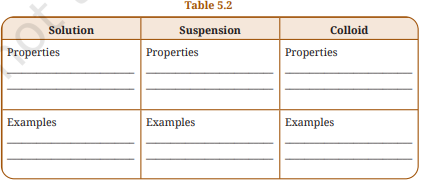
A mixture can be categorised as a solution, a suspension, or a colloid, each possessing distinct properties. Utilise the words or phrases provided in the box to fill in the Table 5.2. Words and phrases may be used more than once.
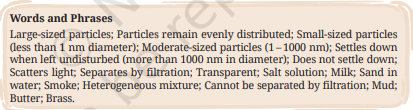
Complete the Table 5.2.
Question 4:
Solve the following problems:
(i) A cake recipe uses dry ingredients, namely 75 g of sugar for 420 g of all-purpose flour and 5 g of sodium hydrogencarbonate.
Express the concentration of each component in the mixture using an appropriate method.
(ii) A brass alloy contains 70% copper by mass. Calculate the quantities of copper and zinc present in 120 g of brass.
Question 5:
The label on a cooking oil pack says one litre (910 g). If this oil is mixed with water, will it form a separate layer? If so, which substance will be on top? How will you separate the two layers? Also, draw the diagram of the apparatus used.
Question 6:
Assertion (A): Solutions do not exhibit the Tyndall effect.
Reason (R): The particles in solutions are larger than 100 nm, so they cannot scatter light.
Choose the correct option:
(i) Both A and R are true, and R is the correct explanation of A.
(ii) Both A and R are true, but R is not the correct explanation of A.
(iii) A is true, but R is false.
(iv) A is false, but R is true.
Question 7:
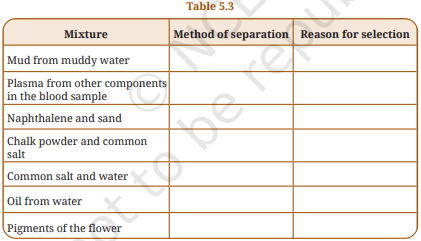
How would you separate the mixtures given in Table 5.3? Mention the reason for choosing your method. If a mixture cannot be separated, explain why.