
NCERT Solutions for Class 9 Science Chapter 7 Work, Energy and Simple Machines कार्य, ऊर्जा एवं सरल मशीनें
Table of Contents
Page No. 116
Question 1:
What will be the magnitude of velocity of the child at the bottom of the blue slide?
ऊपर दर्शाए गए चित्र मेें नीली फिसलपट्टी (Slide) के आधार तल पर बच्चे के वेग का परिमाण क्या होगा?
Answer
The magnitude of the child’s velocity at the bottom of the blue slide can be calculated using the law of conservation of energy. The potential energy at the top is converted into kinetic energy at the bottom.Therefore,where is the vertical height of the slide. The numerical value of velocity depends on the height shown in the diagram.
Thank you for reading this post, don't forget to subscribe!
ऊर्जा संरक्षण के नियम के अनुसार, फिसलपट्टी के शीर्ष पर बच्चे की स्थितिज ऊर्जा आधार तल पर गतिज ऊर्जा में परिवर्तित हो जाती है।अतः,जहाँ फिसलपट्टी की ऊर्ध्वाधर ऊँचाई है। वेग का संख्यात्मक मान ज्ञात करने के लिए चित्र में दी गई ऊँचाई जानना आवश्यक है।
Question 2:
Will two children of different masses reach the bottom of the same slide with the same velocity?
क्या अलग-अलग द्रव्यमान वाले दो बच्चे एक ही फिसलपट्टी के आधार तल पर एक ही वेग से पहुँचेगे ?
Answer
Yes, two children of different masses will reach the bottom of the same slide with the same velocity, provided they start from the same height and friction is neglected. This is because the velocity depends on the height of the slide, not on the mass of the children.
हाँ, अलग-अलग द्रव्यमान वाले दो बच्चे एक ही फिसलपट्टी के आधार तल पर समान वेग से पहुँचेंगे, बशर्ते वे समान ऊँचाई से फिसलना शुरू करें और घर्षण को नगण्य माना जाए। ऐसा इसलिए है क्योंकि वेग फिसलपट्टी की ऊँचाई पर निर्भर करता है, बच्चों के द्रव्यमान पर नहीं।
Question 3:
Which of the slides will result in the largest magnitude of velocity for the child at its bottom?
इनमेें से किस फिसलपट्टी के आधार तल पर कोई बच्चा सबसे अधिक वेग से पहुँचेगा?
Answer
The slide with the greatest vertical height will result in the largest velocity of the child at its bottom, provided friction is neglected. This is because the greater the height, the greater the potential energy converted into kinetic energy.
जिस फिसलपट्टी की ऊर्ध्वाधर ऊँचाई सबसे अधिक होगी, उसके आधार तल पर बच्चा सबसे अधिक वेग से पहुँचेगा, बशर्ते घर्षण को नगण्य माना जाए। ऐसा इसलिए है क्योंकि अधिक ऊँचाई पर स्थितिज ऊर्जा अधिक होती है, जो आधार तल पर अधिक गतिज ऊर्जा में परिवर्तित हो जाती है।
NCERT Solutions for Class 9 Science Chapter 7 Work, Energy and Simple Machines कार्य, ऊर्जा एवं सरल मशीनें
Page No. 119 Pause and Ponder
Question 1:
In the previous chapter, a weightlifter is shown holding a barbell steady in her hands (Fig. 6.8). Is she doing any work on the barbell while holding it steady?
पिछले अध्याय के चित्र (6.8) में एक भारोत्तोलक दर्शाई गई है जिसने भारोत्तलन दंड (barbell) को अपने हाथों में पकड़ कर स्थिर रखा हुआ है। क्या वह इस दड को स्थिर पकडे रखने में कोई कार्य करती है?
Answer
No, the weightlifter is not doing any work on the barbell while holding it steady because the barbell does not move and its displacement is zero.
नहीं, भारोत्तोलक दंड को स्थिर पकड़े रखने में उस पर कोई कार्य नहीं करती है, क्योंकि दंड का विस्थापन शून्य होता है। भौतिकी में कार्य तभी होता है जब बल लगाने से वस्तु में विस्थापन होता है।
Question 2:
Is the work done by friction on the stack of coins that travels on a rough surface (Fig. 6.13c) — positive, negative or zero?
बताइए पिछले अध्याय के चित्र 6.13 (ग) में दर्शाई गई किसी खुरदरी सतह (rough surface) पर गतिमान एक के ऊपर एक रखे सिक्कोंं के एक ढेर पर घर्षण द्वारा किया गया कार्य धनात्मक होगा, ॠणात्मक होगा या शून्य होगा?
Answer
The work done by friction on the stack of coins is negative because friction acts opposite to the direction of motion, reducing the speed of the coins.
सिक्कों के ढेर पर घर्षण द्वारा किया गया कार्य ऋणात्मक (Negative) होगा, क्योंकि घर्षण बल गति की दिशा के विपरीत कार्य करता है और सिक्कों की गति को कम करता है।
NCERT Solutions for Class 9 Science Chapter 7 Work, Energy and Simple Machines कार्य, ऊर्जा एवं सरल मशीनें
Page No. 121 Pause and Ponder
Question 3:
When you pedal a bicycle on a flat road, your muscles supply energy. In what forms does this muscular energy appear as you ride?
जब आप एक सपाट सड़क पर साइकिल पर सवार होकर साइकिल के पैडल पर बल लगाते हैं तो इस प्रक्रिया मेें आपकी माँसपेशियाँ ऊर्जा प्रदान करती हैं। आपकी माँसपेशियों द्वारा प्रदत्त ऊर्जा साइकिल सवारी मेें किस रूप मेें प्रकट होती है?
Answer
The muscular energy appears mainly as kinetic energy of the moving bicycle and rider, and as heat energy due to friction in the bicycle parts and between the tyres and road. Some energy is also used to produce sound.
साइकिल चलाते समय मांसपेशियों द्वारा प्रदान की गई ऊर्जा मुख्यतः साइकिल और सवार की गतिज ऊर्जा तथा घर्षण के कारण उत्पन्न ऊष्मा ऊर्जा के रूप में प्रकट होती है। कुछ ऊर्जा ध्वनि उत्पन्न करने में भी खर्च होती है।
NCERT Solutions for Class 9 Science Chapter 7 Work, Energy and Simple Machines कार्य, ऊर्जा एवं सरल मशीनें
Page No. 123 Pause and Ponder
Question 4:
Two objects A and B of mass m and 4 m have the same kinetic energy. What is the ratio of the magnitude of velocities of A and B?
दो वस्तुोंं A एवं B के द्रव्यमान क्रमश: m एव 4 m हैं। ब ताइए कि यदि इनकी गतिज ऊर्जा समान हो तो इनके वेगों का अनपुात क्या होगा?
Answer
Kinetic energy is given by the formula:
\( KE=\frac{1}{2}mv^2 \)
Since the kinetic energies of A and B are equal,
For object A:
\( KE_A=\frac{1}{2}mv_A^2 \)
For object B:
\( KE_B=\frac{1}{2}(4m)v_B^2 \)
Equating the two:
\( \frac{1}{2}mv_A^2=\frac{1}{2}(4m)v_B^2 \)
\( v_A^2=4v_B^2 \)
\(\frac{v_A}{v_B}=\frac{2}{1} \)
Therefore, the ratio of their velocities is \(\boxed{2:1}\).
गतिज ऊर्जा का सूत्र है:
\( KE=\frac{1}{2}mv^2 \)
दोनों वस्तुओं की गतिज ऊर्जा समान है, इसलिए
\( \frac{1}{2}mv_A^2=\frac{1}{2}(4m)v_B^2 \)
\( v_A^2=4v_B^2 \)
\( \frac{v_A}{v_B}=\frac{2}{1} \)
अतः उनके वेगों का अनुपात \(\boxed{2:1}\) होगा।
Question 5:
Does the kinetic energy of an object which moves with constant velocity change with its position?
क्या नियत वेग से गतिमान किसी वस्तु की गतिज ऊर्जा उसकी स्तिथि में परिवर्तन करने के साथ-साथ परिवर्तित होती है?
Answer
No, the kinetic energy of an object moving with constant velocity does not change with its position because its mass and velocity remain constant.
\( KE=\frac{1}{2}mv^2 \)
नहीं, नियत वेग से गतिमान किसी वस्तु की गतिज ऊर्जा उसकी स्थिति बदलने के साथ परिवर्तित नहीं होती है, क्योंकि उसका द्रव्यमान और वेग नियत रहते हैं।
गतिज ऊर्जा का सूत्र है:
\( KE=\frac{1}{2}mv^2 \)
NCERT Solutions for Class 9 Science Chapter 7 Work, Energy and Simple Machines कार्य, ऊर्जा एवं सरल मशीनें
Page No 126 Pause an Ponder
Question 6:
Does the potential energy of an object near the surface of the Earth change if it moves with constant velocity in the horizontal direction? What if the object is gradually raised in the vertical direction?
यदि कोई गेंद पृथ्वी की सतह के निकट क्षैतिज दिशा में नियत वेग से गतिशील है तो क्या उसकी स्थितिज ऊर्जा में परिवर्तन होता है? जब किसी वस्तु को धीरे-धीरे ऊध् र्व दिशा में ऊपर उठाया जाता है तो क्या इसकी स्तिथिज ऊर्जा में परिवर्तन होगा?
Answer
No, the potential energy of an object does not change when it moves horizontally with constant velocity near the Earth’s surface, because its height remains the same.
When an object is gradually raised in the vertical direction, its potential energy increases because its height above the Earth’s surface increases.
The gravitational potential energy is given by:
\( PE=mgh \)
where \(m\) is mass, \(g\) is acceleration due to gravity, and \(h\) is height.
नहीं, यदि कोई वस्तु पृथ्वी की सतह के निकट क्षैतिज दिशा में नियत वेग से गतिशील है, तो उसकी स्थितिज ऊर्जा में परिवर्तन नहीं होता, क्योंकि उसकी ऊँचाई समान रहती है।
जब किसी वस्तु को धीरे-धीरे ऊर्ध्वाधर दिशा में ऊपर उठाया जाता है, तो उसकी स्थितिज ऊर्जा बढ़ जाती है, क्योंकि पृथ्वी की सतह से उसकी ऊँचाई बढ़ती है।
गुरुत्वीय स्थितिज ऊर्जा का सूत्र है:
\( PE=mgh \)
जहाँ \(m\) = वस्तु का द्रव्यमान, \(g\) = गुरुत्वीय त्वरण तथा \(h\) = ऊँचाई।
NCERT Solutions for Class 9 Science Chapter 7 Work, Energy and Simple Machines कार्य, ऊर्जा एवं सरल मशीनें
Page No 129 Pause and Ponder
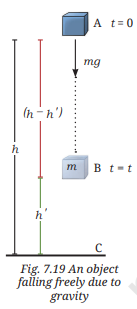
Question 7:
For the situation depicted in Fig. 7.19, calculate the mechanical energy of the ball just before it hits the ground and show that even at this position, it is mgh.
चित्र 7.19 में चित्रित स्थिति के लिए गेंद की यांत्रिक ऊर्जा का मान ठीक उस समय ज्ञात कीजिए जब वह भूतल से टकराती है और दर्शाइए कि इस स्थिति में भी इसका मान mgh ही होगा।
Answer
Just before the ball hits the ground, its height is zero. Therefore, its potential energy is zero.
\( PE=mgh=mg(0)=0 \)
If the ball falls freely from a height \(h\), its velocity just before hitting the ground is given by:
\( v^2=2gh \)
Its kinetic energy is:
\( KE=\frac12 mv^2 \)
Substituting \(v^2=2gh\),
\( KE=\frac12 m(2gh)=mgh \)
Mechanical energy = Kinetic energy + Potential energy
\( ME=KE+PE=mgh+0 \)
\( \boxed{ME=mgh} \)
Hence, the mechanical energy of the ball just before it hits the ground is \(mgh\), assuming no energy is lost due to air resistance.
गेंद के जमीन से टकराने से ठीक पहले उसकी ऊँचाई शून्य होती है। इसलिए उसकी स्थितिज ऊर्जा भी शून्य होगी।
\( PE=mgh=mg(0)=0 \)
यदि गेंद \(h\) ऊँचाई से स्वतंत्र रूप से गिरती है, तो जमीन से टकराने से ठीक पहले उसका वेग होगा:
\( v^2=2gh \)
गेंद की गतिज ऊर्जा:
\( KE=\frac12 mv^2 \)
\(v^2=2gh\) रखने पर,
\( KE=\frac12 m(2gh)=mgh \)
यांत्रिक ऊर्जा = गतिज ऊर्जा + स्थितिज ऊर्जा
\(ME=KE+PE=mgh+0 \)
\(\boxed{ME=mgh} \)
अतः वायु प्रतिरोध के कारण ऊर्जा की हानि न होने पर, जमीन से टकराने से ठीक पहले भी गेंद की यांत्रिक ऊर्जा \(mgh\) ही होती है।
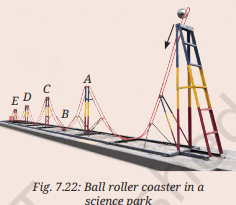
Question 8:
You may have seen an exhibit like that in Fig. 7.22 in a science park, where a ball is released from the highest point. Describe how the kinetic energy and potential energy change at points A, B and C. Why do subsequent points, such as C, D and E, usually have lower heights compared to the previous ones? Could it have anything to do with the energy lost due to friction?
आपने किसी विज्ञान उद्यान मेें चित्र 7.22 जैसा प्रदर्श देखा होगा जिसमें एक गेंद को इस प्रदर्श के उच्चत म बिंदु से छोड़ा जाता है। वर्णन कीजिए कि इसमें बिंदु A, B और C पर गतिज ऊर्जा और स्थितिज ऊर्जा किस प्रकार परिवर्तित होती है। व्याख्या कीजिए कि बाद में आने वाले शीर्ष C, D तथा E पहले वाले शीर्षों की अपेक्षा कम ऊँचाई वाले क्यों होते हैं? क्या इसका संबंध घर्षण के कारण ऊर्जा के कुछ भाग के अन्य रूपों में परिवर्तित होने से हो सकता है?
Answer
At different points, the kinetic energy (KE) and potential energy (PE) of the ball change as follows:
- Point A: The ball is released from a higher point. Its potential energy is maximum, while its kinetic energy is zero or nearly zero.
- Point B: As the ball moves downward, its potential energy decreases and kinetic energy increases. At the lowest point, kinetic energy is maximum and potential energy is minimum.
- Point C: As the ball moves upward, its kinetic energy decreases and potential energy increases. It cannot usually reach the same height as point A because some energy is lost due to friction and air resistance.
The subsequent highest points, such as C, D and E, are usually lower than the previous ones because some mechanical energy is converted into heat and sound due to friction and air resistance. Therefore, the ball gradually loses mechanical energy and eventually comes to rest.
विभिन्न बिंदुओं पर गेंद की गतिज ऊर्जा (KE) तथा स्थितिज ऊर्जा (PE) में निम्नलिखित परिवर्तन होते हैं:
- बिंदु A: गेंद को ऊँचाई से छोड़ा जाता है। यहाँ इसकी स्थितिज ऊर्जा अधिकतम तथा गतिज ऊर्जा शून्य या लगभग शून्य होती है।
- बिंदु B: नीचे आते समय गेंद की स्थितिज ऊर्जा घटती है और गतिज ऊर्जा बढ़ती है। सबसे निचले बिंदु पर गतिज ऊर्जा अधिकतम तथा स्थितिज ऊर्जा न्यूनतम होती है।
- बिंदु C: ऊपर जाते समय गेंद की गतिज ऊर्जा घटती है और स्थितिज ऊर्जा बढ़ती है। घर्षण तथा वायु प्रतिरोध के कारण ऊर्जा की कुछ हानि होने से गेंद सामान्यतः बिंदु A जितनी ऊँचाई तक नहीं पहुँच पाती।
C, D तथा E जैसे बाद के शीर्षों की ऊँचाई पहले के शीर्षों से कम होती है, क्योंकि घर्षण और वायु प्रतिरोध के कारण यांत्रिक ऊर्जा का कुछ भाग ऊष्मा और ध्वनि ऊर्जा में परिवर्तित हो जाता है। इस प्रकार गेंद की यांत्रिक ऊर्जा धीरे-धीरे कम होती जाती है और अंततः गेंद रुक जाती है।
NCERT Solutions for Class 9 Science Chapter 7 Work, Energy and Simple Machines कार्य, ऊर्जा एवं सरल मशीनें
Page No 132 Pause and Ponder
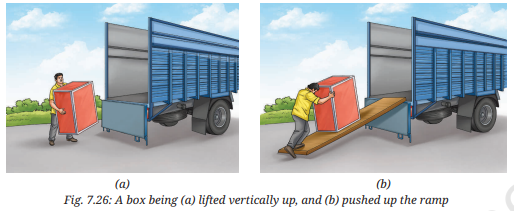
Question 9:
Explain why roads on hills are built to wind around in gentle slopes rather than going straight up (Fig. 4.26)?
व्याखा कीजिए कि पहाड़ों पर सड़कें नीचे से ऊपर तक सीधे न बनाकर कम ढलान की घुमावदार क्यों बनाई जाती हैं (चित्र 4.26)?
Answer
Roads on hills are built with gentle slopes and winding curves rather than straight, steep paths because they reduce the effort required for vehicles to climb. A gentle slope reduces the force needed to move a vehicle uphill, making the journey easier and safer. Thus, winding roads act like an inclined plane, a simple machine, which helps vehicles climb hills with less effort.
पहाड़ों पर सड़कें सीधे और खड़ी बनाने के बजाय कम ढलान वाली घुमावदार बनाई जाती हैं, क्योंकि इससे वाहनों को पहाड़ पर चढ़ने में कम बल लगाना पड़ता है। कम ढलान के कारण वाहन आसानी से और सुरक्षित रूप से ऊपर चढ़ सकते हैं। इस प्रकार, घुमावदार सड़कें आनत तल नामक सरल मशीन की तरह कार्य करती हैं, जिससे कम प्रयास में ऊँचाई तक पहुँचना संभव होता है।
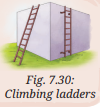
Question 10:
To reach a higher floor, we find climbing an inclined ladder easier in comparison to climbing a vertical ladder (Fig. 7.30). Explain why.
व्याख्या कीजिए कि किसी भवन के ऊपरी तल तक पहुँचने के लिए हमें सीधी खड़ी हुई सीढ़ी की तुलना में आनत सीढ़ी का उपयोग अधिक सुविधाजनक क्योंं लगता है?
Answser
An inclined ladder is easier to climb than a vertical ladder because it provides a greater distance to climb with less effort. It reduces the force required to reach the same height. An inclined ladder works like an inclined plane, which is a simple machine that makes work easier.
आनत सीढ़ी पर चढ़ना सीधी खड़ी सीढ़ी की तुलना में अधिक आसान होता है, क्योंकि इसमें समान ऊँचाई तक पहुँचने के लिए अधिक दूरी तय करनी पड़ती है, लेकिन कम बल लगाना पड़ता है। आनत सीढ़ी आनत तल (Inclined Plane) की तरह कार्य करती है, जो एक सरल मशीन है और कार्य को आसान बनाती है।
NCERT Solutions for Class 9 Science Chapter 7 Work, Energy and Simple Machines कार्य, ऊर्जा एवं सरल मशीनें
Page No 135 – Pause and Ponder
Question 11:
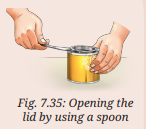
Why is it easier to open the lid of a can by using a spoon as shown in Fig. 7.35?
चित्र 7.35 मेें दर्शाए अनुसार चम्मच की सहायता से किसी डिब्बे का ढक्कन खोलना सरल क्यों होता है?
Answer
It is easier to open the lid of a can using a spoon because the spoon acts as a lever, a simple machine. The edge of the can acts as the fulcrum. The spoon helps multiply the applied force, making it easier to lift the lid with less effort.
चम्मच की सहायता से डिब्बे का ढक्कन खोलना आसान होता है, क्योंकि चम्मच उत्तोलक (Lever) नामक सरल मशीन की तरह कार्य करता है। डिब्बे का किनारा आलंब (Fulcrum) का कार्य करता है। चम्मच लगाए गए बल के प्रभाव को बढ़ा देता है, जिससे कम प्रयास में ढक्कन उठाना आसान हो जाता है।
Question 12:
Why do you push an object closer to scissors fulcrum when you want to cut an object which is hard?
किसी कठोर वस्तु को काटने के लिए उसे कैंची के आलंब के निकट क्योंं रखा जाता है?
Answer
A hard object is placed close to the fulcrum of the scissors because scissors act as a lever. Placing the object closer to the fulcrum increases the cutting force, making it easier to cut hard objects with less effort.
कठोर वस्तु को काटने के लिए उसे कैंची के आलंब के निकट रखा जाता है, क्योंकि कैंची उत्तोलक (Lever) की तरह कार्य करती है। वस्तु को आलंब के पास रखने से उस पर अधिक काटने वाला बल लगता है, जिससे कम प्रयास में कठोर वस्तु को काटना आसान हो जाता है।
Question 13:
Throughout history, many designs of perpetual machines (using wheels, weights or magnets) have been proposed but none actually work. Why do all real machines eventually slow down and stop? Explain in terms of work and energy.
पूरे इतिहास में (पहियों, भार या चुबंकों का उपयोग करके बने) सदैव चलते रहने वाली मशीनों के कई प्रारूप प्रस्तावित किए गए हैं लेकिन वास्तव में कोई भी सदैव के लिए चलती नहीं रहती है। सभी वास्तविक मशीनें अततं : धीमी हो कर रुक क्योंं जाती हैं? कार्य एवं ऊर्जा के पदों में व्याख्या कीजिए।
Answer
All real machines eventually slow down and stop because of friction and air resistance. These forces do negative work on the moving parts of a machine, converting some of its mechanical energy into heat and sound.
A machine cannot produce continuous work without receiving energy from an external source. As its mechanical energy decreases, it slows down and eventually stops. Therefore, a perpetual motion machine is not possible in practice.
सभी वास्तविक मशीनें अंततः धीमी होकर रुक जाती हैं, क्योंकि उनमें घर्षण तथा वायु प्रतिरोध लगता है। ये बल मशीन के गतिशील भागों पर ऋणात्मक कार्य करते हैं और उसकी यांत्रिक ऊर्जा के कुछ भाग को ऊष्मा तथा ध्वनि ऊर्जा में परिवर्तित कर देते हैं।
कोई भी मशीन बाहरी स्रोत से ऊर्जा प्राप्त किए बिना लगातार कार्य नहीं कर सकती। जैसे-जैसे उसकी यांत्रिक ऊर्जा कम होती जाती है, उसकी गति धीमी हो जाती है और अंततः वह रुक जाती है। इसलिए, व्यवहार में बिना बाहरी ऊर्जा के सदैव चलने वाली मशीन बनाना संभव नहीं है।
NCERT Solutions for Class 9 Science Chapter 7 Work, Energy and Simple Machines कार्य, ऊर्जा एवं सरल मशीनें
Page No 136 – Revise, Reflect, Refine
Question 1:
State whether True or False.
(i) Work is said to be done when a force is applied, even if the object does not move.
(ii) Lifting a bucket vertically upward results in positive work done on the bucket.
(iii) The SI unit for both work and energy is joule (J).
(iv) A motionless stretched rubber band has kinetic energy.
(v) Energy can change from one form to another.
Question 2:
Fill in the blanks.
(i) Work done = ______ × ______ (in the direction of force).
(ii) 1 joule of work is done when a force of ______ newton displaces an object by 1 metre in the direction of the force.
(iii) The expression for kinetic energy of a body of mass m and velocity v is ______.
(iv) The potential energy of an object of mass m at a small height h from the Earth’s surface is ______.
(v) Power is defined as the ______ at which work is done.
Question 3:
When a ball thrown upwards reaches its highest point, tick which of the following statement(s) are correct?
(i) The force acting on the ball is zero.
(ii) The acceleration of the ball is zero.
(iii) Its kinetic energy is zero.
(iv) Its potential energy is maximum.
Question 4:
For each of the following situations, identify the energy transformation that takes place: (i) a truck moving uphill, (ii) unwinding of a watch spring, (iii) photosynthesis in green leaves, (iv) water flowing from a dam, (v) burning of a matchstick, (vi) explosion of a fire cracker, (vii) speaking into a microphone, (viii) a glowing electric bulb, and (ix) a solar panel.
Question 5:
A student is slowly lifted straight up in an elevator from the ground level to the top floor of a building. Later, the same student climbs the staircase, all the way to the top. Given that the height of the building is h = 72.5 m, acceleration due to gravity is g = 10 m s–2, and student’s mass is m = 50 kg.
(i) Find the gain in the potential energy if the student is lifted straight up to the top.
(ii) Find the gain in the potential energy when the student climbs the stairs to the same top.
(iii) What do you conclude about the dependence of the potential energy on the path taken?
Question 6:
A crane lifts a mass m to the 10th floor of a building in a certain time. It then raises the same mass to the 20th floor of the same building in double the time. How much more energy and power are required? Assume that the height of all floors is equal.
Question 7:
Which factors determine the energy required to raise a flag from the ground to the top of a tall flagpole using a pulley? Does raising the flag slowly or quickly change the amount of work done? If the speed at which the flag is raised is doubled, how does the power requirement change? Explain your answers.
Question 8:
A man of mass 60 kg rides a scooter of mass 100 kg. He accelerates the scooter to a velocity v. The next day, his son with a mass of 40 kg joins him as a passenger. If the scooter reaches the same speed on both days in the same time interval, what is the ratio of the fuel of the tank used on the two days? Assume that the energy transfer to the scooter happens entirely due to fuel, and no other losses occur due to air resistance and friction.
Question 9:
On a seesaw with sliding seats, a child is sitting on one side and an adult on the other side. The adult weighs twice that of the child. The seesaw however is balanced. Draw a figure which depicts this situation showing the distances from the fulcrum where the child and the adult are seated.
Question 10:
A ball of mass 2 kg is thrown up with a velocity of 20 m s–1.
(i) Identify the sign of the work done by gravity on the ball during its upward motion and its downward motion.
(ii) If the ball reaches a height of 19.4 m, how much work was done by air resistance (assume g = 10 m s–2).
Question 11:
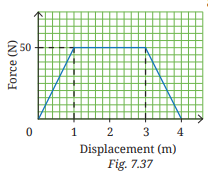
A 10.0 kg block is moving on horizontal floor with negligible friction. As shown in the Fig. 7.37, a variable force is applied on the block in its direction of motion from its position at 0 m till 4 m. If the block had a kinetic energy of 180 J when it was at 0 m, find the block’s speed (i) at 0 m, and (ii) at 4 m. Does the block have negative acceleration in any portion of its motion?
Question 12:
The gravitational attraction on the surface of the Moon (lunar surface) is about 1/6th of that on the surface of the Earth. An astronaut can throw a ball up to a height of 8 m from the surface of the Earth. How far up will the ball thrown with the same upward velocity travel from the surface of the Moon?
Question 13:
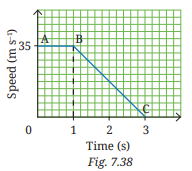
A 1000 kg car is moving along a road at a constant speed. Suddenly, the driver notices some obstruction ahead and pplies the brakes to come to a complete stop. The graphical representation of motion of the car starting from the instant the driver spots the traffic ahead is shown in Fig. 7.38.
(i) Describe how the car moves between positions A and B.
(ii) Calculate the kinetic energy of the car at A.
(iii) State the work done by the brakes in bringing the car to a halt between B and C.
(iv) What does the kinetic energy of the car transform into?
Question 14:
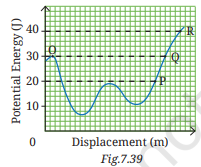
The potential energy-displacement graph of a 0.5 kg ball moving along a frictionless track is shown in Fig. 7.39. At O, the velocity of the ball is 0 m s–1 and potential energy is 30 J. Calculate the velocity of the ball at P, Q and R.
Question 15:
A coconut of mass 1.5 kg falls from the top of a coconut tree onto the wet sand on a beach. The height of the tree is 10 m. On impact, the coconut comes to rest by making a depression in the sand.
(i) Calculate the velocity of the coconut just before it hits the sand.
(ii) Assume that the average resistive force of sand is 3000 N and all of the coconut’s energy is used to create the depression in the sand.
Calculate the depth of the depression the coconut makes in the sand. Assume g = 10 m s–2.
