
NCERT Solutions for Class 9 Kaveri Chapter 1 How I Taught My Grandmother to Read
Word-Meanings of Kaveri Chapter 1 How I Taught My Grandmother to Read
Thank you for reading this post, don't forget to subscribe!
Summary of Class 9 Kaveri Chapter 1 How I Taught My Grandmother to Read
Important Questions for Class 9 Kaveri Chapter 1 How I Taught My Grandmother to Read
Check Your Understanding
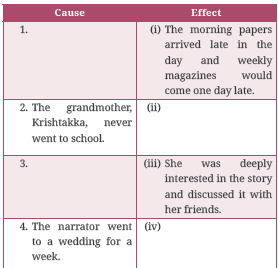
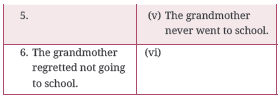
I. Complete the cause and effect table given below based on Part I of the story. Share your answers with your classmates and teacher:
Answer
- Cause: Transport system was not good.
Effect (i): The morning papers arrived late in the day and weekly magazines would come one day late. - Cause: The grandmother, Krishtakka, never went to school.
Effect (ii): She could not read or write and depended on others to read for her. - Cause: The narrator used to read the story Kashi Yatre to her grandmother.
Effect (iii): She was deeply interested in the story and discussed it with her friends. - Cause: The narrator went to a wedding for a week.
Effect (iv): The grandmother could not read the next episode and felt helpless and sad. - Cause: The grandmother realized her helplessness due to illiteracy.
Effect (v):The grandmother never went to school. - Cause: The grandmother regretted not going to school.
Effect (vi): She worked hard to become literate and achieve independence.
II. Do you think the narrator expected to see her grandmother in tears when she returned to the village? If yes, why? If no, why not?
Answer:
No, the narrator did not expect to see her grandmother in tears because she had never seen her cry even in the most difficult situations. She was surprised to see her grandmother so upset.
III. How might the narrator help her grandmother to fulfil her desire to learn to read and write?
Answer:
The narrator can help her grandmother by teaching her the Kannada alphabet step by step. She can read stories to her, give her regular practice in reading and writing, and encourage her to stay motivated. With patience and regular practice, the grandmother can learn to read and write successfully.
NCERT Solutions for Class 9 Kaveri Chapter 1 How I Taught My Grandmother to Read
Part II
Check Your Understanding
I. State whether the following sentences are true or false. Shre your answers with your classmates and teacher.
- The grandmother wanted to learn the Kannada alphabet to gain independence.
Answer:
True - The grandmother asked someone in the village to read Kashi Yatre to her while the narrator was away.
Answer:
False - The narrator was the grandmother’s first teacher and taught her how to read Kannada.
Answer:
True - The grandmother believed that there was no age limit for learning.
Answer:
True - The grandmother touched the narrator’s feet as a mark of respect for her as a teacher.
Answer:
True - The narrator was disappointed with the progress her grandmother made in learning to read.
Answer:
False
NCERT Solutions for Class 9 Kaveri Chapter 1 How I Taught My Grandmother to Read
Critical Reflection
I. Read the extracts given below and answer the questions that follow.
1. When I came back to my village, I saw my grandmother in tears. I was surprised, for I had never seen her cry even in the most difficult situations. What had happened? I was worried.
‘Avva, is everything all right? Are you okay?’
I used to call her Avva, which means mother in the Kannada spoken in north Karnataka.
She nodded but did not reply. I did not understand and forgot about it. In the night, after dinner, we were sleeping in the open terrace of our house. It was a summer night and there was a full moon. Avva came and sat next to me. Her affectionate hands touched my forehead.
(i) Complete the following sentence with the appropriate option.
The phrase ‘never seen her cry in the most difficult situations’ tells us that the grandmother was ____________.
A. strong-willed
B. understanding
C. considerate
D. bold
Answer
A. strong-willed
(ii) Complete the following with the correct option from those given in the brackets.
Grandmother did not reply when the narrator asked if she was alright because she might have been too ____________ (emotional/tired) to respond.
Answer
emotional
(iii) Identify the clue from the extract that indicates a rural setting with traditional customs.
Answer
The clue indicating a rural setting with traditional customs is:
“we were sleeping in the open terrace of our house.”
(iv) Which lines of the extract establish a tender atmosphere?
Answer
The lines that establish a tender atmosphere are:
“Avva came and sat next to me. Her affectionate hands touched my forehead.”
(v) Which of the following aspect is NOT emphasised in the given extract?
A. the emotional turmoil of the grandmother
B. the affectionate bond between the narrator and her grandmother
C. the grandmother’s regret over her lack of education
D. the narrator’s concern for her grandmother
Answer
C. the grandmother’s regret over her lack of education
2. ‘I have decided I want to learn the Kannada alphabet from tomorrow onwards. I will work very hard. I will keep Saraswati Puja day during Dassara as the deadline. That day I should be able to read a novel on my own. I want to be independent.’
I saw the determination on her face. Yet I laughed at her.
‘Avva, at this age of sixty-two you want to learn the alphabet? All your hair is grey, your hands are wrinkled, you wear spectacles and you work so much in the kitchen…’
Childishly I made fun of the old lady. But she just smiled.
‘For a good cause if you are determined, you can overcome any obstacle. I will work harder than anybody but I will do it. For learning there is no age bar.’
(i) What does the grandmother’s statement “I want to be independent,” reveal about her character?
A. She wanted to be literate.
B. She desires self-sufficiency.
C. She wants to prove her intelligence to others.
D. She feels pressured by society to learn.
Answer
B. She desires self-sufficiency.
(ii) Fill in the blank with the appropriate option from those given in the brackets.
The grandmother’s determination shows that learning has no ____________. (age limit/gender bias/cultural barriers)
Answer
age limit
(iii) Complete the following with a suitable reason.
The narrator laughs at her grandmother’s decision to learn the alphabet at the age of sixty-two because ____________.
Answer
because she thinks that at the age of sixty-two, it is too late to learn something new.
(iv) List any two qualities displayed by the grandmother.
Answer
Two qualities displayed by the grandmother are:
(a) Determination
(b) Strong will (or perseverance)
(v) How can we say that the narrator is making assumptions about her grandmother?
Answer
We can say the narrator is making assumptions because she judges her grandmother based on her age and appearance, thinking she is too old to learn, without understanding her determination.
NCERT Solutions for Class 9 Kaveri Chapter 1 How I Taught My Grandmother to Read
II Answer the following questions.
1. Why do you think the grandmother felt embarrassed to ask someone else to read to her while the narrator was away?
Answer
The grandmother felt embarrassed to ask someone else to read to her because she was illiterate and felt ashamed of her inability to read. She did not want others to know about her weakness.
2. Why does the narrator initially laugh at her grandmother’s determination to learn at the age of sixty-two?
Answer
The narrator initially laughed because she believed that at sixty-two, her grandmother was too old to start learning something new like the alphabet.
3. What significance does the story of Kashi Yatre have in both the grandmother’s life and the story?
Answer
The story of Kashi Yatre is significant because it made the grandmother realize the importance of being able to read. It inspired her to learn the Kannada alphabet so she could read independently.
4. What does the grandmother’s desire to learn the Kannada alphabet reflect about her?
Answer
The grandmother’s desire to learn reflects her determination, self-respect, and wish to become independent despite her old age.
5. What lessons can we infer from the grandmother’s action of touching the narrator’s feet?
Answer
The grandmother touching the narrator’s feet shows her humility and respect for knowledge. It teaches us that learning is important and one should respect the person who imparts knowledge, regardless of age.
6. What does the following line tell us about the broader theme of the story?
“For a good cause if you are determined, you can overcome any obstacle.”
Answer
The line shows that determination and strong will can help a person overcome any difficulty. It highlights the broader theme that age, challenges, or limitations do not matter if one is committed to achieving a meaningful goal.
7. How effectively does the story highlight the value of education in supporting personal independence?
Answer
The story very effectively highlights the value of education in supporting personal independence. The grandmother’s inability to read makes her dependent on others, but once she decides to learn, it empowers her. Her journey shows that education brings confidence, self-respect, and freedom to live independently.
NCERT Solutions for Class 9 Kaveri Chapter 1 How I Taught My Grandmother to Read
