
NCERT Solutions for Class 9 SST Chapter 3 Atmosphere and Climate
Table of Contents
Page No. 39 The Big Questions
Question 1:
What is the composition of the atmosphere?
वायुमंडल की संरचना क्या है?
Answer
The Earth’s atmosphere is composed of a mixture of various gases.
(i) Nitrogen and oxygen are the two primary and most abundant gases that are essential to life on the Earth. Carbon dioxide, argon, helium, neon, krypton, xenon, ozone, and hydrogen are some other gases present in the atmosphere, but are found in lesser quantities.
(ii) Besides these, the atmosphere also consists of water vapour and tiny dust particles. The amount of water vapour in the atmosphere varies, but it generally ranges from 0.1 per cent to 0.4 per cent.
(iii) It plays a significant role in cloud formation and precipitation. The composition of the atmosphere also varies with altitude.
Thank you for reading this post, don't forget to subscribe!
पृथ्वी का वायुमंडल विभिन्न गैसों का मिश्रण है।
(i) नाइट्रोजन और ऑक्सीजन वायुमंडल की दो प्रमुख तथा सबसे अधिक मात्रा में पाई जाने वाली गैसें हैं, जो पृथ्वी पर जीवन के लिए अत्यंत आवश्यक हैं। इनके अतिरिक्त कार्बन डाइऑक्साइड, आर्गन, हीलियम, नीयॉन, क्रिप्टॉन, ज़ेनॉन, ओज़ोन तथा हाइड्रोजन जैसी गैसें भी वायुमंडल में अल्प मात्रा में उपस्थित होती हैं।
(ii) इन गैसों के अलावा वायुमंडल में जलवाष्प तथा धूल के सूक्ष्म कण भी पाए जाते हैं। वायुमंडल में जलवाष्प की मात्रा स्थान एवं समय के अनुसार बदलती रहती है, परंतु सामान्यतः यह 0.1% से 0.4% के बीच होती है।
(iii) जलवाष्प बादलों के निर्माण तथा वर्षा में महत्वपूर्ण भूमिका निभाती है। ऊँचाई के अनुसार वायुमंडल की संरचना में भी परिवर्तन होता है।
Question 2:
How do the different layers of the atmosphere affect the planet Earth?
वायुमंडल की विभिन्न परतें पृथ्वी को किस प्रकार प्रभावित करती हैं?
Answer
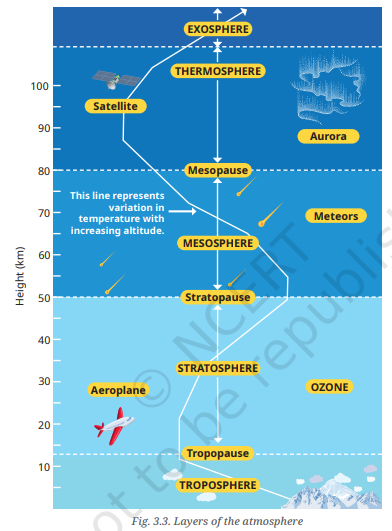
(i) Troposphere: The troposphere is the most important layer of the atmosphere, with an average height of about 12 kilometres. In this layer, temperature decreases with increasing altitude. The air we breathe exists here, along with most of the water vapour and clouds. The troposphere is separated from the stratosphere by a transition zone known as the tropopause.
(ii) Stratosphere: Above the troposphere lies the stratosphere, extending up to 50 kilometres. This layer is ideal for flying aeroplanes because it is free of clouds and other weather disturbances. A notable feature of the stratosphere is that it contains a layer of ozone gas, which shields us by filtering the Sun’s harmful radiation, including ultraviolet radiation.
(iii) Mesosphere: Above the stratosphere lies the third layer of the atmosphere, the mesosphere. It extends up to a height of 80 kilometres. In this layer, temperature decreases with increasing altitude. Most meteorites entering from space burn up in the mesosphere.
(iv) Thermosphere: In the thermosphere, temperature rises very rapidly with increasing altitude, as the gas molecules in this layer absorb the X-rays and short-wave ultraviolet radiation of the Sun. The thermosphere extends from 80 to 700 km. It also helps with radio transmission by reflecting radio waves transmitted from the Earth back towards it.
(v) Exosphere: The uppermost layer of the atmosphere is known as the exosphere, characterised by very thin air. Light gases like helium and hydrogen float into space from this layer due to weak gravity. All of these layers play a vital role in the Earth’s atmospheric processes and also affect its weather and climate.
(i) क्षोभमंडल:क्षोभमंडल वायुमंडल की सबसे महत्वपूर्ण परत है, जिसकी औसत ऊँचाई लगभग 12 किलोमीटर होती है। इस परत में ऊँचाई बढ़ने के साथ तापमान घटता जाता है। हम जो वायु श्वास के रूप में लेते हैं, वह इसी परत में पाई जाती है। इसके साथ ही अधिकांश जलवाष्प और बादल भी इसी परत में होते हैं। क्षोभमंडल को समतापमंडल से क्षोभ-सीमा नामक संक्रमण क्षेत्र अलग करता है।
(ii) समतापमंडल: क्षोभमंडल के ऊपर समतापमंडल स्थित होता है, जो लगभग 50 किलोमीटर की ऊँचाई तक फैला होता है। यह परत विमानों के उड़ने के लिए सबसे उपयुक्त मानी जाती है क्योंकि यहाँ बादल और अन्य मौसम संबंधी विक्षोभ नहीं होते। इस परत की सबसे महत्वपूर्ण विशेषता ओज़ोन परत है, जो सूर्य की हानिकारक किरणों, विशेषकर पराबैंगनी किरणों, को अवशोषित करके हमें उनकी हानिकारक प्रभावों से बचाती है।
(iii) मध्यमंडल : समतापमंडल के ऊपर वायुमंडल की तीसरी परत मध्यमंडल होती है। यह लगभग 80 किलोमीटर की ऊँचाई तक फैली होती है। इस परत में भी ऊँचाई बढ़ने के साथ तापमान कम होता जाता है। अंतरिक्ष से आने वाले अधिकांश उल्कापिंड इसी परत में प्रवेश करते समय जलकर नष्ट हो जाते हैं, जिससे वे पृथ्वी तक नहीं पहुँच पाते।
(iv) तापमंडल: तापमंडल में ऊँचाई बढ़ने के साथ तापमान बहुत तेजी से बढ़ता है, क्योंकि इस परत की गैसों के अणु सूर्य से आने वाली एक्स-किरणों (X-rays) तथा लघु तरंगदैर्ध्य वाली पराबैंगनी किरणों को अवशोषित कर लेते हैं। यह परत लगभग 80 से 700 किलोमीटर की ऊँचाई तक फैली होती है। यह रेडियो तरंगों को पृथ्वी की ओर परावर्तित करके रेडियो संचार में भी सहायता करती है।
(v) बहिर्मंडल:
बहिर्मंडल वायुमंडल की सबसे ऊपरी परत है। इस परत में वायु अत्यंत विरल (पतली) होती है। हीलियम और हाइड्रोजन जैसी हल्की गैसें पृथ्वी के कम गुरुत्वाकर्षण के कारण इसी परत से अंतरिक्ष में निकल जाती हैं। वायुमंडल की ये सभी परतें पृथ्वी की वायुमंडलीय प्रक्रियाओं में महत्वपूर्ण भूमिका निभाती हैं तथा पृथ्वी के मौसम और जलवायु को भी प्रभावित करती हैं।
Question 3:
What is the mechanism of monsoon?
मानसून की कार्यप्रणाली क्या है?
Answer
The monsoon is the seasonal reversal of winds caused by the unequal heating of land and sea. During summer, the Indian landmass heats up faster than the surrounding oceans, creating a low-pressure area over land and a high-pressure area over the sea. Moist winds blow from the sea to the land, bringing heavy rainfall. During winter, the land cools faster than the sea, creating high pressure over land and low pressure over the sea. Dry winds blow from land to sea, causing little rainfall except along the south-eastern coast of India.
मानसून वर्ष के दौरान हवाओं की दिशा में होने वाले मौसमी परिवर्तन को कहते हैं। इसका मुख्य कारण स्थल और समुद्र का असमान रूप से गर्म और ठंडा होना है। ग्रीष्म ऋतु में स्थल तेजी से गर्म होकर निम्न वायुदाब क्षेत्र बनाता है, जबकि समुद्र पर उच्च वायुदाब रहता है। इसलिए आर्द्र हवाएँ समुद्र से स्थल की ओर चलती हैं और वर्षा लाती हैं। शीत ऋतु में स्थल जल्दी ठंडा होकर उच्च वायुदाब तथा समुद्र निम्न वायुदाब क्षेत्र बनाता है। तब शुष्क हवाएँ स्थल से समुद्र की ओर बहती हैं, जिससे अधिकांश भारत में वर्षा नहीं होती।
Quesiton 4:
How can we reduce our carbon footprint?
हम अपने कार्बन फुटप्रिंट को कैसे कम कर सकते हैं?
Answer
We can reduce our carbon footprint by:
(i) Saving energy by switching off lights, fans, and electrical appliances when not in use.
(ii) Using public transport, walking, or cycling instead of private vehicles whenever possible.
(iii) Conserving water by using it wisely and avoiding wastage.
(iv) Reducing, reusing, and recycling waste, and avoiding single-use plastics.
(v) Planting trees, protecting forests, and using renewable sources of energy such as solar and wind power to reduce greenhouse gas emissions.
हम अपने कार्बन फुटप्रिंट को निम्नलिखित तरीकों से कम कर सकते हैं—
- बिजली की बचत करें तथा उपयोग न होने पर लाइट, पंखे और अन्य विद्युत उपकरण बंद रखें।
- निजी वाहनों के स्थान पर सार्वजनिक परिवहन, पैदल चलने या साइकिल का उपयोग करें।
- जल का संरक्षण करें तथा पानी की बर्बादी से बचें।
- कचरे को कम करें, पुनः उपयोग और पुनर्चक्रण करें तथा एकल-उपयोग प्लास्टिक से बचें।
- पेड़ लगाएँ, वनों की रक्षा करें तथा सौर और पवन जैसी नवीकरणीय ऊर्जा का उपयोग करें, जिससे ग्रीनहाउस गैसों का उत्सर्जन कम हो।
Page No 57 Questions and activities
Question 1:
What is atmosphere? Explain its composition with the help of a pie diagram.
वायुमंडल क्या है? पाई आरेख (Pie Diagram) की सहायता से इसकी संरचना समझाइए।
Answer
The atmosphere is the thin layer of gases surrounding the Earth. It is held around the Earth by gravity and provides essential gases needed for life. The atmosphere is composed mainly of nitrogen (78%), oxygen (21%), and other gases like argon, carbon dioxide, and other gases (1%). Water vapour, dust particles, and ozone are also present in small amounts.
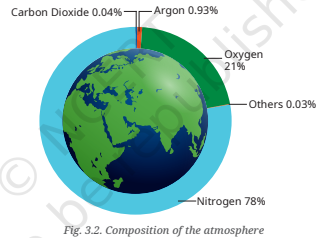
वायुमंडल पृथ्वी को चारों ओर से घेरे हुए गैसों की पतली परत है। यह पृथ्वी के गुरुत्वाकर्षण बल के कारण उसके चारों ओर बनी रहती है और जीवन के लिए आवश्यक गैसें प्रदान करती है। वायुमंडल में मुख्य रूप से नाइट्रोजन (78%), ऑक्सीजन (21%) तथा अन्य गैसें जैसे आर्गन, कार्बन डाइऑक्साइड आदि (1%) पाई जाती हैं। इसमें जलवाष्प, धूलकण और ओजोन भी अल्प मात्रा में उपस्थित होते हैं।
Question 2:
Draw a labelled diagram of the structure of atmosphere.
वायुमंडल की संरचना का नामांकित चित्र बनाइए।
Answer
Question 3:
Which are the four main seasons of India?
भारत की चार मुख्य ऋतुएँ कौन-कौन सी हैं?
Answer
According to the Indian Meteorological Department (IMD), India has four main seasons:
- Cold Weather Season (Winter) – December to February
- Hot Weather Season (Summer) – March to May
- Advancing Monsoon Season (Rainy Season) – June to September
- Retreating Monsoon Season (Post-Monsoon Season) – October to November
These seasons are mainly influenced by changes in temperature, pressure, wind patterns, and the monsoon system.
भारतीय मौसम विभाग (IMD) के अनुसार भारत में चार मुख्य ऋतुएँ होती हैं:
- शीत ऋतु – दिसंबर से फरवरी तक
- ग्रीष्म ऋतु – मार्च से मई तक
- प्रगतिशील मानसून ऋतु – जून से सितंबर तक
- लौटता मानसून ऋतु – अक्टूबर से नवंबर तक
इन ऋतुओं का निर्धारण तापमान, वायुदाब, पवनों की दिशा और मानसूनी गतिविधियों में परिवर्तन के कारण होता है।
Question 4:
Why do you not feel the pressure of the atmosphere?
आप वायुमंडल के दबाव को क्यों महसूस नहीं करते हैं?
Answer
We do not feel the pressure of the atmosphere because the pressure inside our body balances the pressure exerted by the atmosphere outside. The air pressure acts equally in all directions, and our body is adapted to it. Therefore, we do not experience any discomfort due to atmospheric pressure.
हम वायुमंडल के दबाव को इसलिए महसूस नहीं करते क्योंकि हमारे शरीर के अंदर का दबाव बाहर के वायुमंडलीय दबाव को संतुलित करता है। वायु का दबाव सभी दिशाओं में समान रूप से कार्य करता है और हमारा शरीर इस दबाव के अनुकूल हो चुका है। इसलिए हमें वायुमंडलीय दबाव के कारण कोई असुविधा महसूस नहीं होती है।
Question 5:
In which layer of the atmosphere do aeroplanes fly and why?
वायुमंडल की किस परत में हवाई जहाज उड़ते हैं और क्यों?
Answer
Aeroplanes generally fly in the lower part of the stratosphere because this layer has very little water vapour and dust particles. The air is stable, which helps in smooth flying and reduces turbulence. Flying at this height also saves fuel because the thinner air creates less resistance for the aircraft.
हवाई जहाज सामान्यतः समतापमंडल (Stratosphere) की निचली परत में उड़ते हैं क्योंकि इस परत में जलवाष्प और धूलकण बहुत कम होते हैं। यहाँ वायु स्थिर होती है, जिससे हवाई जहाज को सुचारु रूप से उड़ने में सहायता मिलती है और वायु के घर्षण व अशांति (Turbulence) में कमी आती है। इस ऊँचाई पर उड़ने से ईंधन की भी बचत होती है।
Question 6:
Distinguish between the following:
a. The troposphere and stratosphere
b. The south-west monsoon and north-east monsoon
निम्नलिखित में अंतर स्पष्ट कीजिए:
(क) क्षोभमंडल और समतापमंडल
(ख) दक्षिण-पश्चिम मानसून और उत्तर-पूर्व मानसून
Answer
a. Difference between Troposphere and Stratosphere
| Troposphere | Stratosphere |
|---|---|
| It is the lowest layer of the atmosphere. | It is the second layer above the troposphere. |
| It extends up to about 8 km at the poles and 18 km at the equator. | It extends from about 12 km to 50 km above the Earth. |
| All weather phenomena like clouds, rainfall, and storms occur here. | It contains the ozone layer and has very little weather activity. |
| Temperature decreases with height. | Temperature increases with height. |
b. Difference between South-West Monsoon and North-East Monsoon
| South-West Monsoon | North-East Monsoon |
|---|---|
| It occurs from June to September. | It occurs mainly from October to November. |
| Winds blow from sea towards land. | Winds blow from land towards sea. |
| It brings most of the rainfall to India. | It gives rainfall mainly to the Tamil Nadu coast. |
| It is divided into Arabian Sea branch and Bay of Bengal branch. | It is also called the retreating monsoon. |
(क) क्षोभमंडल और समतापमंडल में अंतर
| क्षोभमंडल | समतापमंडल |
|---|---|
| यह वायुमंडल की सबसे निचली परत है। | यह क्षोभमंडल के ऊपर स्थित दूसरी परत है। |
| यह ध्रुवों पर लगभग 8 किमी और भूमध्य रेखा पर 18 किमी तक फैली होती है। | यह पृथ्वी से लगभग 12 किमी से 50 किमी तक फैली होती है। |
| बादल, वर्षा और तूफान जैसी मौसम संबंधी घटनाएँ इसी परत में होती हैं। | इसमें ओजोन परत पाई जाती है और मौसम संबंधी गतिविधियाँ बहुत कम होती हैं। |
| ऊँचाई बढ़ने के साथ तापमान घटता है। | ऊँचाई बढ़ने के साथ तापमान बढ़ता है। |
(ख) दक्षिण-पश्चिम मानसून और उत्तर-पूर्व मानसून में अंतर
| दक्षिण-पश्चिम मानसून | उत्तर-पूर्व मानसून |
|---|---|
| यह जून से सितंबर तक सक्रिय रहता है। | यह मुख्य रूप से अक्टूबर से नवंबर तक सक्रिय रहता है। |
| हवाएँ समुद्र से स्थल की ओर चलती हैं। | हवाएँ स्थल से समुद्र की ओर चलती हैं। |
| यह भारत में अधिकांश वर्षा लाता है। | यह मुख्य रूप से तमिलनाडु के तट पर वर्षा करता है। |
| इसकी दो शाखाएँ होती हैं—अरब सागर शाखा और बंगाल की खाड़ी शाखा। | इसे लौटता हुआ मानसून भी कहा जाता है। |
Question 7:
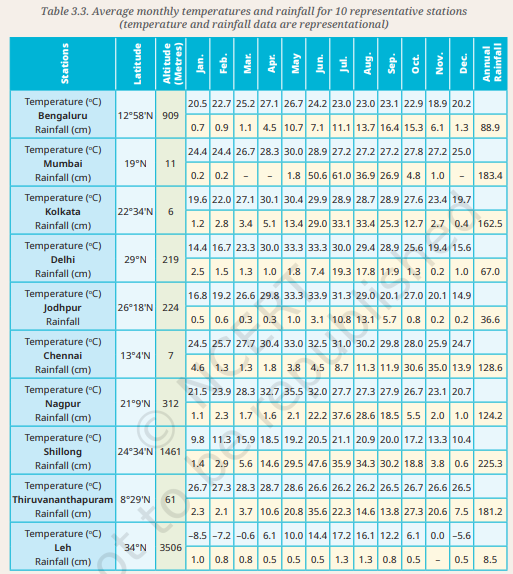
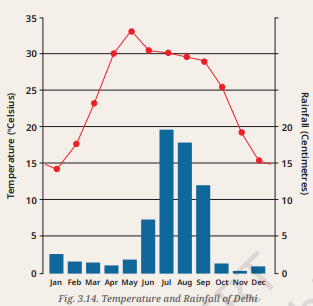
Do it yourself: Table 3.3 shows the average monthly temperatures and rainfall amounts for 10 representative stations. Study these figures on your own and convert them into ‘temperature and rainfall’ graphs. The visual representations will help you grasp their similarities and differences at a glance. One such graph (Fig. 3.14) is already prepared for you. See if you can arrive at some broad generalisations about our diverse climatic conditions.
7.1. Now look at Table 3.3 again. Re-arrange the 10 stations according to their distance from the equator.
7.2 Find out:
a. Two stations with the most extreme climate.
b. Two stations influenced by retreating monsoons.
c. The two hottest stations in the months of (i) February (ii) June
7.3. Now find out:
a. Why does Shillong experience more rainfall than Kolkata?
b. Why does Delhi receive more rainfall than Jodhpur?
7.4. Now think why
a. Thiruvananthapuram has an equable climate?
b. Chennai has more rainfall only after the fury of the monsoon is over in most parts of the country?
c. Leh has moderate precipitation almost throughout the year?
7.5. Despite these differences across regions, can you observe any substantial evidence to conclude that the monsoons provide a very strong framework, lending overall climatic unity to the whole country?
Question 8:
Collect pictures of houses and clothing of people from different regions of India. Examine whether they reflect any relationship with the climatic conditions or the relief of those regions.
