
NCERT Solutions for Class 9 Kaveri Chapter 3 Winds of Change
Word-Meaning of Class 9 Kaveri Chapter 3
Thank you for reading this post, don't forget to subscribe!
Summary of Class 9 Kaveri Chapter 3 Winds of Change
Important Questions of Class 9 Kaveri Chapter 3 Winds of Change
Check Your Understanding
Question 1:
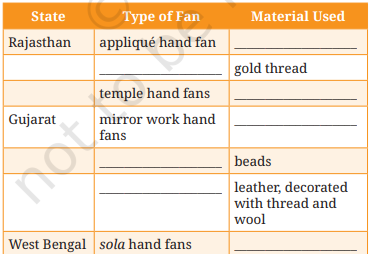
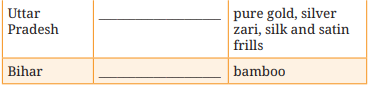
Work in pairs to complete the table on pankha. Share your answers with your classmates and teacher.
Answer
| State | Type of Fan | Material Used |
|---|---|---|
| Rajasthan | appliqué hand fan | Pieces of fabric sewn onto cloth with ornamental needlework |
| Rajasthan | zardozi hand fan | Gold thread |
| Rajasthan | temple hand fans | Engraved brass |
| Gujarat | mirror work hand fans | Pure cotton embellished with mirror work |
| Gujarat | beads hand fan | Beads |
| Gujarat (Kutch) | leather hand fans | Leather, decorated with thread and wool |
| West Bengal | sola hand fans | Sola (milky-white spongy centre of the sola plant) |
| Uttar Pradesh | Phadh hand fans | Pure gold, silver zari, silk and satin frills |
| Bihar | bamboo hand fans | Bamboo |
NCERT Solutions for Class 9 Kaveri Chapter 3 Winds of Change
Critical Reflection
I Read the extracts given below and answer the questions that follow.
- Over time, pankhas became significant cultural goods distributed through trade routes. They were considered exotic and stylish. Although there was substantial commonality in their use across India, different villages and towns developed their own varieties of traditional pankhas. Each place developed pankhas with distinct materials or a variety of intricate designs, that set them apart from one another.
(i) State whether the following sentence is true or false.
Pankhas were one of the most popular items of commerce.
Answer
False.
The passage only states that pankhas became significant cultural goods distributed through trade routes. It does not say that they were among the most popular items of commerce.
(ii) Why has the word ‘traditional’ been used to describe pankhas?
Answer
The word traditional has been used because pankhas have been made and used in India for centuries and are closely connected with the customs, culture, and craftsmanship of different regions.
(iii) Complete the following statement.
The sentence ‘They were considered exotic and stylish’ is an opinion and not a fact because __________.
Answer
Because exotic and stylish are personal judgments and can differ from person to person.
(iv) Infer one reason for commonality in the use of pankhas across India.
Answer
One reason for the commonality in the use of pankhas across India is that they were widely used to provide relief from heat and improve comfort in homes, temples, and royal courts.
(v) Select which one of the two statements is the correct assertion for the given reason.
Reason: Pankhas were made of indigenous materials, unique to the region, with elaborate designs.
A. Each kind of pankha could be distinguished from the other.
B. Pankhas were used by many people
Answer
A. Each kind of pankha could be distinguished from the other.
Explanation:
Since different regions used unique local materials and designs, each type of pankha had its own distinct appearance and identity, making it different from others. - With time and the advent of technology and innovative creations, the beautiful culture of pankhas runs the risk of slowly losing its presence among Indians. Once made for personal use, over time this handicraft has transformed into a commercial business and now provides some form of livelihood to India’s artisans. The slight increase in popularity and demand is significantly factored by the different versions of the pankha being crafted.
(i) Infer one negative impact of technological advancement on pankha.
Answer
Technological advancement has reduced the practical use of traditional pankhas, causing them to gradually lose their presence and importance in everyday life.
(ii) Complete the statement with an appropriate reason.
The writer refers to ‘pankhas’ not just as an object but as a ‘culture’ because __________.
Answer
because they represent the traditions, craftsmanship, history, and artistic heritage of different regions of India.
(iii) Select a line from the extract which depicts how the role of the pankha has changed over the years.
Answer
“Once made for personal use, over time this handicraft has transformed into a commercial business and now provides some form of livelihood to India’s artisans.
(iv) List one way in which the increase in demand of pankhas might benefit artisans.
Answer
An increase in demand for pankhas can provide artisans with better income and more employment opportunities, helping them earn a sustainable livelihood.
(v) Select the factor that has contributed to the commercialisation of pankhas.
A. cultural preservation
B. economic demand
C. technological advancements
D. artisan initiative
Answer
B. economic demand
II Answer the following questions.
- How does the title ‘Winds of Change’ capture the essence of the chapter?
Answer
The title ‘Winds of Change’ aptly reflects the transformation of traditional Indian pankhas over time. Once used for comfort in homes, temples, and royal courts, pankhas have now become decorative handicrafts due to modern technology. The title highlights the changing role of pankhas while emphasizing the need to preserve this valuable cultural heritage and support the artisans who create them. - Support the following statement with any two relevant examples from the chapter.
‘The structure and design of pankhas are testimony to the cultural identity of the region.’
Answer
The structure and design of pankhas reflect the culture and traditions of different regions. For example, Rajasthan’s appliqué and zardozi hand fans are decorated with colourful fabric work and gold thread embroidery, showcasing the state’s rich artistic heritage. Similarly, Gujarat’s hand fans feature mirror work, beads, and leather craftsmanship, representing the region’s famous traditional handicrafts. - The chapter mentions pankhas running the risk of slowly losing their presence among Indians. Evaluate how the balance between preserving traditional craftsmanship and incorporating innovative designs in the creation of pankhas will help in this regard.
Answer
A balance between traditional craftsmanship and innovative designs can help keep pankhas relevant in modern times. Preserving traditional techniques protects India’s cultural heritage, while introducing new designs, colours, and decorative uses can attract younger generations and modern consumers. This increases demand for pankhas, provides sustainable livelihoods for artisans, and ensures that this beautiful handicraft continues to thrive. - How might initiatives such as pankha-making workshops contribute to the preservation of this traditional craft?
Answer
Pankha-making workshops help preserve this traditional craft by creating awareness about its cultural and artistic value. They provide opportunities for artisans to demonstrate their skills and teach traditional techniques to others. Such initiatives encourage public interest, increase demand for handmade pankhas, support artisans financially, and help ensure that this unique Indian handicraft is passed on to future generations. - The writer mentions celebrating pankhas in the concluding part of the chapter. Assess how this could be beneficial to artisans and the craft.
Answer
Celebrating pankhas can increase public appreciation for their cultural, historical, and artistic significance. Greater awareness can lead to higher demand for these handcrafted items, providing artisans with better income and livelihood opportunities. It also encourages younger generations to learn the craft, helping preserve traditional skills and ensuring that the rich heritage of pankha-making continues to flourish. - How does the restriction of the use of pankha for decorative purposes reflect the changing cultural role of these traditional fans in modern India?
Answer
The use of pankhas mainly for decorative purposes shows how their role has changed in modern India. Earlier, they were essential for providing comfort in homes, temples, and royal courts. With the arrival of electric fans and air conditioners, their practical use declined. Today, pankhas are valued more as cultural artifacts and decorative handicrafts that preserve traditional art and heritage.
